





The Ministry of Ayush and the Morarji Desai National Institute of Yoga (MDNIY) will jointly organise the Yoga Mahotsav 2023 from March 13th to 14th, 2023, at Talkatora Stadium in Delhi. Additionally, post-Mahotsav Yoga workshops will be held on March 15th, 2023, at MDNIY. This year’s International Day of Yoga (IDY) aims to establish connections with the global community, aligning with India’s G20 presidency theme of “One World, One Health” and the principle of “Vasudhaiva Kutumbakam” (the world is one family). In addition to international outreach, IDY will focus on spreading yoga to every village in Bharat by actively involving Gram Panchayats and Gram Sabhas. Let us look back and try to find how we in Bharat practised and promoted Yoga over the centuries.
Approximately 5,000 years ago, yoga emerged as a spiritual pursuit among the wandering spiritual teachers of the Indus Sarasvati civilisation. The name “yoga” originates from the confluence of two major rivers of Bharat. In the early 20th century, archaeologists discovered the remains of this ancient civilisation, revealing a culture that was far from primitive. This discovery challenged the belief that yoga was solely associated with Gautama Buddha and his early Buddhist followers, who lived hundreds of years later. Numerous engraved figures of the earliest yogis were uncovered through archaeological excavations in the ancient cities of Harappa and Mohenjodaro. This finding connected the Indus civilisation and the subsequent Indian Hindu tradition. However, there is significant disagreement among scholars regarding the origins of yoga, with some suggesting the Indus people developed it and others proposing it was introduced by the Aryan invaders from the north. Yet, others suggest it resulted from the cultural fusion between the two civilisations. What is undisputed is that the Indus people possessed a thriving maritime economy and well-developed urban centres, which afforded their inhabitants sufficient leisure time to engage in the creation of various artistic, literary, and spiritual traditions.
The earliest yoga “scriptures” can be traced to the Rig Veda, an ancient religious text written in proto-Sanskrit. “Yoga” loosely translates to “yoke” and signifies the union of mind and body. As yoga practitioners, we are part of a centuries-old tradition that originated in India, the world’s oldest civilisation. This region has given us a rich heritage, including the Hindu tradition and the earliest movements of Buddhism and Jainism.
The Vedic yoga masters were known as rishis, meaning “seers” or “visionaries.” Pre-classical yoga refers to the yoga schools that emerged around 2,000 years after the origins of yoga and existed until the second century of the common era. It is associated primarily with religious texts called the Brahmanas and Aranyakas, hymns and ritual texts for hermits living in the forest. With the arrival of the Upanishads, yoga developed as an exposition of hidden truths. The Bhagavad-Gita, also known as the “Song of the Lord,” holds a prominent place among these texts. The Bhagavad-Gita primarily reflects the principle of ahimsa (non-harming) that emerged during the axial age and urged its readers to resist violence against humans and other sentient beings. Written around 500 BC, this text continues to be an essential source of spiritual nourishment for many Hindus today. When contemporary meditation teachers speak of transcending the ego and living in harmony with all sentient beings, they echo the teachings of the Bhagavad-Gita.
Swami Vivekananda, Bal Gangadhar Tilak, Aurobindo Ghosh, and Mahatma Gandhi are notable representatives of modern Indian philosophy. These thinkers hold liberal and dynamic views, considering the law of karma not only as a moral postulate but also as a guiding principle for social service, sacrifice, and compassion. Their perspectives contribute to social solidarity and are still influential today.Within this group of thinkers, B.G. Tilak and Swami Vivekananda emphasise the concept of karma. Tilak’s work, ‘Gita-Rahasya,’ stands out as a notable masterpiece where he dynamically and liberally describes the concept of karma. This work was written during his prison and was a solid philosophical and moral-religious support for selfless actions that led to liberation.
Tilak highlights the concept of ‘Karma Yoga’ from the Bhagavad Gita and strives to apply it for the betterment of all humanity. The profoundly religious perspective of the Gita was a distinctive aspect of Tilak’s teachings. He recognised the significance of karma yoga as an absolute principle. According to Tilak, if the message of the Gita is correctly understood and earnestly followed, it can lead to complete happiness and fulfilment for individuals. Throughout the centuries, Tilak believes that the philosophy of karma, as expounded in the Gita, has played a central role in Indian thought. While accepting the moral teachings of the Gita, Tilak defines ‘karma’ in terms of ‘karma yoga,’ offering a new interpretation of the philosophy of karma. He places great importance on the value of karma yoga and provides a detailed description in his work titled ‘Gita-Rahasya’ or ‘Karma-Yoga-Sastra.’In Tilak’s view, ‘Yoga’ refers to a specific skill or intelligent method of performing actions gracefully. He asserts that the teachings of karma yoga should address topics such as the role of action, the effects of action, and the performance of action itself after the purification of the mind. Tilak categorises karma into ‘nitya karma’ (daily duties), ‘naimittika karma’ (occasional duties), and ‘kamya karma’ (desire-driven duties). Nitya karma encompasses the tasks that must be performed daily, such as bathing and offering prayers at dawn.
Sri Aurobindo delves into the composition of humans as intricate webs of mind, heart, and body. He explains that this composition is rarely perfect in the literal sense, and to realise a divine life on Earth, all aspects of our being—mental, emotional, physical, and spiritual—must harmonise continuously and progressively. Traditional Indian spiritual thought and practice have long recognised the significance of the human body as a vital instrument.
Aurobindo elaborates on the ancient Sanskrit proverb “Shariram Khalu Dharma-Sadhanam,” which suggests that the body serves as a means for fulfilling dharma. Dharma encompasses every ideal we conceive and the principles guiding its realisation and operation. The body must undergo its transformation to accomplish the spiritual transformation of life on Earth within the constraints of the material universe. The ultimate goal can only be achieved when the body’s actions and functions reach maximum capacity. Anasakti-Yoga, advocated by Mahatma Gandhi, is a philosophy and way of life that promotes non-attachment to everything in the material world. Anasakti-yoga involves letting go of attachment to the results of one’s actions. By practising non-attachment, liberation from suffering is believed to be attainable. Practitioners of anasakti yoga remain fully engaged in their actions and work but without being attached to the outcome. The term “anasakti” is derived from the Sanskrit word “asakti,” which means “attachment.” Therefore, anasakti signifies “non-attachment.” The Bhagavad Gita provides detailed descriptions of anasakti yoga, the guiding principle by which Krishna lived, with selfless work and service at its core. These selfless actions are to be performed without attachment to their results.
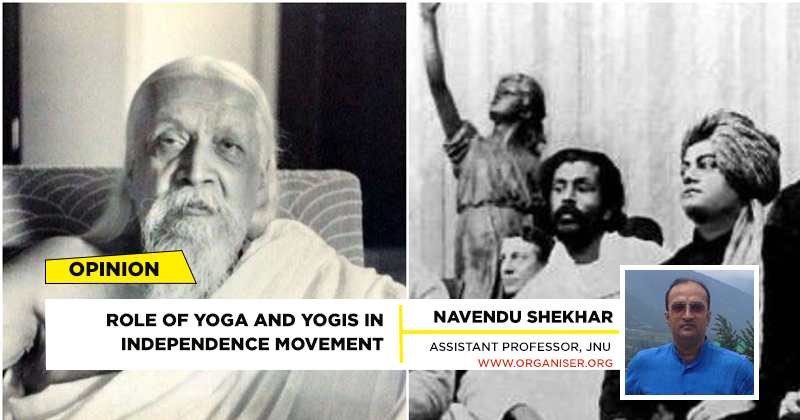
Yogis and Sanyasis played a significant part in India’s struggle for Independence. Yogis had associations with revolutionaries during India’s freedom movement, as they shared a common goal of seeking independence and social transformation. While revolutionaries focused on political action, yogis provided spiritual guidance and support to these individuals.Swami Vivekananda, a prominent yogi of his time, was pivotal in inspiring and motivating revolutionaries with his national pride and selfless teachings. He emphasised the idea of serving the nation with a spiritual perspective, encouraging revolutionaries to act with integrity and a sense of higher purpose.Yogis like Aurobindo Ghosh, who later became Sri Aurobindo, actively participated in the revolutionary movement against British rule. Aurobindo combined his spiritual pursuits with political activism, advocating for a synthesis of spirituality and nationalism. The association between yogis and revolutionaries was not limited to exchanging ideas. Yogis also provided moral support and guidance to the revolutionaries, encouraging them to stay resilient and committed to their cause in the face of adversity.
The diaries of Ram Chandra, known as Babuji, reveal the hidden support provided to Indian freedom fighters. In December 1946, Babuji received instructions from Swami Vivekananda through intercommunication, guiding him on the upcoming social and political changes. Though it may sound incredible, similar stories of sages aiding humanity exist in Indian culture. Babuji and Rishi Agastya collaborated to overthrow British rule in August 1947. Furthermore, Babuji played a crucial role in keeping Mahatma Gandhi alive during his fast in January 1948. These accounts shed light on the spiritual influence behind India’s struggle for independence.













Comments