Hyundai raises 2030 electric vehicle annual sales target to 2 million
October 2, 2026
  • Read Ecopy
  • Circulation
  • Advertise
  • Careers
  • About Us
  • Contact Us
Android AppiPhone AppArattai
Organiser
  • ‌
  • Bharat
    • Assam
    • Bihar
    • Chhattisgarh
    • Jharkhand
    • Maharashtra
    • View All States
  • World
    • Asia
    • Europe
    • North America
    • South America
    • Africa
    • Australia
  • Editorial
  • International
  • Opinion
  • RSS @ 100
  • More
    • World Hindu Congress 2026
    • Op Sindoor
    • Analysis
    • Sports
    • Defence
    • Politics
    • Business
    • Economy
    • Culture
    • Special Report
    • Sci & Tech
    • Entertainment
    • G20
    • Azadi Ka Amrit Mahotsav
    • Vocal4Local
    • Web Stories
    • Education
    • Employment
    • Books
    • Interviews
    • Travel
    • Law
    • Health
    • Obituary
  • Subscribe
    • Subscribe Print Edition
    • Subscribe Ecopy
    • Read Ecopy
  • ‌
  • Bharat
    • Assam
    • Bihar
    • Chhattisgarh
    • Jharkhand
    • Maharashtra
    • View All States
  • World
    • Asia
    • Europe
    • North America
    • South America
    • Africa
    • Australia
  • Editorial
  • International
  • Opinion
  • RSS @ 100
  • More
    • World Hindu Congress 2026
    • Op Sindoor
    • Analysis
    • Sports
    • Defence
    • Politics
    • Business
    • Economy
    • Culture
    • Special Report
    • Sci & Tech
    • Entertainment
    • G20
    • Azadi Ka Amrit Mahotsav
    • Vocal4Local
    • Web Stories
    • Education
    • Employment
    • Books
    • Interviews
    • Travel
    • Law
    • Health
    • Obituary
  • Subscribe
    • Subscribe Print Edition
    • Subscribe Ecopy
    • Read Ecopy
Organiser
  • Home
  • Bharat
  • World
  • Operation Sindoor
  • Editorial
  • Analysis
  • Opinion
  • Culture
  • Defence
  • International Edition
  • RSS @ 100
  • Magazine
  • Read Ecopy
Home World

Hyundai raises 2030 electric vehicle annual sales target to 2 million

Hyundai Motor Company hosted its '2023 CEO Investor Day' in Seoul on June 20, unveiling its visionary mid- to long-term business strategies and financial plans

WEBDESKWEBDESK
Jun 21, 2023, 12:00 pm IST
inWorld, East Asia, Technology
Follow on Google News
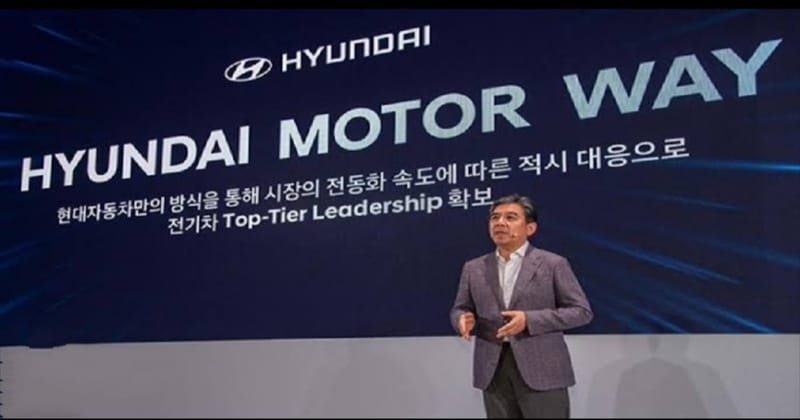
President and CEO Jaehoon Chang, Hyundai Motor Company

President and CEO Jaehoon Chang, Hyundai Motor Company

Facebook
Twitter
WhatsAppTelegramEmail

Hyundai Motor Company aims to boost its annual electric vehicle sales to 2 million units by 2030, against its earlier target of 1.87 million, in line with rising global demands.

Considering that the proportion of global EV production is set to increase from 8 per cent this year to 34 per cent in 2030, the automaker plans to expand production by region through a two-track approach — assembly line conversion in Internal Combustion Engine-based factories and new dedicated EV plant establishment. “Since the demand for ICE vehicles remains high, the company is currently producing EVs on mixed production lines as it is more cost-efficient than building more EV-dedicated factories. By utilising existing lines, construction time is much shorter than building new plants and can be ramped up quickly to meet EV demand,” Hyundai said in a release.

Hyundai Motor Company hosted its ‘2023 CEO Investor Day’ in Seoul on June 20 (local time), unveiling its visionary mid- to long-term business strategies and financial plans.

The company said it has also raised sales targets for major regions and is preparing to adjust its sales target according to the market demand. In terms of profitability in the EV segment, Hyundai Motor is targeting more than 10 per cent by 2030.

The key parts of the strategy include introducing a next-generation modular architecture for EVs, strengthening EV production capacity, battery development capabilities and future businesses.

To enhance its competitiveness in batteries and develop next-generation batteries, Hyundai plans to invest 9.5 trillion won (7.4 billion dollar) over the next 10 years.

Hyundai said it plans to introduce competitive lithium-iron-phosphate (LFP) batteries, a cheaper alternative to lithium-ion batteries that have spurred EV adoption in China, for the first time around 2025.

Its bigger rival Toyota (7203.T), also announced last week a plan to start using LFP batteries.

Hyundai aims to source more than 70per cent of batteries through joint ventures by 2028 and beyond. Other plans include collaboration with specialised companies and startups, as well as establishing joint ventures with battery companies to ensure stable supply.

“Joint research and equity investment in startups to accelerate the development of next-generation batteries is also under way,” the company said.

Hyundai said it aimed to achieve an operating profit margin of 10per cent or higher in the EV business by 2030.

President and CEO Jaehoon Chang laid out the ‘Hyundai Motor Way’ roadmap for success in the electrification era. He explained how the company’s second-generation dedicated EV platform, under the new Integrated Modular Architecture (IMA), will replace its Electric-Global Modular Platform (E-GMP) going forward.

Hyundai plans to invest a total of South Korean won 109.4 trillion from 2023 to 2032, with an average annual investment of around KRW 11 trillion. It includes KRW 47.4 trillion for R&D, KRW 47.1 trillion for capital expenditure, and KRW 14.9 trillion for strategic investments.

“The next three years will be dominated by a 50/50 funding split between ICE vehicles and future technologies. From 2026 onward, when EV volume expansion and the application of next-generation EV platforms are in full swing, investment in ICE will gradually decrease,” it said.

Hyundai is currently producing EVs in this way at its plants in the US, South Korea, the Czech Republic, and India; it plans to convert additional lines as market demand dictates. Hyundai’s first dedicated EV factory in Georgia, US, is under construction which will have an annual production capacity of 300,000 units and is expected to be commissioned in the second half of 2024.

A dedicated EV factory in Korea, which is being established with an investment of about KRW 2 trillion, aims to start mass production in 2025 to cater to domestic and export demand.

Established in 1967, Hyundai Motor Company offers a range of vehicles and mobility services in more than 200 countries.

(with inputs from ANI)

Topics: Hyundai Motor WayHyundai Motor CompanyEV salesHyundai2023 CEO Investor DaySeoul
Share1
Tweet
SendShareSend
✮ Subscribe Organiser YouTube Channel. ✮
✮ Join Organiser's WhatsApp channel for Nationalist views beyond the news. ✮
Previous News

Assam: Imam of mosque arrested in Barpeta District; Drugs and cash seized

Next News

Police restricting Jagannath Rath Yatra would amount to interference with religious practice: Calcutta High Court

Related News

India-South Korea ties poised to grow

President of South Korea vists India

South Korea President Lee Jae-myung visits India: Heralding New Delhi-Seoul strategic relations across Indo-Pacific

Representative Image

Peace in the Korean Peninsula: South Korean President Lee may turn to PM Modi

DPRK Political Leader Kim Yo Jong

North Korean weapons not for export, but against Seoul: DPRK leader Kim-Yo-Jong after US sanctions Russian firms

Representative image

North Korea rattles regional stability with launch of multiple cruise missiles off west coast: Seoul

North Korea warns it may shoot down US spy planes violating its airspace

Load More

Latest News

VB-G RAM G: A New Rural Jobs Framework

VB-G RAM G: How India’s new rural employment framework links jobs with village development

USS
Theodore Roosevelt

West Asia Conflict: US sends third carrier USS Theodore Roosevelt with 10K troops as Trump weighs next move on Iran

All 4 LeT Commanders In Viral Pahalgam Photo Killed: How They Died

From Junaid Bhat to Musa: How security forces took down all 4 LeT commanders behind Pahalgam terror attack

Union Home Minister Amit Shah chairs a high-level meeting on the Mahanadi water dispute in New Delhi with Union Jal Shakti Minister C. R. Patil and the Chief Ministers of Odisha and Chhattisgarh.

Mahanadi Water Dispute: Amit Shah chairs high-level meeting; Odisha and Chhattisgarh signal progress towards resolution

A representative image

The New Plastic Economy: How Indian cities are moving from waste collection to recycling

Representative Image- Indian Railways

Indian Railways’ decade of safety tech: 15 initiatives from KAVACH 4.0 to AI, drones and predictive track monitoring

A representative image

Rs 1200 crore PM-RKVY support for 10 states as centre pushes ‘Team agriculture’ for rabi season

Former Prime Minister Lal Bahadur Shastri with Bharatiya Jawans

Red Shadow against Lal Bahadur : from ‘Shastri Vrat’ to ‘Tashkent’

Tamil Nadu: Western Ghats Lit Fest 2026 to celebrate ‘Bharat Rising’ in Coimbatore on October 24–25

From Bombs to Ballots: How Nanoor’s sea of women is rewriting Bengal’s violent political history

Load More
  • Privacy
  • Terms
  • Cookie Policy
  • Refund and Cancellation
  • Delivery and Shipping

© Bharat Prakashan (Delhi) Limited.
Tech-enabled by Ananthapuri Technologies

  • Home
  • Search Organiser
  • Bharat
    • Assam
    • Bihar
    • Chhattisgarh
    • Jharkhand
    • Maharashtra
    • View All States
  • World
    • Asia
    • Africa
    • North America
    • South America
    • Europe
    • Australia
  • Editorial
  • Operation Sindoor
  • Opinion
  • Analysis
  • Defence
  • Culture
  • Sports
  • Business
  • RSS @ 100
  • Entertainment
  • More ..
    • Sci & Tech
    • Vocal4Local
    • Special Report
    • Education
    • Employment
    • Books
    • Interviews
    • Travel
    • Health
    • Politics
    • Law
    • Economy
    • Obituary
  • Subscribe Magazine
  • Read Ecopy
  • Advertise
  • Circulation
  • Careers
  • About Us
  • Contact Us
  • Policies & Terms
    • Privacy Policy
    • Cookie Policy
    • Refund and Cancellation
    • Terms of Use

© Bharat Prakashan (Delhi) Limited.
Tech-enabled by Ananthapuri Technologies