





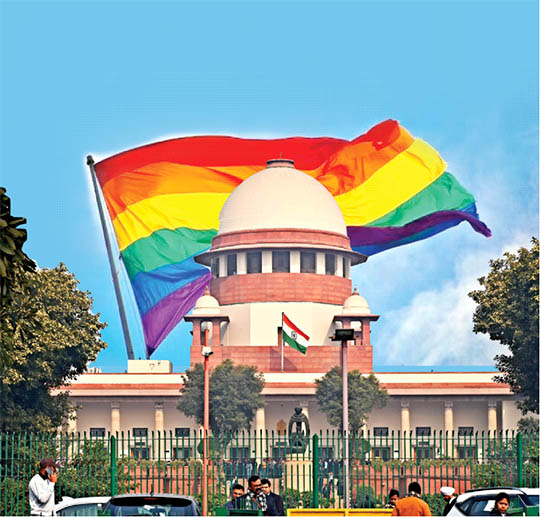
“I have no representation in Parliament. That is why it is the Courts we come to.” These were the words used by Senior Advocate Mukul Rohatgi (as reported by Bar and Bench) in the Hon’ble Supreme Court, in the matter of legalising same-sex marriages. Sr. Adv. Rohatgi appeared for persons seeking legal recognition of same-sex marriages and the consequent legal benefits such as the right to adoption etc. The words in quote precisely sum up a sentiment which is today finding more and more metaphorical sellers in the Bar and buyers in the Bench. If Parliament does not help you, go to court. Or to put differently, if the law is not in your favour, go to court.
This idea was not born overnight. It perhaps marks the culmination of a phenomenon which started long back. Over the years, the Hon’ble Supreme Court has tremendously expanded the ambit of Part III of the Constitution (Fundamental Rights). Many new rights were given the status of Fundamental Rights. For example, the word ‘privacy’ does not even once occur in the entire Constitution. Nevertheless, today the Right to Privacy is recognized as a Fundamental Right. This happened not by any process of constitutional amendment, but because the Supreme Court found (whether rightly or wrongly) that the Right to Privacy was an inherent part of the Right to Life and Personal Liberty enshrined in Article 21. Similarly many other rights were interpreted by the Supreme Court as being inherent to, implicit in, or implied by, the Fundamental Rights expressly granted by the provisions of Part III.
In this case, the apex court was asked to strike down a part of a legislation, and replace it with another. In effect, the Supreme Court was asked to act as an alternative Parliament
In this case, the apex court was asked to strike down a part of a legislation, and replace it with another. In effect, the Supreme Court was asked to act as an alternative Parliament
A natural corollary of giving such wide interpretation to Part III (Fundamental Rights) was that the powers of the Supreme Court as well as the High Courts to interfere in various matters also increased proportionately. The Supreme Court and High Courts can pass appropriate orders for the protection of Fundamental Rights under Articles 32 and 226 respectively. Thus, if the scope of Fundamental Rights expands, powers under Articles 32 and 226 also expand. Similarly, Article 13 states that any law that takes away or abridges Fundamental Rights shall, to such extent, be void. Thus by expanding the scope of Fundamental Rights, the courts also expand their own power to strike down laws.
As the courts began giving such a wide interpretation to the provisions of Part III of the Constitution, a conflict between the domains of the Judiciary and the domains of the Legislature was inevitable. The Hon’ble Supreme Court, in the case of Independent Thought vs Union of India, struck down a particular exception to a penal provision as unconstitutional. The result was that an act which was not previously a crime now became a crime. Similarly, in Navtej Singh Johar vs Union of India, Section 377 of IPC, which penalized “intercourse against the order of nature” was partially struck down, thus de-criminalising consensual homosexual intercourse between adult men. Traditionally, classifying a particular act as criminal or non-criminal has been considered to be exclusively within the domain of the legislature. Nevertheless, due to the wide interpretation given to Part III, the Supreme Court could abridge existing offences as well as effectually create new ones.
MISUSE OF JUDICIARY, SAY 21 RETIRED JUDGES
A group of 21 former High Court judges issued a statement on March 29 against legalisation of same-sex marriage. The 21 signatories of the open letter included former Chief Justice of Rajasthan High Court Justice (retired) SN Jha, Justice (retd) MM Kumar, former Chief Justice of Jammu and Kashmir High Court, Gujarat Lokayukta Justice (retd) SM Soni and Justice (retd) SN Dhingra.
The letter said: “The people of the nation… are deeply shocked by this western-tinted outlook that is being superimposed on Bharatiya society and culture to weaken the family system. In our humble opinion, legalising same-sex marriage will strike at the very root of the family system and thus will have devastating impact on the society at large. Marriage in India is a socio-religious sacramental union, not only between two individuals but between two families.”
“The cancerous problems that the West is facing are sought to be imported into Bharat by vested interest groups through the misuse of the judiciary as an institution in the name of the right to choose.”
However, what Rohatgi on behalf of his clients, seeks in court today, is one large step ahead of what was done by the courts in the aforementioned cases. Rohatgi asks the Supreme Court that the words ‘man’ and ‘woman’ or ‘husband’ or ‘wife’, occurring in the Special Marriage Act, 1954 should be “interpreted” by the court to be read as “spouse”. This, according to Rohatgi, would allow his clients to legally marry the persons of their choice.
Previously, the court merely struck down certain parts of a legislation (though in effect it might have even created a new offence as demonstrated). In this case, what is being sought is that the apex court should strike down a part of a legislation, and replace it with another. In effect, the court is asked to amend a statue. The court is asked to substitute its own wisdom for that of the legislature. In effect, the Supreme Court is asked to act as an alternative Parliament.
What Rohatgi’s arguments perhaps missed is the fact that the issue of same-sex marriages is not a question involving merely the Fundamental Rights of his clients. It is a social issue having a much wider import and concerning the Fundamental Rights of other citizens as well. For example, one major problem faced by societies which recognize same sex marriage and allow such couples to adopt, is that two individuals enter into a sham marriage and adopt a child only to exploit him or her by paedophilia. When the issue at hand is so complicated, where the Fundamental Rights of other members of the society are also involved, one is forced to wonder how the apex court can be asked to apply the technical expertise of Parliament to weigh in the effects of its own decision?
Even looking at it from a purely legal perspective, the matter involves a host of legal issues such as adoption, maintenance, inheritance, age of majority, etc. The entire legal framework of the country is based on the premise of an exclusively heterosexual marriage. A non-heterosexual marriage can only be recognised if this entire structure is reworked.
Finally, Rohatgi’s argument begs the question that, if the Parliament consciously or unconsciously omits to do an act which only the Parliament is empowered by the law to do, should the Court step in to interfere? Are the Fundamental Rights of any group, whether purported or real, so important that the Court shall ignore the principles of Separation of Powers, Rule of Law and Democracy?
Or again in lesser words, the Supreme Court was asked to function as the Alternative Parliament. Should it ever choose to do so?












Comments