





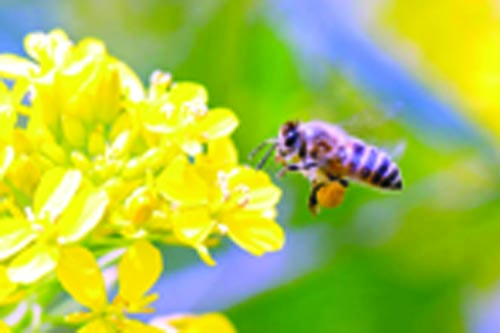
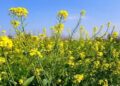
The serenity of the vast golden yellow-hued landscape of rapeseed and mustard is inseparably associated with the image of honey bees on its flowers, reflecting the unique association of mustard and honey bees since time immemorial.
Flowering plants and insects, especially bees coevolved 60-100 million years ago, long before the appearance of mankind on the earth. Plants evolved a mechanism of reproduction that involved pollination only where pollinators lived and a majority of 2.50 lakhs flowering plant species on the earth has amazingly complex relationships with the bees and pollinators. Such relatively colourful flowers have a capacity to reflect ultraviolet light which is well seen by the bees. Plants have progressively evolved themselves to prevent self fertilisation. The plants invested heavily into production of colourful flowers with carbohydrate rich nectar and protein rich pollen. Animal pollinators on the other hand modified their feeding behaviour to utilise these floral resources. Bees are thus, not just the guests but thoroughly adopted symbionts, because they feed and rear their young ones on the products gathered from the flowers and in turn bees provide cross pollination services to the plants.
India is the geographic home to the greatest genetic diversity of rapeseed and mustard – a group comprising yellow sarson, brown sarson, toria, carinata and taramira besides many wild species. Indian mustard (Brassica juncea), the major species, is mainly grown in Haryana, Punjab, Rajasthan, Uttar Pradesh, Madhya Pradesh and eastern States of West Bengal, Bihar, Assam, in winter season under limited moisture conditions. India is home to three of the four well known species of honey bees viz. Indian hive bee, Apis cerana which is both domesticated and available in the wild; and two wild bees – the rock or giant honey bee, A. dorsata and Little bee, A. florea.
Nature continuously performed the selection process based on the principle of “survival of the fittest” in the evolutionary process which is slower. Taking a cue from nature, scientists adopted traditional breeding practices by selecting varieties with better yield and quality traits. Rapid strides in science changed the face of traditional breeding and the recent approaches of genetic engineering facilitated inter-specific gene transfer to breed “genetically modified or GM” crops. GM crops were seen as the major game changer but the world is divided into two blocks, one favouring them and the other having aspersions of their ill effects. GM mustard is among the ever-growing list of GM crops including cotton, maize, soybean, brinjal, alfalfa, beet, squash, sugar beet, etc. Bt cotton was the first GM crop introduced in India and has witnessed initial success but later on failure due to multiple reasons. Reports of illegal planting of Bt brinjal has also been reported. Genetically engineered mustard hybrid DMH 11 developed by Centre of Genetically Manipulation of Crop plants (CGMPC), University of Delhi South Campus has sought clearance from the GEAC, Ministry of Environment and Climate Change in 2016 that was deferred under public pressure.
Contribution of Pollinators
As per the estimates of Chaudhary and Chand (2017), oilseeds in India, primarily comprising 14 crops, are the fourth largest contributor (10.0 per cent) to the national agriculture output, valued at Rs 1,29,143 crores. Oilseeds are essentially dependent on honey bee pollinators for their production. The estimated economic value of pollination (EVP) of rapeseed and mustards in India are staggering Rs. 19,355.7 crores annually and contribution of all the oilseeds at an average EVP of 34.1 per cent is valued at Rs. 43,993.08 crores annually. Recently, Genetic Engineering Approval Committee (GEAC), Ministry of Environment and Forest, while concluding the biosafety assessment of the above proposal has approved its environment clearance paving the way for its commercial release. Due to the intervention of the Supreme Court, the release of DMH 11 is on hold now. Substantial difference in days taken for flowering by B. oleracea, B. carinata, Sinapsis alba and Rhaphanus sativus (112 days) and GE mustard hybrid DMH 11 (58 days) and the absence of synchronous flowering under growing season has been proposed to negate the possibility of outcrossing among these species by the developers. The reality in fact, is opposite since it is practically impossible to avoid staggered sowing under field conditions. Practically, sowing normally extends from October to mid November due to numerous factors including weather conditions, availability of fields, rainfall, germination, field events like crop/plant destruction due to pests, etc. resulting in asynchronous flowering and enhances greatly the gene flow/contamination and outcrossing with B. oleracea and other oilseed crops not only in the vicinity but in the entire foraging range of the honey bees.
GM pollen travel is estimated up to only 20 metres due to the presence of 7 herbicide Basta resistant plants within this distance is considered safe. However, failure to factor honey bee mediated gene transfers up to 3 km distance and even interspecific crossability of DMH-11 with B. juncea varieties may prove disastrous unless seed production is ensured in safest enclosures, which is extremely unlikely. Complications arising from accidents or willful acts during seed production can’t be ruled out.
Compounding the misery is the viability of DMH-11 pollen up to 72 hours that can lead to wide scale contamination from the honey bee colonies back migrated from North and central Indian migratory sites after cessation of mustard season to eastern state of Bihar within a period of 48 hours where yellow mustard is still in flowering. Such cross country contamination may ruin the highly demanded Indian yellow mustard.
Even on the biosafety concerns, the reported conclusion that “although, food and environment biosafety assessment elaborated in this document did not reveal any measurable risk, for sustained use of technology for newer hybrids some post-release monitoring/stewardship is suggested as a precautionary measure. The measures suggested include monitoring of honey bee behaviour particularly with respect to presence of target proteins in honey; impact on non-target organisms and intra and inter-specific interactions.” This statement of the developers of DMH 11 is a testimony that mandatory protocols have not been undertaken during the testing and are relegated to the post release that are impermissible. Similar is the condition for mandatory biosafety assessment of pests, parasites and predators that are lacking. The rapid fire destruction of up to 95 per cent of Indian hive bees, A. cerana colonies from 1978-1983 from North-East to North India and from 1991-93 in South India that ravaged a flourishing Indian honey industry still echoes in the mind of the beekeeping fraternity. The present initiatives of introducing GM mustard DMH 11 is a grim reminder of the events that may unfold in the future. Indian beekeeping at this juncture is not in a position to take any other body blow. The mutualistic relationship of the mustard and the honey bees since time immemorial, recent world and Indian events of rapid fire spread and epidemic of deadly pest and diseases is a forewarning that shall not be ignored by venturing into unnecessary misadventures that may spell doom to another man-made ecological disaster.













Comments