
How RSS fought Indira Gandhi's Emergency
September 14, 2026
  • Read Ecopy
  • Circulation
  • Advertise
  • Careers
  • About Us
  • Contact Us
Android AppiPhone AppArattai
Organiser
  • ‌
  • Bharat
    • Assam
    • Bihar
    • Chhattisgarh
    • Jharkhand
    • Maharashtra
    • View All States
  • World
    • Asia
    • Europe
    • North America
    • South America
    • Africa
    • Australia
  • Editorial
  • International
  • Opinion
  • RSS @ 100
  • More
    • World Hindu Congress 2026
    • Op Sindoor
    • Analysis
    • Sports
    • Defence
    • Politics
    • Business
    • Economy
    • Culture
    • Special Report
    • Sci & Tech
    • Entertainment
    • G20
    • Azadi Ka Amrit Mahotsav
    • Vocal4Local
    • Web Stories
    • Education
    • Employment
    • Books
    • Interviews
    • Travel
    • Law
    • Health
    • Obituary
  • Subscribe
    • Subscribe Print Edition
    • Subscribe Ecopy
    • Read Ecopy
  • ‌
  • Bharat
    • Assam
    • Bihar
    • Chhattisgarh
    • Jharkhand
    • Maharashtra
    • View All States
  • World
    • Asia
    • Europe
    • North America
    • South America
    • Africa
    • Australia
  • Editorial
  • International
  • Opinion
  • RSS @ 100
  • More
    • World Hindu Congress 2026
    • Op Sindoor
    • Analysis
    • Sports
    • Defence
    • Politics
    • Business
    • Economy
    • Culture
    • Special Report
    • Sci & Tech
    • Entertainment
    • G20
    • Azadi Ka Amrit Mahotsav
    • Vocal4Local
    • Web Stories
    • Education
    • Employment
    • Books
    • Interviews
    • Travel
    • Law
    • Health
    • Obituary
  • Subscribe
    • Subscribe Print Edition
    • Subscribe Ecopy
    • Read Ecopy
Organiser
  • Home
  • Bharat
  • World
  • Operation Sindoor
  • Editorial
  • Analysis
  • Opinion
  • Culture
  • Defence
  • International Edition
  • RSS @ 100
  • Magazine
  • Read Ecopy
Home Opinion

How RSS fought Indira Gandhi’s Emergency

RSS Sarsanghchalak Balasaheb Deoras was apprehended at Nagpur station on June 30th. "In this extraordinary situation, it is the duty of the volunteers not to lose their balance," he exhorted before his arrest.

Dr Pankaj Jagannath JayswalDr Pankaj Jagannath Jayswal
Jun 25, 2022, 10:57 am IST
inOpinion
Follow on Google News
Facebook
Twitter
WhatsAppTelegramEmail

On June 20, 1975, the Congress held a massive rally at which Devkant Barua declared, “Indira Teri Subah Ki Jai, Teri Sham Ki Jai, Tere Kaam Ki Jai, Tere Naam Ki Jai,” and during this public meeting Indira Gandhi stated during her speech that she would not resign as Prime Minister.

On June 25, 1975, in front of a large crowd at Ramlila Maidan, Jayaprakash Narayan stated, “All opposing sides should unite for the sake of the country, otherwise dictatorship will be established here and the people will be unhappy.” “After this, meetings will be held in villages demanding Indiraji’s resignation, and daily satyagraha will be held in front of the President’s residence from June 29,” said Nanaji Deshmukh, secretary of the Lok Sangharsh Samiti. On the same evening, as thousands of people returned from the massive public meeting at Ramlila Maidan, it seemed as if the demand from every corner was that “the Prime Minister resign and follow the tradition of a true republic.” (P.G. Sahasrabuddhe, Manikchandra Bajpai, Emergency Struggle Story (1975–1977), p. 1)

Rashtriya Swayamsevak Sangh and Emergency

On the 15th and 16th of March 1975, the Deendayal Shodh Sansthan in New Delhi hosted a discussion on the subject of emergency and democracy in the Constitution. During this discussion, former Supreme Court Chief Justice Shri Koka Subbarao stated, “A situation may arise when the President and the Cabinet unite to destroy constitutional democracy.” (DeendayalSansthan, Revoke Emergency, p. 17) Who could have predicted that such a situation would arise only three months later?  (P.G. Sahasrabuddhe, ManikchandraBajpai, Emergency Struggle Story (1975–1977), p 40)

On July 4, 1975, the Rashtriya Swayamsevak Sangh was banned.

The formation of the Lok Sangharsh Samiti. The committee organised an anti-emergency struggle that included Satyagraha and the imprisonment of over one lakh volunteers.

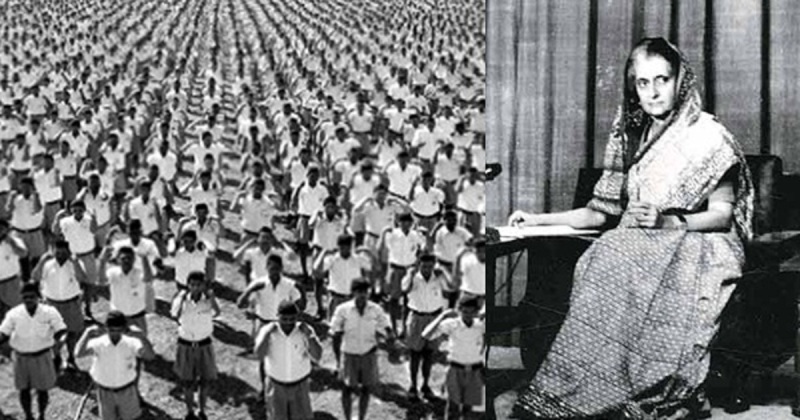
RSS Sarsanghchalak Balasaheb Deoras was apprehended at Nagpur station on June 30th. “In this extraordinary situation, it is the duty of the volunteers not to lose their balance,” he exhorted before his arrest. Continue the work of the Sangh and build the capacity of the general public to perform their national duty by doing public relations, public awareness, and public education as soon as possible, according to the orders of Sarkaryavah Madhavrao Mule and the officer appointed by him.

More than 100,000 of the total 1,30,000 Satyagrahis who took up the Satyagraha during the Emergency were from the Rashtriya Swayamsevak Sangh.

More than 25,000 of the 30,000 people imprisoned under Misa were Sangh volunteers.

During the Emergency, 100 Rashtriya Swayamsevak Sangh workers were sacrificed, most in captivity and some outside. Shri Pandurang Kshirsagar, the head of the Sangh’s All India Management team, was among them. (Kratiroop Sangh Darshan, p. 492)

The Sangh’s Protest Against the Emergency

All forms of communication, including newspapers and magazines, forums, the postal service, and elected legislatures, were halted. In this situation, the question was who should organise the mass movement. It could only be done by the Rashtriya Swayamsevak Sangh. The Sangh had its own network of shakhas throughout the country and could only serve in this capacity. The Sanghhas grown from the ground up through direct contact between people. For public relations, it was never reliant on the press or the stage. As a result, while the media’s shutdown had an impact on other parties, it had no effect on the Sangh. Its central decisions at the all-India level reach the village via the province, department, district, and tehsil levels. This Sangh communication system worked flawlessly between the time the emergency was declared and the end of the emergency. The homes of the Sangh workers proved to be the greatest boon to the fabric of the underground movement, and as a result, intelligence officers were unable to track down the underground workers. (P486-87, HV Sheshadri, Kratiroop Sangh Darshan)

Prior to his arrest, Shri Jayaprakash Narayan had entrusted the Lok Sangharsh Samiti movement to Shri Nanaji Deshmukh, a full-time Rashtriya Swayamsevak Sangh worker.

When Nanaji Deshmukh was arrested, the leadership was unanimously passed to Shri Sunder Singh Bhandari.

“I am pleased to learn that the volunteers of the Rashtriya Swayamsevak Sangh, as well as any other group of political resistance, Were willing to openly collaborate and support those who opposed emergency and are able to work with enthusiasm and integrity, against the diabolical regime that resorts to blatant repression and lies,” Achyuta Patwardhan wrote. Seeing the volunteers’ bravery and valour in leading the movement in the face of police atrocities and brutality, the Marxist Member of Parliament – Shri AK Gopalan – became emotional as well. “There must be some high ideal giving them indomitable courage for such a heroic act and sacrifice,” he had said. (June 9, 1979, Indian Express)

“The Rashtriya Swayamsevak Sangh is particularly noteworthy among the sections that have done this work with fearless dedication,” MC Subramaniam wrote. Satyagraha was organised by them. Maintained the entire India communication system. Funds for the movement were quietly collected. Arrangements have been made for the free distribution of literature. Helped fellow prisoners of other parties and even from different ideologies in the prison. In this way, they demonstrated that it is the closest character to Swami Vivekananda’s call for a sannyasi army for social and political work in the country. They are revolutionary traditionalists. (April 1977, Indian Review – Madras)

Emergency and Communist

The CPI saw the Emergency as an opportunity and welcomed it. The leaders of the CPI believed they could turn the Emergency into a communist revolution. The CPI supported Indira Gandhi’s Emergency during the 11th Bathinda Congress. (Coalition Strategies and Indian Communism Tactics, p. 224)

RSS has proven itself time and again when it comes to protecting the four pillars of democracy, assisting each one during natural disasters, developing each one’s personal and national character, and improving the environment.

Topics: RSSRashtriya Swayamsevak SanghemergencyIndira GandhiLok Sangharsh Samiti
Share38
Tweet
SendShareSend
✮ Subscribe Organiser YouTube Channel. ✮
✮ Join Organiser's WhatsApp channel for Nationalist views beyond the news. ✮
Previous News

US Supreme Court overturns Roe vs Wade, ends constitutional right to abortion; Protests erupt nationwide

Next News

‘Congress snatched Constitutional rights of every Indian overnight for power’: Amit Shah on 47 years of Emergency

Related News

Bharatiya Kisan Sangh distributed free school uniforms, notebooks, pen bundles, bags to 7,000 students in flood-affected areas of Assam

Assam: Bharatiya Kisan Sangh distributes free school uniforms, notebooks & bags to 7,000 flood-affected students

RSS Sarsanghchalak Dr Mohan Bhagwat, attended the 37th annual prize distribution ceremony ‘Swaraj’ at L.K. Singhania Education Centre

Education must go beyond livelihood and focus on holistic human development: Dr Mohan Bhagwat

The RSS has spent a century building influence through organisation, social networks and ideological formation beyond the electoral arena

RSS at 100: How the Sangh built a century-long network of influence beyond Indian politics

Indonesian Jaranan Dance Video Falsely Shared as Congress Supporter Being Abducted in Ladakh

FACT CHECK: Indonesian Jaranan video falsely shared as Congress supporter abducted in Ladakh by RSS Swayamsevaks

K Kunjikkannan (File Photo)

Obituary: Senior journalist and Janmabhumi resident editor K Kunjikkannan passes away at Thiruvananthapuram

NIA raids Patna flats linked to the Ranchi RSS office petrol bomb attack

Ranchi RSS Office Attack: NIA recovers Rs 20 lakh in Patna raids linked to petrol bombing

Load More

Latest News

RSS Akhil Bharatiya Sah-Bauddhik Shikshan Pramukh Deepak Vispute addressing the gathering

‘Nation First’ should be the guiding principle for every individual, regardless of their Field: Deepak Vispute

‘India was not poor; it was made poor’: The truth re-emerges through Jema Ferrer’s perspective

Six years after talent manager Disha Salian was found dead, her father Satish Salian on September 11 recorded a detailed statement with the Central Bureau of Investigation (CBI), naming Shiv Sena (UBT) leader Aaditya Thackeray, actors Dino Morea and Sooraj Pancholi, and others.

Disha Salian Murder Case: Father names Aaditya Thackeray in CBI statement; Lawyer claims gang rape, murder cover-up

Release of a book at Vishwa Bandhutva Diwas programme that was organised in Ujjain

Bharat’s youth rooted in sacrifice, service & discipline can give new direction to World: Parag Abhyankar

AI Generated Representative Image

“Let Go” — But only when it suits you? Exposing the double standards of Kashmir’s political leadership

Bharatiya Kisan Sangh distributed free school uniforms, notebooks, pen bundles, bags to 7,000 students in flood-affected areas of Assam

Assam: Bharatiya Kisan Sangh distributes free school uniforms, notebooks & bags to 7,000 flood-affected students

Chinmoy Prabhu

When a Bengali Hindu suffers in Bangladesh, where does ‘Bangali-Prem’ go?

AI Generated Representative Image

BRICS Summit: Not de-dollarisation, but derisking from dollar; India scripts pragmatic shield against external shocks

RSS Sarsanghchalak Dr Mohan Bhagwat, attended the 37th annual prize distribution ceremony ‘Swaraj’ at L.K. Singhania Education Centre

Education must go beyond livelihood and focus on holistic human development: Dr Mohan Bhagwat

(Left) Prime Minister Narendra Modi and Russian President Vladimir Putin (Right) Prime Minister Narendra Modi and Chinese President Xi Jinping in the backdrop of the Rameshwaram temple corridor in the backdrop of the BRICS 2026 summit

Bharat’s civilisational pride at BRICS 2026: Rameswaram temple corridor frames world leaders

Load More
  • Privacy
  • Terms
  • Cookie Policy
  • Refund and Cancellation
  • Delivery and Shipping

© Bharat Prakashan (Delhi) Limited.
Tech-enabled by Ananthapuri Technologies

  • Home
  • Search Organiser
  • Bharat
    • Assam
    • Bihar
    • Chhattisgarh
    • Jharkhand
    • Maharashtra
    • View All States
  • World
    • Asia
    • Africa
    • North America
    • South America
    • Europe
    • Australia
  • Editorial
  • Operation Sindoor
  • Opinion
  • Analysis
  • Defence
  • Culture
  • Sports
  • Business
  • RSS @ 100
  • Entertainment
  • More ..
    • Sci & Tech
    • Vocal4Local
    • Special Report
    • Education
    • Employment
    • Books
    • Interviews
    • Travel
    • Health
    • Politics
    • Law
    • Economy
    • Obituary
  • Subscribe Magazine
  • Read Ecopy
  • Advertise
  • Circulation
  • Careers
  • About Us
  • Contact Us
  • Policies & Terms
    • Privacy Policy
    • Cookie Policy
    • Refund and Cancellation
    • Terms of Use

© Bharat Prakashan (Delhi) Limited.
Tech-enabled by Ananthapuri Technologies