Pineapple agroforestry could help tackle climate change and biodiversity loss
August 23, 2026
  • Read Ecopy
  • Circulation
  • Advertise
  • Careers
  • About Us
  • Contact Us
Android AppiPhone AppArattai
Organiser
  • ‌
  • Bharat
    • Assam
    • Bihar
    • Chhattisgarh
    • Jharkhand
    • Maharashtra
    • View All States
  • World
    • Asia
    • Europe
    • North America
    • South America
    • Africa
    • Australia
  • Editorial
  • International
  • Opinion
  • RSS @ 100
  • More
    • Op Sindoor
    • Analysis
    • Sports
    • Defence
    • Politics
    • Business
    • Economy
    • Culture
    • Special Report
    • Sci & Tech
    • Entertainment
    • G20
    • Azadi Ka Amrit Mahotsav
    • Vocal4Local
    • Web Stories
    • Education
    • Employment
    • Books
    • Interviews
    • Travel
    • Law
    • Health
    • Obituary
  • Subscribe
    • Subscribe Print Edition
    • Subscribe Ecopy
    • Read Ecopy
  • ‌
  • Bharat
    • Assam
    • Bihar
    • Chhattisgarh
    • Jharkhand
    • Maharashtra
    • View All States
  • World
    • Asia
    • Europe
    • North America
    • South America
    • Africa
    • Australia
  • Editorial
  • International
  • Opinion
  • RSS @ 100
  • More
    • Op Sindoor
    • Analysis
    • Sports
    • Defence
    • Politics
    • Business
    • Economy
    • Culture
    • Special Report
    • Sci & Tech
    • Entertainment
    • G20
    • Azadi Ka Amrit Mahotsav
    • Vocal4Local
    • Web Stories
    • Education
    • Employment
    • Books
    • Interviews
    • Travel
    • Law
    • Health
    • Obituary
  • Subscribe
    • Subscribe Print Edition
    • Subscribe Ecopy
    • Read Ecopy
Organiser
  • Home
  • Bharat
  • World
  • Operation Sindoor
  • Editorial
  • Analysis
  • Opinion
  • Culture
  • Defence
  • International Edition
  • RSS @ 100
  • Magazine
  • Read Ecopy
Home Bharat

Pineapple agroforestry could help tackle climate change and biodiversity loss

WEBDESKWEBDESK
Aug 19, 2021, 09:04 am IST
inBharat
Follow on Google News
Facebook
Twitter
WhatsAppTelegramEmail

                                                                                                                                                                  Umashankar Mishra 


The study assessed the tree diversity and ecosystem carbon storage through the traditional agroforestry system practised by the local communities. 


New Delhi: Pineapple-based agroforestry, traditionally practised by ethnic “Hmar” tribe in southern Assam, can be a sustainable alternative to jhum cultivation for North East India. According to a new study, this traditional practice can provide twin solutions for climate change and biodiversity loss. The Department of Ecology and Environmental Science, Assam University, Silchar, with support from the Climate Change Program Division of the Department of Science & Technology (DST) carried this study out.


Researchers are looking for agroforestry options that would also offer high carbon storage potential and tree diversity to couple this with solutions for challenges of climate change and biodiversity loss, the DST statement said.


Jhum cultivation, also called swidden agriculture, the dominant agricultural practice in the region, has become unsustainable primarily due to the reduced fallow cycle resulting in depletion in soil fertility, severe soil erosion, and low agronomic productivity. Hence, North East India and many south Asian countries are shifting to agroforestry and high-value cropping systems from traditional jhum practices, which are considered sustainable and profitable alternatives over the past decades.


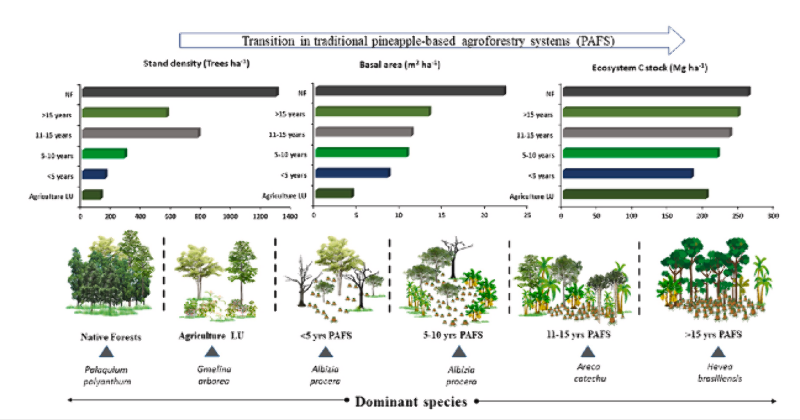
The study assessed the tree diversity and ecosystem carbon storage through the traditional agroforestry system practised by the local communities. It showed that the system they practice maintains a steady ecosystem carbon stock while reducing land-use-related carbon emission and providing additional co-benefits to the communities.

The research team, led by Arun Jyoti Nath, Associate Professor in the Department of Ecology and Environmental Science, Assam University, conducted this study in the ethnic villages in the Cachar district of Assam part of the Himalayan foothills and the Indo-Burma, centre of a global biodiversity hotspot. They explored changes in tree diversity and transition of dominant tree species from swidden agriculture through different aged PAFS. The changes in the biomass carbon and ecosystem carbon storage in tree and pineapple components from swidden

agriculture through different aged PAFS were also noted.


Researchers found that farmers apply traditional knowledge for tree selection through prior knowledge and long-term farming experience. Additionally, fruit trees such as Areca catechu and Musa species are planted on farm boundaries as live fences. The live fence reduces soil erosion and acts as a windbreak and shelterbelt. A combination of economically important trees like Albiziaprocera, Parkiatimoriana, Aquilariamalaccensis, and fruit trees like papaya, lemon, guava, litchi, and mango with pineapple caters for both home-consumption and

selling all year round. The upper canopy trees regulate light, enhance biomass inputs, and increase farm diversity, resulting in soil fertility and improved plant nutrition. The tree-related management practices promote the conservation of the farmers favoured indigenous fruit trees. In the older pineapple agroforestry farms, farmers introduce rubber trees.


The research shows that the practice can be applied for the REDD+ mechanism to add to the carbon capturing and reducing deforestation by contributing to tree cover, which may further incentivise against the carbon credit to the poor farmers.


Pineapple agroforestry systems (PAFS) are dominant land use in the Indian Eastern Himalayas and other parts of Asia and are mostly grown in association with multipurpose trees. The ethnic “Hmar” tribe in southern Assam has been cultivating pineapple for centuries. At present, they practice the indigenous PAFS for both home consumption and boosting economic benefits.


They have applied traditional knowledge to evolve a unique agroforestry system. The study published in the ‘Journal of Environmental Management’ recently can provide information about emission factors for the indigenous agro-ecosystems in North East India for mitigation purposes, facilitating the formulation of incentives for the communities. It could also equip forest managers with information for accounting for the changes in carbon storage due to deforestation and jhum cultivation.


Courtesy: India Science Wire

Share
Tweet
SendShareSend
✮ Subscribe Organiser YouTube Channel. ✮
✮ Join Organiser's WhatsApp channel for Nationalist views beyond the news. ✮
Previous News

‘War is not over’, says Amrullah Saleh: Taliban 2.0 – Back to Darkness, Tyranny

Next News

Film festival highlighting the role of scientists in the Indian independence movement concludes

Related News

UP CM Yogi Adityanath has ordered strict action, including under the Essential Services Maintenance Act, against hoarding and black-marketing of Sugar

No Sugar Shortage in Uttar Pradesh: CM Yogi orders crackdown on hoarders, black-marketers

Swami Laxmanananda Saraswati

Swami Laxmanananda Saraswati Death Anniversary: A legacy of service, education and social reform

CGHS wellness centre to remain open

Fact Check: Health Ministry says wellness centres not closing for NEET-PG exam duty, check official update

Beyond the familiar festivities, Onam carries a layered Hindu civilisational memory shaped by Bhagwan Vamana, Mahabali, sacred texts and centuries of tradition.

Onam’s Forgotten Roots: How a Hindu civilisational tradition was recast in modern Keralam’s political narratives

AIAPGET 2026 Disrupted in Jaipur; NTA Issues Notice to Eduquity (This image is generated by AI)

AIAPGET 2026: NTA suspends Eduquity after power failure disrupts exam at Jaipur centre; Show-cause notice served

MEA exposes Telangana CM Revanth Reddy real agenda of Telangana CM Revanth Reddy's visit to US. Stops him from visiting US

MEA exposes Telangana CM Revanth Reddy’s anti-Bharat agenda masked as ‘State Development’

Load More

Latest News

UP CM Yogi Adityanath has ordered strict action, including under the Essential Services Maintenance Act, against hoarding and black-marketing of Sugar

No Sugar Shortage in Uttar Pradesh: CM Yogi orders crackdown on hoarders, black-marketers

Swami Laxmanananda Saraswati

Swami Laxmanananda Saraswati Death Anniversary: A legacy of service, education and social reform

CGHS wellness centre to remain open

Fact Check: Health Ministry says wellness centres not closing for NEET-PG exam duty, check official update

Beyond the familiar festivities, Onam carries a layered Hindu civilisational memory shaped by Bhagwan Vamana, Mahabali, sacred texts and centuries of tradition.

Onam’s Forgotten Roots: How a Hindu civilisational tradition was recast in modern Keralam’s political narratives

AIAPGET 2026 Disrupted in Jaipur; NTA Issues Notice to Eduquity (This image is generated by AI)

AIAPGET 2026: NTA suspends Eduquity after power failure disrupts exam at Jaipur centre; Show-cause notice served

MEA exposes Telangana CM Revanth Reddy real agenda of Telangana CM Revanth Reddy's visit to US. Stops him from visiting US

MEA exposes Telangana CM Revanth Reddy’s anti-Bharat agenda masked as ‘State Development’

(Left to Right) Congress MP and former Punjab chief minister Charanjit Singh Channi, Late former Congress leader Sajjan Kumar, Deepender Hooda

‘Mind your tongue’: Channi Vs Hooda clash over ‘role model’ praise for 1984 anti-Sikh riots perpetrator Sajjan Kumar

EAM Jaishankar(File Photo)

EAM Jaishankar decodes geopolitical reality with 3Cs; Outlines 4Ds as strategic solutions to fortify national security

Pakistan PM Shehbaz Sharif and Former PM Imran Khan

Pakistan: Contempt plea filed against PM Shehbaz Sharif & 2 ministers for defying Supreme Court order on Imran Khan

PM Modi’s Free Online Coaching Mission: A tool for digital inclusion and social mobility

Load More
  • Privacy
  • Terms
  • Cookie Policy
  • Refund and Cancellation
  • Delivery and Shipping

© Bharat Prakashan (Delhi) Limited.
Tech-enabled by Ananthapuri Technologies

  • Home
  • Search Organiser
  • Bharat
    • Assam
    • Bihar
    • Chhattisgarh
    • Jharkhand
    • Maharashtra
    • View All States
  • World
    • Asia
    • Africa
    • North America
    • South America
    • Europe
    • Australia
  • Editorial
  • Operation Sindoor
  • Opinion
  • Analysis
  • Defence
  • Culture
  • Sports
  • Business
  • RSS @ 100
  • Entertainment
  • More ..
    • Sci & Tech
    • Vocal4Local
    • Special Report
    • Education
    • Employment
    • Books
    • Interviews
    • Travel
    • Health
    • Politics
    • Law
    • Economy
    • Obituary
  • Subscribe Magazine
  • Read Ecopy
  • Advertise
  • Circulation
  • Careers
  • About Us
  • Contact Us
  • Policies & Terms
    • Privacy Policy
    • Cookie Policy
    • Refund and Cancellation
    • Terms of Use

© Bharat Prakashan (Delhi) Limited.
Tech-enabled by Ananthapuri Technologies