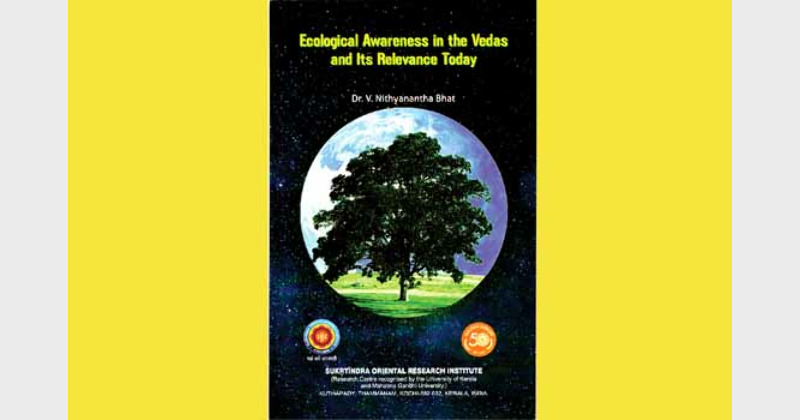
The latest book of Dr. V Nithyanantha Bhat gives a clear picture of the efficacy of the Vedic environmental ethics in saving our planet from the catastrophe it is presently faced with
-U Gopal Maller
Ecological Awareness in the Vedas and its Relevance Today, Published by: Sukrtindra Oriental Research Institute KOCHI – 682 032 (Kerala) ,Rs 1499
Kalidasa, one of the greatest literary personalities of Bharat, was, it is said, in the initial stages of his life, a stupid, so much so that once he cut the very branch of a tree on which he was perched, oblivious of the dangerous consequences. In the modern age, humanity has been busily engaged in a similar stupid activity! However, there is a difference! If Kalidasa had done the foolish act because of his ignorance, we are doing it to satisfy our greed, knowing very well that we are taking this planet to a condition the inevitable result of which will be total destruction! And the signs of the impending catastrophe are already in the air!
It is in this context, the latest book, “Ecological Awareness in the Vedas and Its Relevance Today,” of Dr. V. Nithyanantha Bhat, Honorary Director, Sukrtindra Oriental Research Institute, assumes great significance. The foreword to the book, written by Dr. Nanditha Krishna, President, C.P. Ramaswami Aiyar Foundation, and Honorary Director, C.P.R. Environmental Education Centre, Chennai, is very succinct.
In the introductory chapter, the author cites ‘the belief that human beings are separate from and superior to nature’ as one of the major factors that contribute to the environmental crisis. According to him, ‘man’s indiscriminate exploitation of nature’ is the other factor (page: 13). Here, it is worth mentioning that native people in every continent, like the people of Bharat, lived in perfect harmony with nature. Their traditions and belief systems clearly indicate that they regarded nature with utmost respect. So, naturally the question arises as to what made humanity to deviate from the traditions and belief systems of their ancestors?
“The holistic world view, seeing the world as an integrated whole rather than a dissociated collection of parts,” (page 14) propounded by Fritjof Capra, has been an integral part of Hindu tradition from time immemorial, as reflected in the verse ’Vasudhaiva kutumbakam’ (the whole world is one single family- Maha Upanishad 6:72). Here, the following words of Dattopant Thengadiji, founder of the Bharatiya Mazdoor Sangh, are very relevant: “Dharma envisages autonomy of each human group to seek its social self- fulfilment through its own unique paradigm, and psychological integration of all such groups in a common framework of harmonious and mutually complementary interrelationships of One World (Vasudhaiva Kutumbakam) – each group enriching the common, human understanding by making its own characteristic contribution to the collective wisdom of humanity” (Lecture delivered at the ‘World Vision 2000’ in Washington, U.S.A., in August 1993).
The observation made by Roger S. Gottlieb, an authority on religious environmentalism and environmental ethics, on the relationship between religion and ecology is very relevant. It seems, his suggestion “How traditional religions viewed nature and how these views should be reinterpreted or altered in the light of the environmental crisis” (page 15), has already received the attention of, if not all, at least some religious sections, as is evident from the Encyclical Letter of the incumbent Pope Francis, dated May 24, 2015, which is started by quoting the following words of Saint Francis of Assisi: “Praise be to you, my Lord, through our sister, Mother Earth, who sustains and governs us, and who produces various fruit with coloured flowers and herbs.” The suggestion made by Mary Evelyn Tucker and John Grim, Founders and Directors of the Forum on Religion and Ecology at Yale University on the “involvement of religions with the development of a more comprehensive worldview and ethics for a movement toward sensibility,” is really laudable. However, to what extent dogmatic religions will cooperate with such an endeavour is unpredictable. Here, I would like to quote Swami Ranganathananda: “Much of the irrelevance of the world’s religious traditions today proceed from their inability to separate the Sruti, or the essential, from the Smrti, or the obsolete, contents, the eternal spiritual truths from the historical socio-political dogmas, in these traditions, and their unwillingness to throw overboard the latter which have ceased to have any currency value in the changed conditions, and their incapacity to forge new Smrtis in response to the new demands.”
(The Message of the Upanishads- page 9-emphasis author’s).
The author has rightly said, “Hinduism has always been an environmentally sensitive philosophy.” The main reason for it is its view on cosmology: “The whole universe is filled with the spirit of God” (Isa Upanishad: Verse- 1). It is in this context, as said by the author, “perhaps only Hindu religion and its scriptures like the Mahabharata, the Ramayana, the Vedas, the Upanishads, the Bhagavat Gita, the Puranas and Smrti” lay so much emphasis on environmental ethics.
“For us Dharma is universal. It is not mandated by anybody,” says Swami Dayananda Saraswathi of Arsha Vidya Centre (Do all Religions have the same goal? Page: 10). The concept and scope of Dharma is very wide. And the author has commendably dealt with the nuances and dimensions of Dharma in the introductory chapter. He says: “Dharma is meant for the welfare or the well-being of all living creatures. It is the Dharmic tradition of the Hindus that has helped sustain our ecology for centuries. For Hindus, the environment is protected not because of the selfish urgency to save biodiversity and hence save human future, but because it is the Dharmic way of life and hence a righteous duty that all humans are obliged to perform. And ignorance of this Dharmic way of life has resulted in the abuse and exploitation of the earth and its resources” (page 23-24). Can anyone present the crux of the problem in a better way with more cogency and clarity? I don’t think so!
What the 14th century Persian historian, Abdulla Wassaf, said about our land and quoted by the author is very significant and really exhilarating. Says Abdulla Wassaf: “India is the most agreeable land on earth and most pleasant quarter of the world. Its dust is purer than air and air is purer than purity itself. Its delightful plains resemble the gardens of paradise, even paradise itself is not comparable to it” (page 25). This reminds us of a verse in the Vishnu Purana, which says: “Of the divisions of Jambu-dweepa Bharat is the only land of Karma; the others are places of bhoga (enjoyment) alone (2:3:22).
The author concludes the introductory chapter by quoting Christopher Fici, Director, Hinduism and Ecology Society, who says: “While the modern age defines the environment as the relationship of and among the living creatures, earth, air and water (The Environment Protection Act 1986), the Vedic worldview is far more comprehensive and insightful” (page 28).
And in the second chapter, Ecological Awareness in the Vedas, he starts with the observations made by Sri Aurobindo about his relentless pursuit of the Vedas “knowing which, all is known!”
So much degradation of nature is the direct consequence of man’s insatiable quest for physical happiness. However, it is a fallacy to confine happiness only at the physical level, and it should include mental, intellectual and spiritual happiness. The book in a nutshell gives a clear picture of the efficacy of the Vedic environmental ethics in saving our planet and biodiversity from the catastrophe it is presently faced with, and hence I would rather call it a ‘manifesto’ aimed at salvaging our ecosystem from imminent danger. Dr. Nityananth Bhat has really done a great service by presenting through his book the holistic solution, based on Vedic wisdom, to the existential problem faced by humanity.
(The writer is Kerala based columnist and writer)