Modern medicine owes a debt to Ayurveda. The doctrine of humoral pathology had developed in India much before Hippocrates, the Father of Modern Medicine, was born. Taking cue from China, India should recast its strategies to aggressively promote research in Ayurveda and make it acceptable to the world
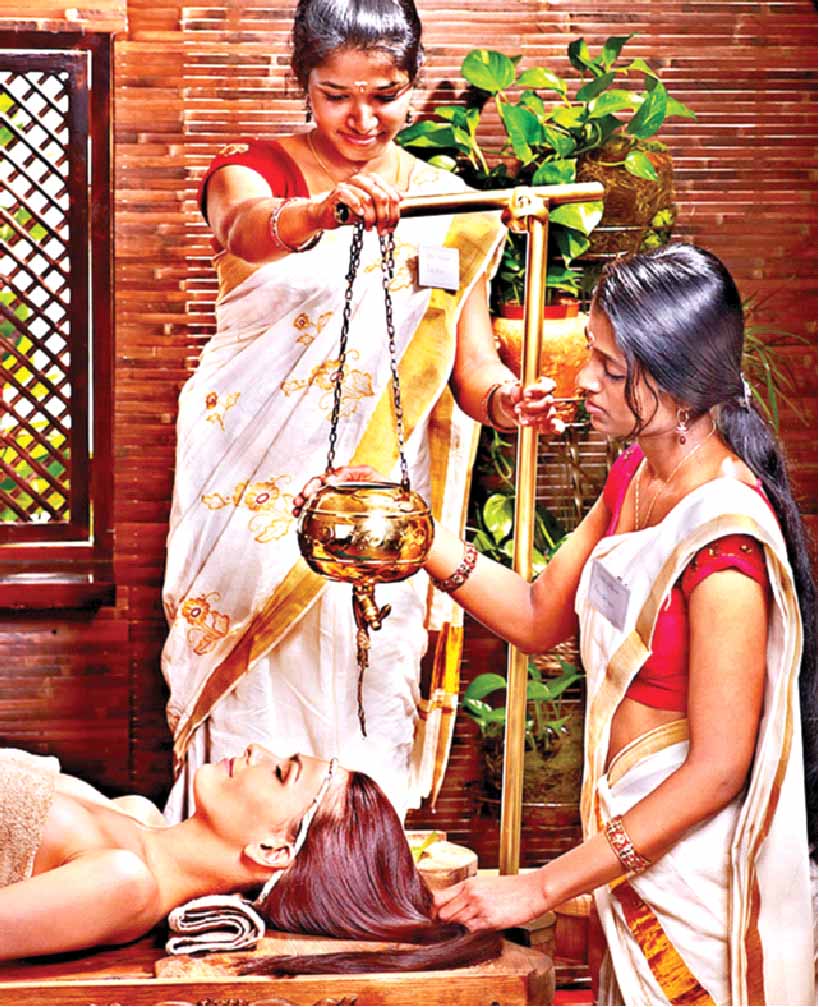
The Arabians have been credited with propagating science and mathematics in Europe after the decline of Greek civilisation. But history has it that they were only carriers of the knowledge from the East. The spark originated in India. “When in the dark and middle ages, the lamp of knowledge had begun to burn very low in Europe and even when the very vestiges of Greek culture and learning had all but disappeared, save in the obscure and dingy cells of the monk, it was the Arabs who carried there the accumulated intellectual treasures of the East, and thus laid the foundation, so to speak, of modern European greatness,” says Prof P C Ray, eminent scientist, in his book A History of Hindu Chemistry.
Many Indian scholars were inducted into the court of the Caliphs in Baghdad. The author of Kitab-al-Fihrist Haji Khalifa (10th century) and Ibn Abu Usaibiah (13th century) mention that the Caliphs Harun and Mansur had ordered the translation of several standard Hindu works on medicine, materia medica, and therapeutics into Arabic.
Gustav Leberecht Flugel, German orientalist, states, on the authority of Kitab-al-Fihrist, Susrud (Sanskrit name Sushrut Samhita) was translated by an Indian physician Mankh, who cured Caliph Harun al-Raschid of a serious illness. The Caliph appointed him in charge of the Royal Hospital. Similarly, Charaka Samhita was also translated into Arabic by the same author. Haji Khalifa, the Arabic writer, reveals that many of his countrymen were learning Hindu astronomy, algebra under Hindu scholars who were appointed by the Caliphs. Also, many Muslim students “used to flock to centres of learning in India”.
Max Muller reveals that besides Charaka and Sushruta, Nidana and Vagbhada’s Ashtanga were rendered into Arabic. Al-Beruni, the Persian scholar and traveller, who had spent many years in India in the 10th century, studied Sanskrit to learn India’s system of medicine, philosophy, mathematics, and astronomy. Edward Sachau, who translated Al-Beruni, says, “Some of the books that had been translated under the first Abbasid Caliphs were extant in the library of Al-Beruni, when he wrote his Khitab-al-Hind, Brahmasiddhanta or Sindhind……..the Charaka in the edition of Ali Ibn Zain and the Panchtantra or Kalila and Dimna.”
According to Prof P C Ray, the fact that the Charaka occupied a place in the library of a cultured Arab affords additional proof of the esteem in which the Hindu system of medicine was held by the Muslim world. Even before the advent of Islam, India was the favourite destination for students of medicine and other sciences. “Barzouhyeh, a contemporary of the celebrated Sassanian king Nashirvan, (AD 531-572), visited India to acquire proficiency in the Indian sciences.”

Even as China promoted its traditional medicines aggressively
abroad, there has been institutional and intellectual lethargy to promote Ayurveda
abroad, there has been institutional and intellectual lethargy to promote Ayurveda
Later, when Sindh came under the rule of the Khalif Mansur (AD 753-774), many Indian scholars were invited to Baghdad. They introduced Brahmasiddhanta of Brahmagupta (Sindhind) and his Khandakadyaka (Arkand in Arabic). Prof Edward Sachau, who translated Al-Baruni’s works into English, states: “With the help of these pundits Alfazari, perhaps also Yakub Ibn Tarik, translated them. Both works have been largely used, and have exercised a great influence. It was on this occasion that the Arabs first came acquainted with a scientific system of astronomy. They learned from Brahmagupta earlier than from Ptolemy.”
Another wave of Hindu learning happened during Caliph Harun’s regime from AD 786 to 808. “The ministerial family Barmak, then at the zenith of their power, had come with the ruling dynasty from Balkh, where an ancestor of theirs had been an official in Buddhist temple Naubehar i.e. Navavihara. The name Barmak is said to be of Indian descent, meaning Paramaka i.e. superior… During the 8th and 9th centuries, the Indians became the teachers in arithmetic and algebra of the Arabs, and through them of the nations of the West. Thus, though we call the latter science by an Arabic name, it is a gift we owe to India.”
Although the Barmak family had converted to Islam, they never held Islam in high esteem or regarded it as genuine. Dr P C Ray writes, “Induced probably family traditions, they sent scholars to India to study medicine and pharmacology. Besides, they engaged Hindu scholars to come to Bagdad, made them the chief physicians of their hospitals, and ordered them to translate from Sanskrit into Arabic, books on medicine, pharmacology, toxicology, philosophy, astrology, and other subjects.”
Flugel states on the authority of Kitab-al-Fihrist, Susrud (Sanskrit name Sushrut Samhita) was translated by an Indian physician Mankh, who cured Caliph Harun al-Raschid of a serious illness.
Marxist Subterfuge
Marxist historian D N Jha, in an interview with Business Standard, said, “There is no science in the Vedas”. More than his lack of knowledge about the Vedas and India’s rich tradition of alchemy, the statement betrays his deep ideological biases which always seek to show ancient Hindus and Hinduism in poor light. Left historians and intellectuals have always been reluctant to acknowledge the profound contributions of the Hindus of old in the fields of philosophy, alchemy, medicine, mathematics, including astronomy, arithmetic, algebra, trigonometry and geometry. Moreover, there has been a concerted effort to devalue the contributions of Hindus in various fields.
For instance, although ancient Indians have contributed immensely to the growth of chemistry, no university in India has a book prescribed for students which makes a fair assessment of ancient Indians’ contributions. In India, chemistry has evolved as a “handmaid of medicine” and later on as an “adjunct of the Tantric cult”, states P C Ray.
The Rig Veda eulogises the twin gods of healing, Aswins, who fitted an iron limb on Vispala whose leg was cut off in a conflict. The many gods in the Rig Veda are personifications of elements and natural phenomena. While Tulsi plant having many medicinal values is regarded as mother, herbs endowed with potent and active properties have been given status of gods. The scriptures extol the magic powers of Soma rasa which has “conferred immortality to the gods”.
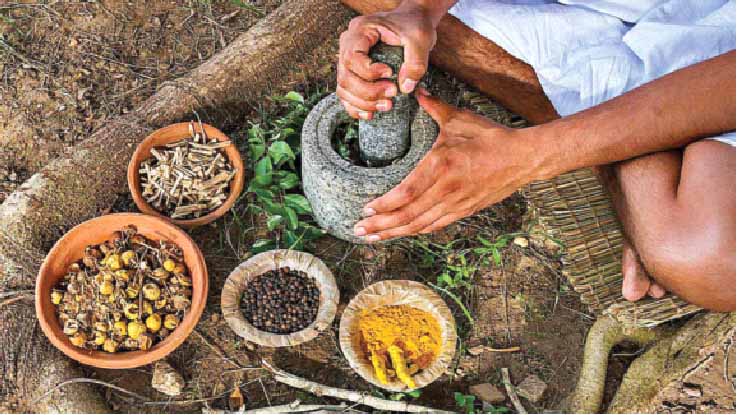
Ancient rishis were aware of the therapeutic qualities of the preparations made out of plants. The plant apamarga, which is used in the preparations of medicines, is invoked as the “mistress of remedies”. The Atharva Veda has slokas explaining the qualities and advantages of using pearl, gold and lead. This shows that people in the Vedic period had alchemical notions about gold and lead.
Ayurveda and Greeks
Hippocrates is regarded as the ‘Father of Modern Medicine’. However, much before the birth of Hippocrates, the Hindus had an elaborate system of medicine based on humoural pathology. But Western scholars and Marxist historians refuse to accord greatness to Indians. P C Ray writes: “It is curious to reflect that the upholders of ‘Greek Culture’ are often found ready, though unconsciously to twist and torture facts and conclusion to serve their own purpose, and reserve to themselves the benefit of doubt as regards date; but whenever priority of the Hindus is unquestionable, an appeal is made to the theory of common origin and independent parallelism of growth. These scholars smart under a sense of injury if they have to confess that Europe owes an intellectual debt to India, hence many a futile attempt to explain away positive historical facts.”
Max Muller reveals that besides Charaka and Sushruta, Nidana and Vagbhada’s Ashtanga were rendered into Arabic. Al-Beruni, the Persian scholar and traveller, who had spent many years in India in the 10th century, studied Sanskrit to learn India’s system of medicine, philosophy, mathematics, and astronomy
The science of alchemy witnessed much development since Charaka’s period, about 1000 years after the Atharv Veda. Charaka, in his medical treatise, regards Ayurveda as an upanga (subsidiary) of Atharv Veda. In the treatises of Charaka and Sushruta, there are descriptions about minerals and natural salts being used in the medicines. Buddhist monks also contributed greatly to the growth of alchemy. Many treatises like Rasarnava, Rasartna Samuchaya, etc., were written by Buddhist scholars.
Certain European scholars, like the Leftists of today, were keen to show that all Hindu treatises were of recent origin and Indian scholars were influenced by Greeks, despite mounting evidence.
Al-Beruni, well-versed in Arabic, Greek, astronomy and alchemy, who visited India in the XI century has written extensively about Indians’ proficiency in chemistry. He says: “The adepts in this art try to keep it concealed, and shrink back from intercourse with those who do not belong to them. Therefore, I have not been able to learn from the Hindus which methods they follow in this science and what element they principally use, whether a mineral or an animal or a vegetable one. I only heard them speaking of the process of sublimation, of calcination, of analysis and of the waxing of talc, which they call in their language “talaka”, and so I guess that they incline towards the mineralogical method of alchemy. …They have a science similar to alchemy which is quite peculiar to them. They call it Rasayana, a word composed with rasa, i.e, gold (rasa actually means mercury).”
Sachau, who translated Al-Beruni, says, “Some of the books that had been translated under the first Abbasid Caliphs were extant in the library of Al-Beruni, when he wrote his Khitab-al-Hind, Brahmasiddhanta or Sindhind……..the Charaka in the edition of Ali Ibn Zain and the Panchtantra or Kalila and Dimna”
The way forward
Related News