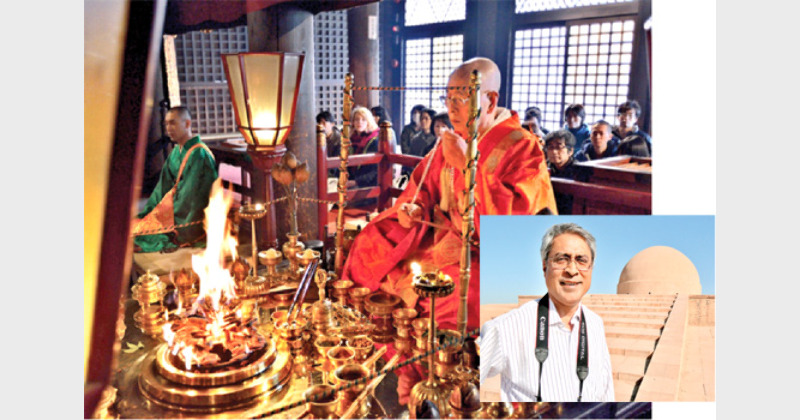
Hindu Deities Shine in Japan
June 12, 2026
  • Read Ecopy
  • Circulation
  • Advertise
  • Careers
  • About Us
  • Contact Us
Android AppiPhone AppArattai
Organiser
  • ‌
  • Bharat
    • Assam
    • Bihar
    • Chhattisgarh
    • Jharkhand
    • Maharashtra
    • View All States
  • World
    • Asia
    • Europe
    • North America
    • South America
    • Africa
    • Australia
  • Editorial
  • International
  • Opinion
  • RSS @ 100
  • More
    • Op Sindoor
    • Analysis
    • Sports
    • Defence
    • Politics
    • Business
    • Economy
    • Culture
    • Special Report
    • Sci & Tech
    • Entertainment
    • G20
    • Azadi Ka Amrit Mahotsav
    • Vocal4Local
    • Web Stories
    • Education
    • Employment
    • Books
    • Interviews
    • Travel
    • Law
    • Health
    • Obituary
  • Subscribe
    • Subscribe Print Edition
    • Subscribe Ecopy
    • Read Ecopy
  • ‌
  • Bharat
    • Assam
    • Bihar
    • Chhattisgarh
    • Jharkhand
    • Maharashtra
    • View All States
  • World
    • Asia
    • Europe
    • North America
    • South America
    • Africa
    • Australia
  • Editorial
  • International
  • Opinion
  • RSS @ 100
  • More
    • Op Sindoor
    • Analysis
    • Sports
    • Defence
    • Politics
    • Business
    • Economy
    • Culture
    • Special Report
    • Sci & Tech
    • Entertainment
    • G20
    • Azadi Ka Amrit Mahotsav
    • Vocal4Local
    • Web Stories
    • Education
    • Employment
    • Books
    • Interviews
    • Travel
    • Law
    • Health
    • Obituary
  • Subscribe
    • Subscribe Print Edition
    • Subscribe Ecopy
    • Read Ecopy
Organiser
  • Home
  • Bharat
  • World
  • Operation Sindoor
  • Editorial
  • Analysis
  • Opinion
  • Culture
  • Defence
  • International Edition
  • RSS @ 100
  • Magazine
  • Read Ecopy
Home Bharat

Hindu Deities Shine in Japan

Many of our forgotten deities are still being worshipped in Tokyo and other Japanese cities. This can now be seen in a seminal film "Indian deities worshipped in Japan" by Benoy K. Behl

Archive ManagerArchive Manager
Apr 29, 2021, 10:59 am IST
in Bharat
Follow on Google News
FacebookTwitterWhatsAppTelegramEmail
 
Many of our forgotten deities are still being worshipped in Tokyo and other Japanese cities. This can now be seen in a seminal film “Indian deities worshipped in Japan” by Benoy K. Behl
 
-Madhur Tankha


a_1 H x W: 0 x
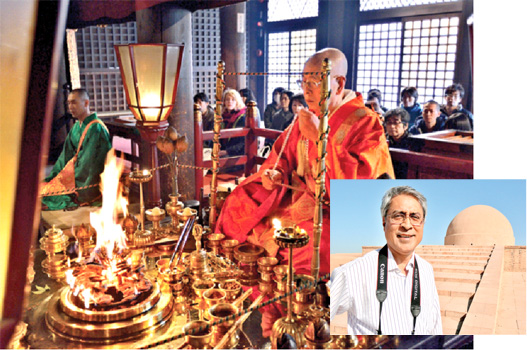
Hawan or Homa, called Goma in Japan, Takahata Fudo Temple, Tokyo and Art Historian,
Flim-maker and Photographer Benoy K Behl
 
It is a welcome surprise that Hindu deities are accorded the pride of place in Buddhist temples in far off Japan. Our deities are being regularly worshipped by the locals. Their seriousness of intent can be seen from the fact that elaborate Havans as prescribed by Hindu scriptures are conducted in 1,200 temples.
 
In fact, Vayu, Varuna and Kamadeva – deities long forgotten in our urban cities – continue to be worshipped in Nippon till this date. The pujas are being conducted in temples situated in Tokyo, Kyoto, Nara and Koyasan by Japanese priests who chant Sanskrit shlokas. Interestingly, these priests don’t understand Sanskrit but can utter our country’s ancient language flawlessly as Japanese alphabet kanta is created from the phonetics of Sanskrit.
 
These religio-cultural symbols of Indian heritage have now been brought alive in a seminal film “Indian deities worshipped in Japan” by Benoy K. Behl, a filmmaker-cum-historian, who has been researching the cultural connections between India and Japan, for over two decades. The Japan Foundation honoured Behl recently by screening his film as well as beaming his lecture on its Facebook.
 
Earlier, the Foundation gave Behl, a Delhiite who is meticulous when it comes to research, a Fellowship which helped him study this engrossing yet lesser known subject in a comprehensive way.
 
After completing his research, Behl knocked on the doors of the present Union Government. “I suggested to the Ministry of External Affairs, Government of India, that we should make a film about this subject,” reveals Behl. The intent was to foster a people-to-people relationship between Japan and India.
 
The film gives viewers a glimpse into the interiors of important temples of Japan. This film needs to be seen as a blossoming of cross-cultural exchange between the two Asian nations.
 
Challenging task
 
Normally, video shooting is out of bounds in the hallowed temples of Japan. The reticent Chief Priests don”t give their nod. While Behl was planning on how to take forward his labour of love, professors from around the world cautioned him that he would not be allowed to film in any of the major temples in Japan.
 
Fortunately, Behl’s patience and perseverance made him succeed. He wrote to the chief priests of 50 Buddhist temples in Nara explaining the rationale behind his prospective film. Fortunately, all 50 agreed for the shootings and even obliged him with interviews.
 
However, making the film was fraught with difficulties. The filmmaker had to interact with priests but he was not conversant with Japanese. Luckily, there was a silver lining as his background of research and documentation of yoga internationally proved to be very helpful. “Swami Sitaramananda, Senior Acharya of Sivananda International Yoga Ashrams and Centres put me in touch with an interpreter in Tokyo, named Keiko Ito. Another practitioner of Sivananda Yoga, Chisato Nakayama came all the way from Hokkaido to Nara and Kyoto to help. It was wonderful to see the way Keiko and Chisatio provided assistance every day, from morning till night, in the true spirit of karma yoga,” says Behl.
 
The duo were so dedicated to the project that it was a learning experience for Behl.
 
Creating awareness
 
The film is expected to boost tourism as some Hindu devotees would like to witness pujas being solemnised by Japanese priests on Hindu deities in Buddhist temples in Japan. The film focuses on the less ignored fact that a number of Hindu deities are actively worshipped in Japan. “In fact, there are hundreds of shrines of Saraswati alone. There are innumerable representations of Lakshmi, Indra, Brahma, Ganesha, Garuda and other deities,” says Behl, who is an authority on the subject.
 
Preservation is the key
 
In India, there has been constant evolution and change. On the other hand, the Japanese have valued ancient knowledge and have preserved its philosophical dimensions, well into the modern age.
 
In many ways, Japan has preserved very ancient Indian traditions, even when they may have evolved in India. Explaining this through a valid example, the historian says in Japan, Saraswati is depicted and venerated not only with the Veena, but also remembered for her association with water. “Therefore, she is also worshiped in pools of water in Japan. The most important lake in Japan is named after Saraswati’s Veena, nameed Biwa in Japanese.”
 
Ancient India was the originator of great ethical traditions of Buddhism and Hinduism. Japan is to be credited with the continuance of ethical values in modern times.
 
The Ministry of External Affairs contributed immensely in the making of this film. On YouTube itself on the Channel of Public Diplomacy, the film already has garnered over 2,25,000 views. This is most unusual for a serious film about an academic subject. “The Government of India have given a most meaningful support to this glorious subject,” says Behl, who as visiting professor in colleges across the globe will deliver lectures on his film post-Coronavirus. This message-oriented film establishes the spiritual and cultural link between the people of India and Japan. 



ShareTweetSendShareSend
✮ Subscribe Organiser YouTube Channel. ✮
✮ Join Organiser's WhatsApp channel for Nationalist views beyond the news. ✮
Previous News

1.33 Crore Register for Vaccination on CoWIN as Vaccination Process Opens for 18-44 Age Bracket

Next News

Rusting Steel Frames

Related News

US: Anshul Kuncha’s death exposes anti-India racist racket; Assaulting the community that powers American economy!

Security forces undertake anti-Maoist campaign in Odisha in Kandhamal and Malkangiri and seize huge cache of arms

Odisha: Security forces recover caches of weapons of Maoists in Kandhamal and Malkangiri in last three days

Kashmiri Pandits at Kheer Bhawani Temple(File Photo)

J&K: Exiled Kashmiri Pandits throng temples amid enhanced security; Crowd peaks on Jyestha Ashtami at Kheer Bhawani

Global Peace Index Farce: Does the GPI penalise democracies fighting terrorism? India’s case explained

Five Ayush hospitals cum medical colleges to come up in Uttar Pradesh (This is an AI generated image)

Uttar Pradesh plans five integrated AYUSH Colleges and Hospitals to expand traditional healthcare and medical education

(Left) Site of the protest (Right) NIA team in JNIMS hospital

Manipur: NIA starts forensic probe of abduction and killings of 6 Naga civilians by Kuki militants

Load More

Latest News

US: Anshul Kuncha’s death exposes anti-India racist racket; Assaulting the community that powers American economy!

Security forces undertake anti-Maoist campaign in Odisha in Kandhamal and Malkangiri and seize huge cache of arms

Odisha: Security forces recover caches of weapons of Maoists in Kandhamal and Malkangiri in last three days

Kashmiri Pandits at Kheer Bhawani Temple(File Photo)

J&K: Exiled Kashmiri Pandits throng temples amid enhanced security; Crowd peaks on Jyestha Ashtami at Kheer Bhawani

Global Peace Index Farce: Does the GPI penalise democracies fighting terrorism? India’s case explained

Five Ayush hospitals cum medical colleges to come up in Uttar Pradesh (This is an AI generated image)

Uttar Pradesh plans five integrated AYUSH Colleges and Hospitals to expand traditional healthcare and medical education

(Left) Site of the protest (Right) NIA team in JNIMS hospital

Manipur: NIA starts forensic probe of abduction and killings of 6 Naga civilians by Kuki militants

Prime Minister Narendra Modi

The MODI Era: Legacy of 4399 days of Transformation

Late Laxmananda Saraswati (File Photo)

Missing Swami Laxmananda murder judicial inquiry report triggers FIR in Odisha; BJP targets Naveen Patnaik

4,399 days of Prime Minister Narendra Modi

The Meaning of 4,399 Days: Why Even the Opposition Must Now Play by the New Rules Set in the Modi Era

Keralam: Audit finds gold and silver ornaments missing from nearly 20 temples under Neyyattinkara Devaswom sub group

Load More
  • Privacy
  • Terms
  • Cookie Policy
  • Refund and Cancellation
  • Delivery and Shipping

© Bharat Prakashan (Delhi) Limited.
Tech-enabled by Ananthapuri Technologies

  • Home
  • Search Organiser
  • Bharat
    • Assam
    • Bihar
    • Chhattisgarh
    • Jharkhand
    • Maharashtra
    • View All States
  • World
    • Asia
    • Africa
    • North America
    • South America
    • Europe
    • Australia
  • Editorial
  • Operation Sindoor
  • Opinion
  • Analysis
  • Defence
  • Culture
  • Sports
  • Business
  • RSS @ 100
  • Entertainment
  • More ..
    • Sci & Tech
    • Vocal4Local
    • Special Report
    • Education
    • Employment
    • Books
    • Interviews
    • Travel
    • Health
    • Politics
    • Law
    • Economy
    • Obituary
  • Subscribe Magazine
  • Read Ecopy
  • Advertise
  • Circulation
  • Careers
  • About Us
  • Contact Us
  • Policies & Terms
    • Privacy Policy
    • Cookie Policy
    • Refund and Cancellation
    • Terms of Use

© Bharat Prakashan (Delhi) Limited.
Tech-enabled by Ananthapuri Technologies