As evident from the budget of 2021-22, the government has decentralised to attain market efficiency. The divestment policy, asset monetisation of assets lying idle with the government, a free hand to the private sector, and attracting foreign investors dilute the government control. But by creating stronger laws to govern the corporates and simplifying the compliance process for them, the government has negotiated a balance. By giving equal importance to the social schemes for a common man, the government in this budget has tried to stay in the grey area, The Third Way!!
-Abhishek Malhotra
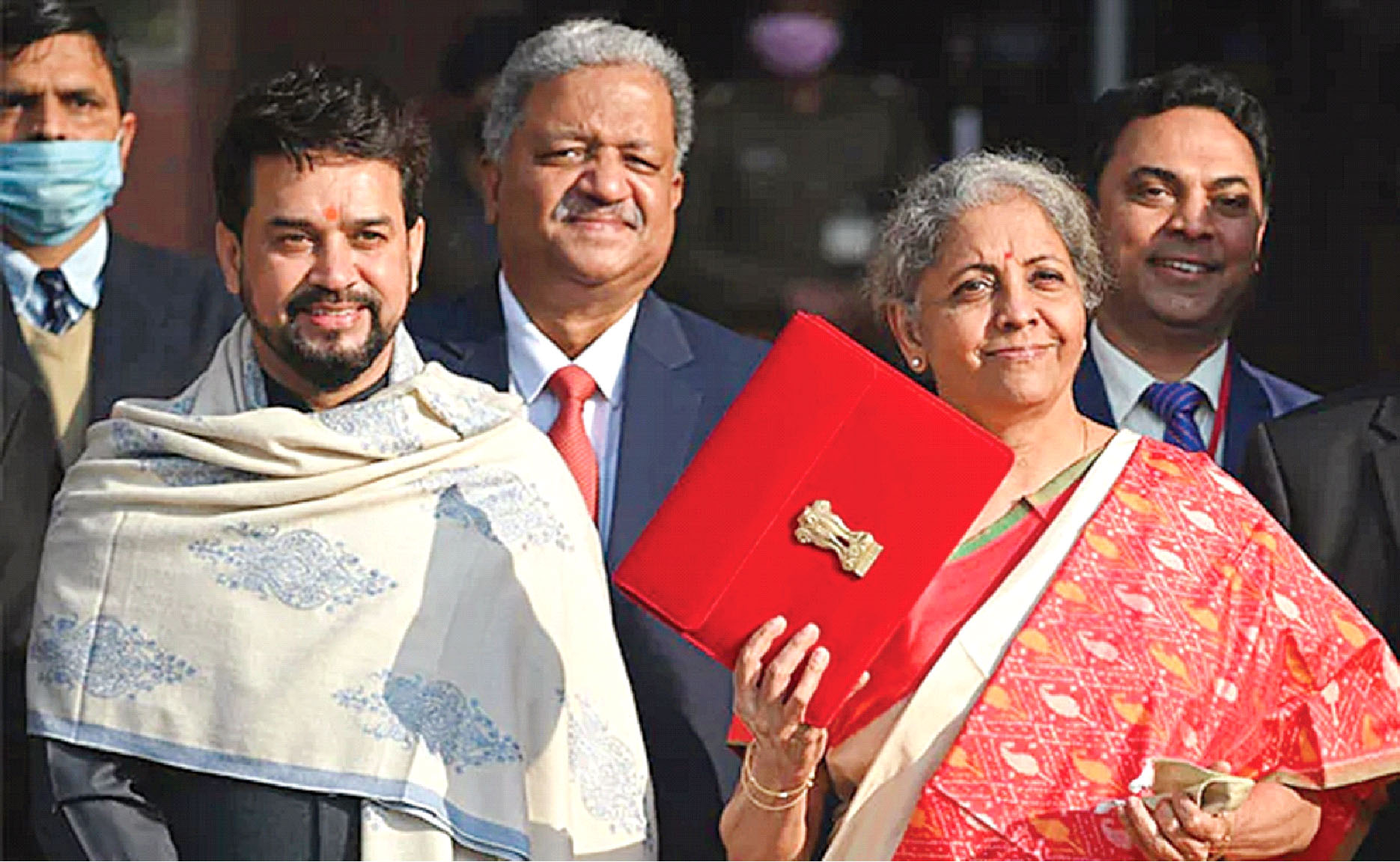
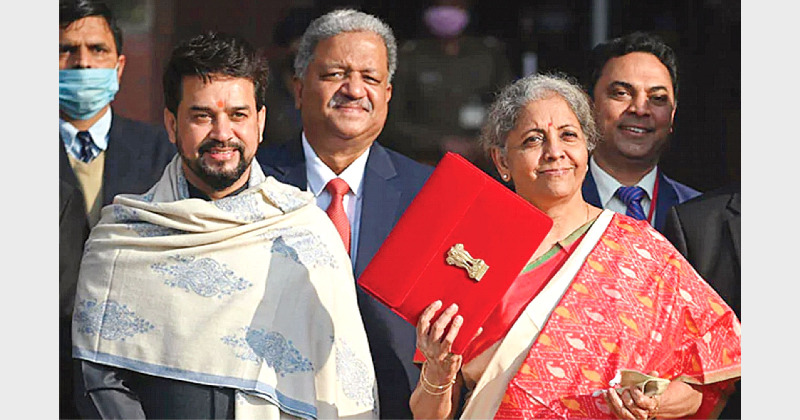
Finance Minister Nirmal Sitraman with Anurag Thakur
The recent Union Budget was regarded as the second phase of liberalisation post-1991. With plans of infrastructure development using foreign investors, divestment, increasing FDI limits, and opening the markets for private, the government has taken another step towards privatisation.
With the ongoing pandemic situation, economic revival is not an easy task. In such conditions, the Finance Minister’s measures can be seen in line with the Keynesian economic principles. During the Great Depression, when all efforts of boosting consumer demand failed, Keynes suggested that the state (government) intervene to stimulate growth in productivity, output, and real wages.
Though the Indian economy has not plummeted into any form of economic depression, the situation warrants an immediate intervention by the government using the fiscal tools to ease the rising burden. In the last year, consumer demand fell drastically due to various reasons arising out of COVID. The middle class is hesitant to spend given the situation, and any additional money provided to them as direct transfers will become savings, which we also call a ‘leakage’. Thus, to increase the aggregate demand, the government needs to do what the private sector is hesitant in doing -Invest. By investing money in the economy, the government pushes the aggregate demand but the investment also becomes a catalyst for the private sector and foreign investors. This thereby increases production in the economy. When the production is increased, there needs to be an equal consumption demand. As observed in the budget, the government did not impose any extra taxes on citizens or the corporates to recover the burden of COVID and/or cover the incremental expenditure that it plans to make. An increase in taxes for either would have decreased the real wages of the consumers. The Union Budget 2021-22 can be seen in this context mentioned above. The government chose to invest heavily and increased total spending by around Rs 4 lakh crores without disturbing the real wages to expand the market. An expansionary fiscal policy is an answer to close out the recessionary gaps that have arisen in the economy due to the falling demand.
A different way of looking at the budget is to understand the intention of the government. On one side, the government has opened the way for FDIs and eased out the situation for the private players in the market, while on the other side, the government has heavily invested in social schemes. From the Aayushman Bharat mission to the PM AtmaNirbharSwasth Bharat Yojana, the government has provided significant relief to the poor and the middle class in the healthcare sector. The government has also decided to launch a portal to collect information on the unorganised labour force to provide them with proper housing, insurance, credit, skill, and health facilities. One Nation One Ration card is another major boost that will benefit the migrant workers.
Similarly, the government has initiated various schemes intending to double the farmer’s income. In-short, the government is not only taking care of the corporates and the foreign investors but is equally investing in eradicating poverty and providing necessary facilities to the poorest of the poor. The government is not focussing on any extreme ends of going either towards the socialist regime or towards the capitalist economy. This is the grey between both extremes, which has long been discussed about, The Third Way.
The Socialist or Communist regimes have globally failed. The countries still working in the regime, although many years indicate the state’s failure to let free their people raise their voice against the suppression. They are a sad commentary on the efficacy of social structure in moulding social minds. The state might own the industries, but the citizens themselves do not own the state. Thus, absolute power to communism is the worst form of authoritarianism. A communist state can never be a classless and democratic society of the free and equal.
Similarly, the capitalist regime followed in western countries based on the materialism concept has almost collapsed entirely. It led to a system where states became an instrument in the hands of the capitalists. The capitalists created machines to counter human beings. The major drawback of the capitalist system is the displacement and subjection of human beings to privation. The Western countries are still figuring out how to strike a balance between Nationalism, Democracy, Socialism, and Equality. Different combinations have been tried, but all have failed. While capitalists think that capital and enterprise are the core of production and deserve a bigger share of profits, the communists believe that labour is the main factor in production. However, both are wrong.
The government has initiated various schemes intending to double the farmer’s income. In-short, the government is not only taking care of corporates and foreign investors. Still, it is equally investing in eradicating poverty and providing basic facilities to the poorest of the poor
Neither communism nor capitalism is important, except for the happiness of the citizens. Any economic system should be such that it provides basic facilities to all. Roti, Kapda, Makaan are the basic human necessities. It is the government’s responsibility to educate the people, provide them with skills, and employ them to serve society. While a man has hands to work, the hands have limited capacity to produce. They need the assistance of capital in the form of machines. To provide such capital, firms need to exist. The world is a creation of these two, and none can exist without the other. Thus, the power need not be centralised with either the state or the capitalists. Hench, the solution lies in decentralisation.
As evident from the budget of 2021-22, the government has decentralised to attain market efficiency. The divestment policy, asset monetisation of assets lying idle with the government, a free hand to the private sector, and attracting foreign investors dilute the government control. But by creating stronger laws to govern the corporates and simplifying the compliance process for them, the government has negotiated a balance. By giving equal importance to the social schemes for a common man, the government in this budget has tried to stay in the grey area, The Third Way!!
(The writer is a PhD Scholar in Economics at University of Hyderabad)