Amid mounting tension on LAC, Bharat sends a clear message to China by thwarting PLA’s incursion bid
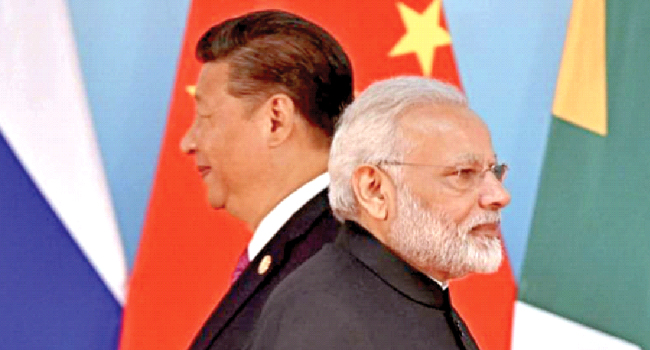
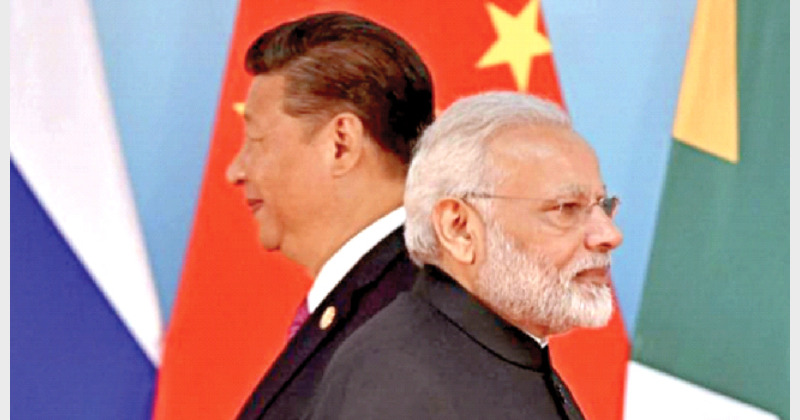
Prime Minister Narendra Modi and Chinese President Xi Jinping.
Bharat has made a clear departure from its weak-kneed foreign policy. ‘New India’ under Prime Minister Narendra Modi has left the stale and sterile dogmas of the Nehruvian era a million miles behind, which were the main stumbling blocks on its way to reclaim its civilizational preeminent position among the comity of nations. As External Affairs Minister S Jaishankar said: “A nation that has the aspiration to become a leading power someday cannot continue with unsettled borders, an un-integrated region and under-exploited opportunities. Above all, it cannot be dogmatic in approaching a visibly changing world order.”
Unlike in the past, Bharat is not ready to take humiliations and attacks on its interests lying down. To protect its territorial integrity, it won’t hesitate to launch military strikes across borders. It would go to any extent to protect its citizens, secure justice for its people through legal means and bring back home those who are stranded in war zones or pandemic-hit countries.
In one of his speeches, National Security Advisor Ajit Doval had argued that Bharat used to always “punch below its weight” in its foreign relations. This anomaly has been rectified by changing the paradigm from ‘defensive’ to ‘offensive defense strategy. It has done away with its ambivalent stance with regard to its relations with Israel. Now, Israel is a strong strategic partner for India and a country to bank upon for supply of critical weaponry.
Now, Bharat effectively leverages its economic power to push its interests and expand its sphere of influence. The way in which Bharat has dealt with Turkey and Malaysia after those countries toed a Pakistani line on Kashmir betrays its determination and no-nonsense approach. Through a series of calibrated moves, Bharat made these countries pay a heavy economic price for their folly.
A few years ago, then Defence Minister A K Antony told Parliament that Bharat deliberately did not construct border infrastructure because the government believed that lack of roads in the border areas was a good defence strategy to prevent Chinese incursions. According to Antony, infrastructure construction also provoked China, triggering chances of conflict. But the Modi government changed the lopsided strategy. It invested crores of rupees in building the infrastructure along the LAC ignoring the Chinese displeasure. Several strategically important projects were executed in no time. Even at the peak of Covid-19 pandemic, Bharat did not call off work on infrastructure. Giving a snub to China, Prime Minister Modi visited Arunachal Pradesh three times since 2014. Bharat is building trans-Arunachal two-lane highway to the Bahlukpong-Tawang railway line apart from projects such as Varak, Arunank, Brahmank and Udayak.
China’s misadventure and India’s resolve
China misread Bharat’s resolve when the former mounted aggression along the LAC and more particularly in Galwan Valley since May 5. The Chinese side transgressed in the areas of Kugrang Nala, Gogra and north bank of Pangong lake on May 17 and 18. According to an expert, by staging aggression, China wanted to send a signal to Bharat. “China sought to retain escalation dominance at all the three levels — tactical, theatre and politico-strategic level,” he states. China thought India would cave in to its psychological moves.
Deception has always been the hallmark of the Chinese foreign policy. But this time around — five decades after the humiliating defeat in 1962 — Bharat has outsmarted China in its own game by mounting a smart pre-emptive operation to claim strategic outposts offering a clear view of troop movements in disputed territory. According to a Defence official, on August 29, around 500 People Liberation Army (PLA) soldiers had tried to cross into Spanggur, a narrow valley near the village of Chushul. Bharat’s security forces resisted the move and a fight ensued. On August 31, Chinese troops again indulged in provocative actions despite our soldiers earlier occupying the heights to thwart the PLA’s aggression.
Meanwhile, according to media reports, the Indian Army has changed its posture from border management to securing the border on the LAC in Ladakh after PLA’s aggression in the Chushul sector followed by additional induction of troops and support elements. A Hindustan Times report said the Indian Army has also matched the PLA’s reinforcement of troops into the sector by deploying additional specialised forces such as the Special Frontier Force (SFF) that was raised to counter China after the 1962 war. SFF soldiers had played a lead role in preempting the Chinese PLA, which tried to grab Indian territory five days ago on the southern bank of Pangong Tso. Indian soldiers since then occupy key heights on the southern bank.
Multi-pronged strategy
In a bid to counter China in South East Asia, Bharat is trying to boost its trade relations with the ASEAN Countries. Presently, India’s trade with ASEAN countries stands at about $82 billion, which is negligible compared to India’s volume of trade with China. Increasing trade with ASEAN countries help development of impoverished North-Eastern states. An industry study suggested that India’s bilateral trade with the ASEAN economies would touch $300 billion by 2025. There are huge trade and investment opportunities for enhancing India-ASEAN cooperation in sectors such as infrastructure and Fintech, culture and tourism, IT/ITES and e-commerce, education and skill development, healthcare and pharmaceuticals and agriculture and food processing, among others, the study said.

Unlike in the past, Bharat is not ready to take humiliations
and attacks on its interests lying down
and attacks on its interests lying down
A pact with Indonesia has given Bharat access to Sabang Port near the strategic chokepoint of the Malacca Strait. About 80% of the crude of China was shipped through this chokepoint. This poses a major disadvantage to China as India can restrict China’s maritime movements
Bharat, through its ‘Act East’ policy, has established strong ties with ASEAN countries which are victims of China’s ‘Salami Slicing’ policy. Belligerent China has maritime disputes with the countries in the entire region. Bharat’s increased interactions with Japan, Australia and the US bid to tighten its grip on China in the Western Pacific Region have brightened the hopes of the ASEAN countries. Traditionally, the US has ensured that a balance of power is maintained in the region. However, China, which has no respect for international maritime laws or multi-lateral agencies, has upset the equations. Bharat’s entry into the South China Sea would change the balance and countries such as Vietnam, Indonesia, the Philippines, Brunei and even Malaysia, are looking up to Bharat for countering growing Chinese expansionism in the region.
Although China has a much bigger navy, in the event of a war, Bharat can cut off its energy supplies. Besides, Bharat has deployed its Navy and aircraft in the strategically important Andaman and Nicobar islands, much to the chagrin of Beijing. A pact with Indonesia has given Bharat access to Sabang Port near the strategic chokepoint of the Malacca Strait. About 80% of the crude of China was shipped through this chokepoint. This poses a major strategic disadvantage to China, as India can restrict China’s maritime movements.
China’s debt diplomacy vs India’s generosity
There is rising resentment against China among smaller countries, especially poor African nations. China has been using its Belt and Road Initiative (BRI) to broaden its geopolitical and economic clout by lending unsustainable loans to least developed and developing countries thereby increasing their dependency on China. In many cases, China has forced debtors to place their strategic assets, such as their resources, mineral deposits, port access rights, and the like, as collaterals. The general complaint is that there is no transparency in these deals. Noting a lack of economic feasibility of some BRI projects, many observers suspect that the initiative is partly motivated by China’s desire to stimulate its own economy, obtain strategic assets, and convert its economic access into political and strategic influence in recipient nations. For instance, Sri Lanka had to hand over Hambantota Port, built with Chinese assistance, and 15,000 acres on lease to the creditors, after it failed to pay back mounting debts.
In contrast, Bharat’s assistance to poor countries is not guided by any such considerations. “For India, the most fundamental principle in development cooperation is respecting our partners. That is why our development cooperation does not come with any conditions. It is not influenced by political or commercial considerations,” said Prime Minister Modi.
Growing support
Even as Bharat was locked in a conflict with China in Ladakh, it was elected to the United Nations Security Council with an overwhelming majority of 184 votes running on a platform of fighting terrorism and promoting the ethos of Vasudhaiva Kutumbakam. Pakistan’s attempt to corner Bharat on the Kashmir issue was rejected by members of the Organization of Islamic Conference.
Banning of Apps
Bharat took a slew of economic measures aimed at hurting China’s economic interests. The Centre said Chinese companies would not be allowed to take part in road projects. Chinese telecom companies have been kept out from 5G trials. On September 2, the government blocked 118 more mobile applications, including the popular PUBG, in the interest of “sovereignty and integrity of India, defence of India, security of state and public order” by invoking Section 69 of the IT Act. The banned apps include Baidu, Baidu Express Edition, Tencent Watchlist, FaceU, WeChat Reading, Ludo All Star, Alipay and Tencent Weiyun, besides PUBG Mobile and PUBG Mobile Lite, according to an official statement. Earlier, the government had banned 59 Chinese apps.
“The Ministry of Electronics and Information Technology, Government of India invoking it’s power under section 69A of the Information Technology Act read with the relevant provisions of the Information Technology (Procedure and Safeguards for Blocking of Access of Information by Public) Rules 2009 and in view of the emergent nature of threats has decided to block 118 mobile apps since in view of information available they are engaged in activities which is prejudicial to sovereignty and integrity of India, defence of India, security of state and public order,” the Ministry of Electronics and Information Technology said in an official release.