Hindutva is a much-maligned and most misunderstood term that has come to haunt the Communists, Left liberals and, of course, the Congress. Time to clear the cloud and shine the light on a phenomenon that is seeking to redefine Mother India and the ethos on which Bharat was originally established
– Namit Saxena & Rahul Chaudhary
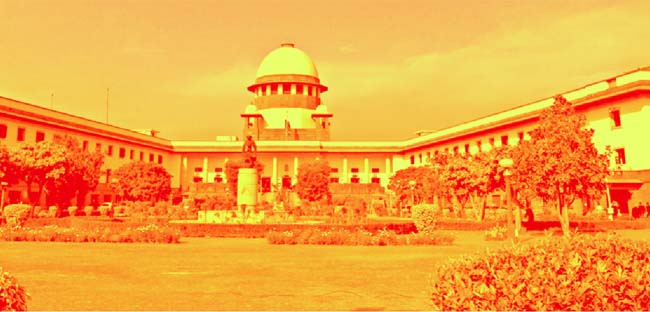
Hindutva remains a hotly debated subject for a considerable time. While every individual is free to have personal opinions on the subject, the concept of Hindutva has been interpreted by the Supreme Court as well. While we discuss its tryst with judiciary and how it has been judicially interpreted, the concept has to be understood with the chronologically developing social and political context surrounding the issue.
The expression ‘Hindutva’ can be traced back to Chandranath Basu’s book titled Hindutva (tattva meaning reality). The expression gained popularity after a pamphlet was published by VD Savarkar written during incarceration originally under the title ‘Essentials Of Hindutva’ in 1923 and later retitled as ‘Hindutva: Who Is a Hindu?’ when reprinted in 1928. India obtained Independence in 1947 and adopted the Constitution fully in 1950 which granted a fundamental freedom to practice religion and barred discrimination on the ground of religion. Indian National Congress (INC) was the leading national political party then and shortly in 1951 Bharatiya Jan Sangh (BJS) was formed by Shyama Prasad Mukherjee. First Lok Sabha elections were conducted in 1952 and INC dominated the political scenario countrywide for many subsequent years.
Interestingly, the symbol of the original Congress Party during elections held between 1952 and 1971 was an image of two bullocks with a plough. INC split later on into INC(R) and INC(O). The symbol of INC(R) during the 1971–1977 period was a cow with a suckling calf. Many cow slaughter prevention/protection laws came around this period. This was also to attract Hindu voters. In between in 1966, Shiv Sena was formed by Bal Thackrey. Both Shiv Sena and BJS affirmed their views with certain differences on Hindutva.
The word ‘secular’ was not a part of the preamble to the Constitution initially. In Nain Sukh Das v State of U.P., [AIR 1953 SC 384] the Supreme Court held that the constitutional mandate against religious discrimination extended to political rights. In 1962, the Supreme Court expressed its views on the secular nature of the Constitution for the first time in Sardar Taheruddin Syedna Saheb v. State of Bombay in the judgment of Ayyangar J. In 1966, a 5- judge bench of the Supreme Court through Chief Justice Gajendra Gadkar in ‘Sastri Yagnapurushadji’ case [1966 SCR (3) 242] gave the first judicial observation on this issue.
It observed that “When we think of the Hindu religion, we find it difficult, if not impossible, to define Hindu religion or even adequately describe it. Unlike other religions in the world, the Hindu religion does not claim any one prophet; it does not worship any one God, it does not subscribe to any one dogma; it does not believe in any one philosophic concept; it does not follow any one set of religious rites or performances; in fact, it does not appear to satisfy the narrow traditional features of any religion or creed….”. It was categorically found that it may broadly be described as a way of life and nothing more.
On 24.04.1973, in Kesavananda Bharati the Supreme Court reiterated that secularism was a part of the basic structure of the Constitution. Enumerating the basic features of the Constitution, Sikri, CJ named “secular character of the Constitution” as one of them. Shelat and Grover, JJ stated that “secular and federal character of the Constitution” were among the main ingredients of the basic structure enumerated therein. Jaganmohan Reddy, J, stated clearly that “Liberty of thought, expression, belief, faith and worship” could not be amended at any cost as they are part of the basic features of the Constitution.
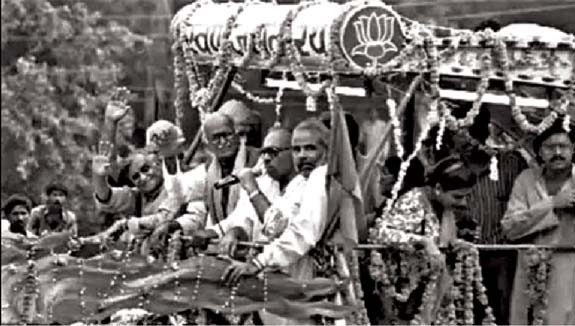
BJP veteran LK Advani leading Ayodhya Ram Rath Yatra in 1990,
current PM Modi seen too (file photo)
After Keshavananda Bharati’s judgment, Indira Gandhi sought to control the judiciary and the three senior judges who wrote the majority opinion (Shelat, Grover and Hegde JJ) were dramatically superseded and Justice AN Ray was made the Chief Justice of India. Indira Gandhi repeated herself after few years when Justice HR Khanna who in his minority dissent opined in the A.D.M Jabalpur case that fundamental rights cannot be suspended during Emergency, was also superseded.
When we think of the Hindu religion, we find it difficult, if not impossible, to define Hindu religion or even adequately describe it. Unlike other religions in the world, the Hindu religion does not claim any one prophet; it does not worship any one God, it does not subscribe to any one dogma
In 1975, the Allahabad High Court nullified the election of Indira Gandhi for indulging in corrupt practices and disqualified her from contesting elections for 6 years. After the Supreme Court granted only a conditional stay, in June 1975, Emergency was imposed upon countrymen by INC-led Indira Gandhi Government. It was during Emergency that the constitution was amended vide the 42nd amendment and the expression ‘secular’ was inserted in the Preamble.
In between, the Supreme Court in R Sridharan’s case [1976 (Sup) SCR 478] held that Hinduism embraces within self so many diverse forms of beliefs, faiths, practices and worships that it is difficult to define term ‘Hindu’ with precision.
Post Emergency (1977), BJS merged with several other parties to form the Janta Party & it defeated the incumbent INC in the 1977 elections. After enjoying 3 years in power, the Janata Party was dissolved in 1980 with the members of the erstwhile BJS convening to form the Bharatiya Janta Party (BJP). The 7th Lok Sabha elections were conducted in January 1980 & Indira Gandhi again became the Prime Minister.
Immediately within 3 days from 16.02.1980, Legislative Assemblies of 9 States – Rajasthan, Andhra Pradesh, Bihar, Punjab, Uttar Pradesh, Madhya Pradesh, Gujarat, Maharashtra and Orissa were dissolved by the then President Neelam Sanjeeva Reddy who acted on the advice of Indira Gandhi. Reddy earlier had served as Minister in Indira Gandhi-led Govt. These State Governments were dismissed in spite of leaders including Bhairon Singh Shekhawat, M.G. Ramachandran, Sharad Pawar, Prakash Singh Badal, Babu Banarasi Das enjoying majority support in their respective Assemblies.
Indira Gandhi was assassinated in 1984 in the aftermath of Operation Blue Star and her son Rajiv Gandhi was engaged as the leader of INC. The BJP & Shiv Sena, continued with the issue of Hindutva and the issue of Ram Janmabhoomi Temple at Ayodhya, became an important issue gradually. This led to seeking and casting of votes in the name of ‘Hindutva’.
In 1985, elections were held to the Karnataka State Legislative Assembly & the Janata Dal won. RK Hegde became the Chief Minister. Due to his resignation in 1988, S.R. Bommai became the Chief Minister. Inter-party political aspirations collided & few members of Janta Dal deflected leading to imposition of President’s Rule in the State. The Governor of the State then was Pendekanti Venkatasubbaiah, who was earlier a minister in both Indira Gandhi and Rajiv Gandhi Govts. The President then was R.Venkataraman who also served earlier as INC’s cabinet minister under Indira & Rajiv Gandhi. Venkatasubbaiah refused to give Bommai an opportunity to test his majority in the Assembly. This was despite the latter presenting him with a copy of the resolution passed by the Janata Dal Legislature Party. Bommai challenged the same which ultimately reached the doors of the Supreme Court. We will shortly come to its conclusion but few parallel developments are extremely interesting and gripping.
It was under the regime of Rajiv Gandhi that television serials such as Ramayan (1987) and Mahabharat (1988) were started on Doordarshan. These were followed by many TV serials depicting Hindu Gods and Goddesses (Jai Hanuman, Shri Krishna, Om Namah Shivay etc). This worked against Rajiv Gandhi and not only created public sentiment towards Hindutva but also led to increase in buying of Hindu scriptures and publishing houses such as Gita Press, Gorakhpur came in front.
No one knew at that time that the national politics was awaiting a massive upturn. In 1987, elections were conducted for Maharashtra legislative assembly. Dr. R.Y. Prabhoo contested & won from Vile Parle Constituency on a Shiv Sena ticket which had sought votes in the name of Hindutva. It was challenged as a corrupt practice and the Bombay High Court declared his election invalid. Bal Thackrey was also found guilty. Appeals were filed before the Supreme Court in 1989.
In 1990, V P Singh became the Prime Minister with the support of BJP. The then BJP president Lal Krishna Advani took out a cross-country rath yatra with support from Shiv Sena and Vishwa Hindu Parishad (VHP) to garner support for the move to build a Ram temple at the site. This was a very important socio political development for the concept of Hindutva.
In the elections held in Feb 1990, BJP emerged as majority party in the Legislative Assemblies of Uttar Pradesh, Madhya Pradesh, Himachal Pradesh & Rajasthan & formed the Govt.
In the 1990 election from Dadar constituency in Greater Bombay, Manohar Joshi, the BJP-Shiv Sena candidate won against his Congress rival, Nitin Bhaurao Patil. Patil alleged that speeches made by Joshi, Bal Thackeray, Pramod Nawalkar and Chhagan Bhujbal violated Section 123 (3) and (3A) of the Representation of People Act—that is of using religion in seeking votes. The main contention of the petitioner was that Shiv Sena and BJP sought votes “in the name of Hindutva, i.e. Hindu religion.” High Court declared the election void and this matter also reached the Supreme Court eventually.
In the same elections, Abhiram Singh, another BJP Candidate won his seat from Santa Cruz constituency against C.D. Commachen. His election was also challenged and the matter also reached doors of Supreme Court eventually.
In Thane Constituency, BJP’s candidate Kapse won against Congress (I)’s candidate Harbansh Singh. Singh challenged the election on ground of corrupt practices. This was on basis of speeches made by Pramod Mahajan, Sadhvi Reetambhara and LK Advani seeking votes in the name of Hindutva. HC nullified the election. This matter also reached the doors of SC eventually.
Congress came to power at centre after elections in 1991, while BJP became the major opposition party. On 06.02.1992, the disputed structure Babri Masjid at Ayodhya was demolished. Within 10 days, the then President Shankar Dayal Sharma, who also had served as Central Minister for INC dismissed the State Governments in Uttar Pradesh, Madhya Pradesh, Himachal Pradesh & Rajasthan.
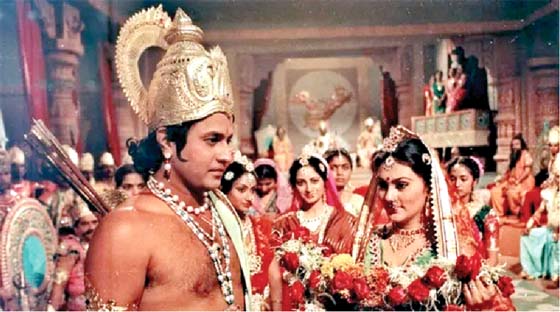
A still from Ramanand Sagar’s iconic Ramayana
It was under the regime of Rajiv Gandhi that television serials such as Ramayan (1987) and Mahabharat (1988) were started on Doordarshan. These were followed by many TV serials depicting Hindu Gods and Goddesses (Jai Hanuman, Shri Krishna, Om Namah Shivay etc). This worked against Rajiv Gandhi and not only created public sentiment towards Hindutva but also led to increase in buying of Hindu
In 1994, the important judgment in the SR Bommai’scase (1994 3 SCC 1) was pronounced. While confirming that secularism is a basic feature of the Constitution, seeking votes in the name of Hindutva also found recognition by SC, (Para 159 in the opinion of Ramaswamy J) by way of the submission of Ram Jethmalani on the issue. No express finding in this issue was however given by the Court.
In the same year, Bharucha, J. in Ismail Faruqui[1994 (6) SCC 360] for himself & Ahmadi, J. observed – “….Hinduism is a tolerant faith. It is that tolerance that has enabled Islam, Christianity, Zoroastrianism, Judaism, Buddhism, Jainism and Sikhism to find shelter and support upon this land.”
In a 3 judge combination speaking through Justice J.S. Verma, the Supreme Court decided appeals by Prabhoo and Bal Thackrey [1996 3 SCC 130, Para 31 onwards] and held that the word “Hindutva” by itself does not invariably mean Hindu religion and it is the context and the manner of its use which is material for deciding the meaning of the word “Hindutva” in a particular text. It cannot be held that in the abstract the mere word “Hindutva” by itself invariably must mean Hindu religion. It was further held that the words `Hinduism’ or `Hindutva’ are not necessarily to be understood & construed narrowly, confined only to the strict Hindu religious practices unrelated to the culture and ethos of the people of India, depicting the way of life of the Indian people unless the context of a speech indicates a contrary meaning or use, in the abstract these terms are indicative more of a way of life of the Indian people and are not confined merely to describe persons practising the Hindu religion as a faith.
Considering the terms ‘Hinduism’ or ‘Hindutva’ per se as depicting hostility, enmity or intolerance towards other religious faiths or professing communalism, proceeds from an improper appreciation and perception of the true meaning of these expressions. Misuse of these expressions to promote communalism cannot alter the true meaning of these terms. The mischief resulting from the misuse of the terms by anyone in his speech has to be checked and not its permissible use.
In Manohar Joshi’s Case [1996 1 SCC 169 decided on 11.12.1995], Justice JS Verma reiterated the same holding that it cannot be held that in the abstract the mere word “Hindutva” by itself invariably must mean Hindu religion. Similar challenges from Aurangabad Constituency [1996 1 SCC 394 decided on 11.12.1995], Nehru Nagar Constituency [1996 1 SCC 384 decided on 11.12.1995] and Kurla Constituency [1996 1 SCC 399 decided on 11.12.1995] were dumped using these judgments. In Kapse’s Case [1996 1 SCC 206 decided on 11.12.1995], Justice JS Verma held that there was no legal evidence to prove corrupt practice that votes were sought in the name of Hindu religion.
These set of judgments, popularly known as the Hindutva judgments hold the filed on the subject. However, few months later in Abhiram Singh’s case [1996 3 SCC 665 decided on 16.04.1996] the issue was referred to a larger bench by a 3 judge bench which did not include Justice JS Verma.
In 2002, in Narayan Singh v Sunderlal Patwal, a question of interpretation of Section 123(3) of the Representation of People’s Act, 1951 was referred to a bench of 7 judges. The issue in Abhiram Singh referred to a bench of 5 judges was heard by a bench led by Justice Lodha in 2013/14 which found that the issue involved interpretation of Section 123(3) of the Representation of People’s Act, 1951 and was tagged with Narayan Singh’s case. The 7 judge bench rendered a decision in question of reference in January 2017 and remanded the matter to regular bench of 5 judges. In February 2020, the same was mentioned to the Chief Justice SA Bobde who agreed to list the matter (which interestingly is a civil appeal from 1992) after the conclusion of the 9 judge bench hearing in Sabarimala hearing.
The matter still awaits final adjudication while the Hindutva judgments hold the field. The tryst of Hindutva with politics and judiciary still continues!
(Namit Saxena is Advocate-on-Record, Supreme Court of India & Rahul Chaudhary is a research scholar, DR RMLNLU, Lucknow)