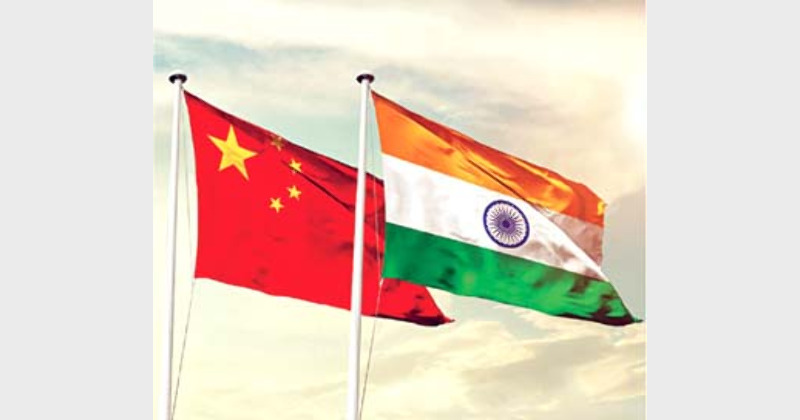
China always remains vary of India’s global aspirations and tries to sabotage it by hook or by crook, by raising border issues
–Dr Ambikesh Kumar Tripathi
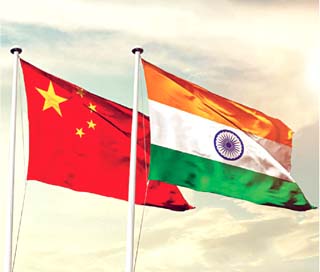
After 1975 in Tulung La sector, Arunachal Pradesh, this is first time death and injuries are reported on Indo-China border at Galwan Valley region in Ladakh. This stand-off between the two world’s largest armies caused a heavy toll on both sides. India lost her twenty braves, and at least forty Chinese troops have died. The political leadership of both countries are accusing each other of incursion in the region, but the satellite images expose China’s claim and reinforce India’s points. Chinese incursions in the border region have been increased since last year, and such incidents have happened almost 650 times from the Chinese side. China knows that direct war with India, like 1962, is rarely possible due to different economic and strategic reasons. However, complying with the ‘Salami slicing’ tactics, China’s expansionist-policy is continued with neighbours including India; Galwan Valley episode is a recent example after the Doklam military stand-off in 2017.
Sino-India Border Dispute: Key Issues
China shares its border with fourteen countries. Apart from India and Bhutan, it has settled its border disputes with other twelve countries. Despite having great ancient trade and traditional relations and today’s shared interests, both countries are engaged in the serious border dispute. In 1949, Communist party came to power in China, and its relationship with India was cordial with Nehru’s promoted slogan Hindi-Chini Bhai-Bhai, but very soon Nehru’s idealism stained. China built a road in Aksai Chin and refused to accept the McMohan line as it was colonial. In October 1962, China unleashed a major attack on India and crossed the McMahon Line. China announced a unilateral ceasefire, after the humiliation of India’s status worldwide. Political and diplomatic relations between India and China, which were stopped for long, began with the then PM Rajiv Gandhi’s China visit in 1988 and both sides agreed on a joint working group on boundary issues. 1993 and 1996 Sino-India agreements, re-spectively ‘to set up a group to define the LAC’ and ‘set up confidence-building measures to avoid border clashes’, wherein a little success made.
China has already built infrastructure and strategic roads on its border adjacent Line of Actual Control (LAC). Now it is easily possible, for China, to transport a large number of military troops and equipment to the border. This provides strategic gains to China. To counter Chinese strategic position, India has started infrastructure development along the side of its border. Since such development brings India in a position to counter, is highly objectionable for China. In the backdrop of the Chinese objection, India is beefing up the infrastructure for better connectivity to the LAC so that troops and other logistics can reach on time. Amidst China’s consistent objection to Indian road construction activities in the LAC region, India has con-structed a strategic tunnel in Uttarakhand that will be a milestone to provide faster mobility of troops and transportation of equipment to the border with China. The Border Roads Organisation (BRO) last year constructed roads in Pangong Tso, and another strategic road was built that links Darbukh-Shyok (DBS) with Daulat Beg Oldie (DBO). BRO is constructing some of the link roads along with LAC in DBS-DBO road. China’s major objection is on these link roads constructions, and Galwan valley episode took place in that backdrop.
Former Defence Minister of India, in UPA Government, AK Antony once admitted before the Indian Parliament in 2013 that for years even after Independence, India didn’t develop infrastructure along the border with China. He stated that China’s infrastructure on the border, along with LAC is much advanced and superior to India. Current Modi-led Government staunchly focused on infrastructure development along the border with China; this is also the reason behind Chinese military infiltration and the stand-off between both sides’ troops on LAC, time and again. With the Galwan Valley episode, scholars believe that the chapter started in 1988 to maintain peace and tranquillity on the border came to an end.
Rise of China: Bound to fall?
China’s speedy rise has always been suspicious. The University of Chicago’s famous international relations theorists John Mearsheimer was sceptical about China’s rise. He wrote a piece on October 2014 in The National Interest magazine, Can China Rise Peacefully?, where he warns, ‘If China continues growing rapidly, the US will once again face a potential peer competitor, and great-power politics will return in full force’. He had predicted years ago, ‘China’s impressive economic growth will lead to intense security competition’ is proving true. Making rapid economic growth, China has become the second-largest economy in the world and now trying to increase its political influence in an international order based on its economic power. The Chinese thirst for world superpower status is gradually making it a suspicious power. China’s dubious position on COVID-19 pandemic has seen worldwide. Some scholars are predicting the tragic fall of China in the coming decade. They have some valid point such as dissent voices from Tibet, Xinxiang and Inner Mongolia, Chinese people’s demand for democracy and other issues. But China is not USSR of 1991.
India’s Position: The Way Ahead
China always remains sceptical of India’s global presence and tries to wreck it by raising border issues. But this time India has ‘taught them a lesson’ and Chinese newspaper Global Times has repeatedly written that ‘we want peace on border’. PM Modi’s statement in the all-party meeting, ‘Chinese troops were neither able to enter the country nor take over any post’, has strategic meanings.
Amidst China’s consistent objection to Indian road construction activities in the LAC region, India has constructed a strategic tunnel in Uttarakhand that will be a milestone to provide faster mobility of troops and transportation of equipment to the border with China
China will never relish India’s closer relationship with the US and other emerging powers. India’s non-alignment policy was in favour of China, but NAM 2.0 has changed the status quo. With multi-alignment policy, India gradually not only came closer to different stakeholders in world power politics but now setting up new standards of power-politics. President Trump’s invitation to include India in G7, QUAD (US-India-Australia-Japan quadrilateral security dialogue), and deepening relationship with Israel are some instances of realistic turn in India’s foreign policy. No doubt China is among India’s largest trade partner and suddenly decoupling of the economy with China would be setback. India has to identify its trusted economic partner and to get close economic relations with them along with creating herself as a manufacturing hub. It’s time bring major realist change in foreign policy as well in economic policy. Only such a change can answer the Dragon’s dream.
(The writer teaches Peace and Conflict Studies at Mahatma Gandhi Central University, Bihar)