Sandeep Mahapatra
The Court needs to be circumspect lest it would be flooded with petitions equating English with Christianity, Urdu with Muslims and so on and so forth
ASATO MA SADGAMAYA
TAMASO MA JYOTIRGA MAYA
MRITYUR MA AMRITDAGAMAYA
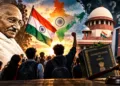
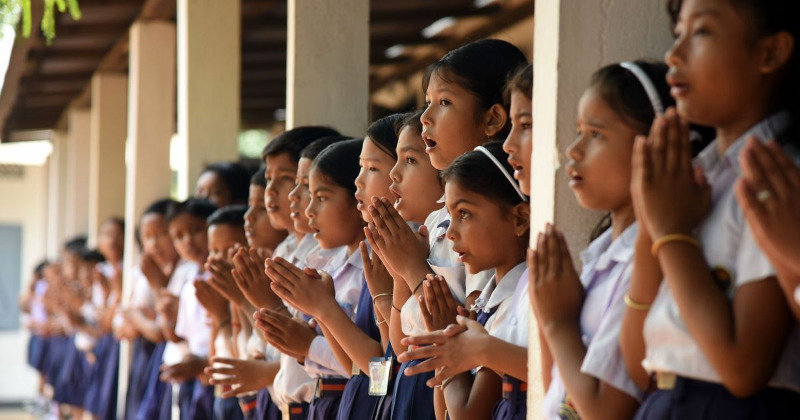
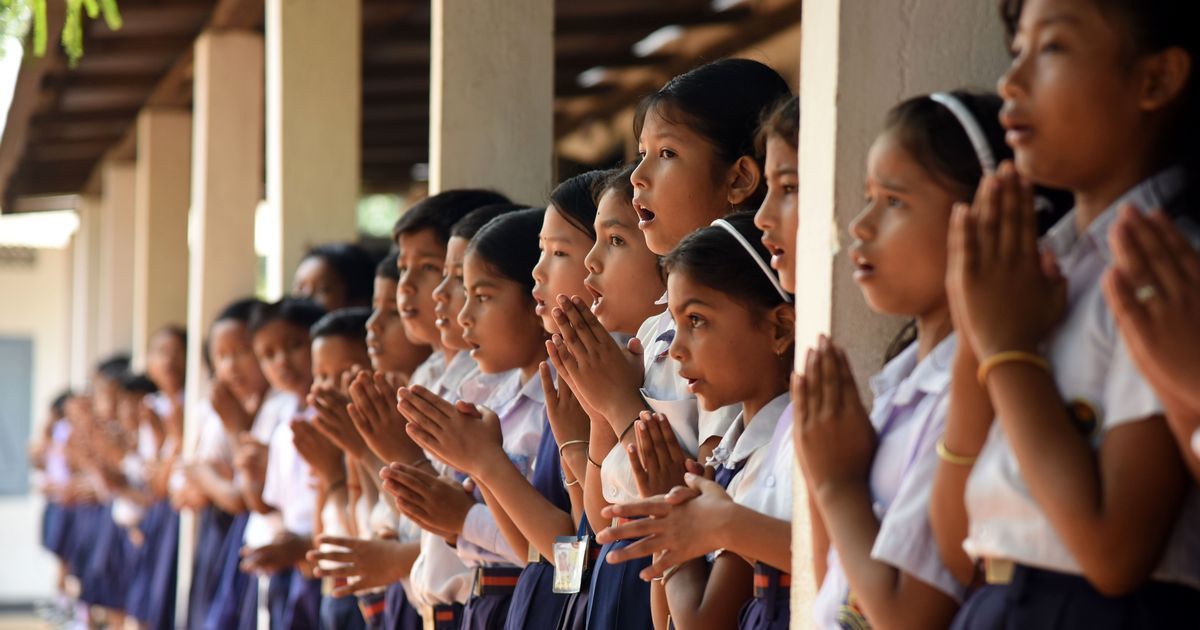
The verses, in just three lines, mentioned above, and recited during the morning assembly of Kendriya Vidyalaya, which translated to English would mean, Take me from “Untruth towards Truth” “From Darkness to Light”, From death towards immortality” has become the subject of a Supreme Court petition leading to reference to a Constitution Bench of five judges to consider if the recitation is in sync with provisions of the Constitution of India. Shorn of legalese the issue to be decided is whether these sentences have a communal character and lead to imparting religious instructions in schools maintained out of the State funds. The related issue, that also needs to be adjudicated by the Supreme Court would be whether and because these recitations are in Sanskrit, do they have ingrained a communal character as the language is being identified with the Hindu religion.
Sanskrit is the oldest classical language of India. Most of the sources for the study of ancient Indian history is written in Sanskrit. Vedas, Puranas, Mahapuranas, and other important works of Scholars like Kalidas, Aryabhatta, etc. have been written in this language. Some of the important Buddhist texts and Jaina texts are also written in Sanskrit. Sanskrit has also contributed to the emergence of other languages of India.
All our institutions and establishments such as armed forces, educational institutions have their insignias in Sanskrit. It is the practice which is being followed from the period when we got independence. All these insignias are the words of inspirations.
The verses recited in KendriyaVidylayas, since 1964 are a timeless saying from across religions, across countries, across civilisations. The student, a seeker who is dwelling herself in knowledge, seeking to pray to the divine to show the path to tread from ignorance to knowledge. That knowledge, in turn, leads you to a greater path all way up to immortality, not of the body, but that of the soul.
The Petition before the Supreme Court essentially says that the Petitioner, whose children were studying in Kendriya Vidyalaya, believes that the recitation of these verses in the morning assembly followed by a prayer affects the scientific temperament of students as they tend to start believing in a higher form without seeking to develop a practical approach towards life. The second point raised is based on Article 28 (3) of the Constitution and a decision of the Supreme Court of 2002 in the case of Aruna Roy Vs. UOI which says that acquainting students with basics of all religion and a comparative study of all religion is not in violation of Article 28 but imparting religious instructions will be. So the moot point is does reciting three sentences in Sanskrit followed by a prayer which only invokes the divinity without any specific reference to any Hindu deity amounts to imparting religious instructions? Also given the fact that Hindu religion has never believed in proselytisation, rather the Hindus have been and still are victims of proselytisation, how are these three sentences in Sanskrit be construed to have the effect of imparting religious instruction. If anything, this recitation talks about universal truth and nothing else, thus, unsurprisingly, the order of the Supreme Court to refer the issue to a Constitution Bench has rightly given rise to a debate.
It is likely and expected that Court’s interference/pronouncements on how to celebrate Holi, Diwali, what should be the height of the DahiHandi, during Janmashtami, how not to pollute water bodies during immersion of Hindu idols, banning of Jalikattu etc. to cite a few examples will form part of such debate. Above all, the proponent of such restrictions in celebrating Hindu festivals will bring in the concept of “Constitutional morality” to justify their position notwithstanding the fact that no less than the present Attorney General of the country and a well-accomplished lawyer at that has cautioned the Supreme Court in invoking this concept to justify its decision in subrogation to social morality.
What however is not surprising, is that the very same proponent of “constitutional morality” maintain a deafening silence when it comes to minority rights and as an extension of the practices of prayers etc. in the minority run schools where it is mandatory for everyone, irrespective of faith, beliefs, agnostic, atheist etc. etc. to recite the prayers invoking Jesus for example. Faced with this, such proponents take umbrage under Article 29 & 30 of the Constitution which empowers the minority to run educational institutions in the manner they like. What however needs to be remembered is that Article 28 (3) provides that the embargo regarding religious instructions also extends to institutions receiving aids from the State. This leads to another interesting question what about minority-run educational institutions which have received for example the land to establish it at a concessional rate? Would this not tantamount to aid? If so whether the embargo to impart religious instruction would not be applicable to them as well?
If it is a case of state funding alone, most of the minority institutions get concessions from governments – be it land or any other. The madrasas, in particular, survive through state largesse including salary funding among many others.
It is also to be kept in perspective that the Supreme Court in another judgment T.M.A Pai Foundation held that in the matters of admissions Article 28 & 29 will be applicable to all institutions receiving aid from the State irrespective of caste, religion language etc. Being so, it would be fair to contend that in the matters of religious instructions as well the minority run educational institutions may fall foul in case, and which is the case most of the time, the students are asked to join in prayers invoking the God of the faith that runs such institution.
So as is apparent the issue of what forms religious instructions cannot be examined on a standalone basis without taking into consideration the entire spectrum or “State-run” and “State aided” institutions lest tomorrow someone would file a petition saying that the Supreme Court is not secular cause the emblem reads “Yado Dharma Statho Jaya”. Someone would file a petition saying LIC is promoting Hinduism as it says YogakshemamVahamyaham….
Sanskrit is an Indian language. Right through the ages, many have said so many things about the language. It is also a mother language to most Indic and Indo-European languages. To have such a timeless quote and mouthing it daily with full-throatedness is an apt way to begin the day for students and to energise oneself. Now when the premier schools all over the world, be it in Germany, England or America are one after another seeing the values of Sanskrit and have started adopting it one after another in their daily curriculum and invocation, it is only in India that we are shying away from our scientific traditional practices.
So as is apparent the issue of what forms religious instructions cannot be examined on a standalone basis without taking into consideration the entire spectrum or “State-run” and “State aided” institutions lest tomorrow someone would file a petition saying that the Supreme Court is not secular cause the emblem reads “Yado Dharma Statho Jaya”. Someone would file a petition saying LIC is promoting Hinduism as it says YogakshemamVahamyaham….
Sanskrit is an Indian language. Right through the ages, many have said so many things about the language. It is also a mother language to most Indic and Indo-European languages. To have such a timeless quote and mouthing it daily with full-throatedness is an apt way to begin the day for students and to energise oneself. Now when the premier schools all over the world, be it in Germany, England or America are one after another seeing the values of Sanskrit and have started adopting it one after another in their daily curriculum and invocation, it is only in India that we are shying away from our scientific traditional practices.
Three innocuous sentences in Sanskrit expressing universal truth can open a Pandora’s Box, nay a box of worms, and hence the Court needs to be circumspect lest it would be flooded with petitions equating English with Christianity, Urdu with Muslims and so on and so forth.
(The writer is an Advocate, Supreme Court of India)