






What went into the making of RSS? What were the thoughts and ideations regarding the establishment of the Sangh in the minds of those young men who gathered around Dr. Hedgewar to work for the Hindu Sangathan and social reconstruction?
– KR Malkani
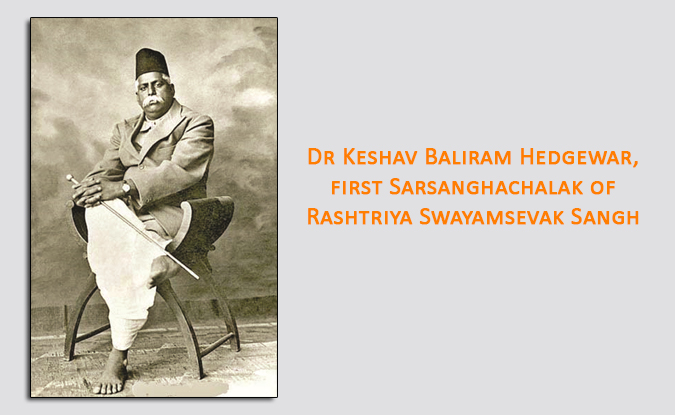
The patriotic young men of Nagpur, led by Dr Hedgewar, decided on a strong patriotic organisation. But they were not sure how to go about organising it. Indeed the RSS of Vijayadashmi 1925 was as different from the RSS of later years as a mango kernel is from a mango tree. The whole thing was slow but organic growth.
To begin with, these young men were told to continue in their respective akhadas (gymnasia); and most of them went to Anna Khote’s Nagpur Vyayamshala. The only special activity was their gathering together at Itwar Darwaza on Sundays at 5.00 am. Their uniform for the occasion was the same as that of Nagpur Congress Session Volunteers in 1920—Khaki shirt, knee-long Khaki shorts and Khaki cap with two buttons. It was only five years later that the black cap came in. Every Thursday they met to hear a senior colleague on the state of the nation. After two years this talk came to be known as ‘bauddhik’, the name it bears to this day. As the numbers increased, Maharashtra Vyayamshala and Pratap Akhada also came up. But it was seen that rivalry among Vyayamshalas could hurt, and so daily shakhas came up to be held the following year. Now the Lathi was also introduced.
But a Shakha was easier started than run. They made a start with Mohite Wada, uneven ground with some walls but no ceiling. The place was believed to be haunted by ghosts. But once the Swayamsevaks came in with their jollity, nobody again heard of ghosts. However, Sardar Mohite had mortgaged the place to a money-lender. And the CID now asked this moneylender to get it vacated. Raja Lakshman Rao Bhonsle was good enough to offer his Hathikhana. But when he died, the Shakha had to be shifted to Tulsi Bagh. However, the police asked his successors to have Tulsi Bagh ploughed for farming!
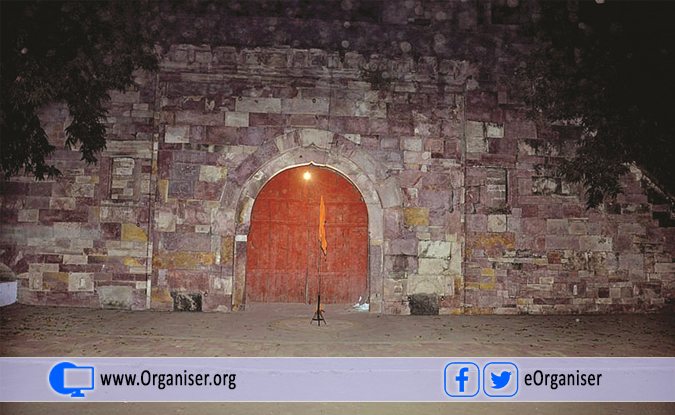
This is the place in Nagpur, called Mohite Wada, where the first Shakha of RSS was started in 1925 on the day of Vijayadashami
It was only in 1934 that Doctorji bought Reshim Bagh as the permanent and central Sanghasthan, in the midst of a jungle on the outskirts of the city. But in 1944 Government tried to acquire even this particular patch of ground
It was only in 1934 that Doctorji bought Reshim Bagh as the permanent and central Sanghasthan, in the midst of a jungle on the outskirts of the city. But in 1944 Government tried to acquire even this particular patch of ground in the name of a cinema hall and stadium—though there was any amount of other land lying all around. It was only the unanimous protest of the leading citizens of Nagpur that saved the ground for RSS.
Later still, Mohite Wada also came to RSS. In 1940-41 the moneylender had to cash a Rs 12,000 hundi within three days or go into bankruptcy. His lawyer approached RSS. Shri Guruji raised the necessary amount for him from friends within hours. In gratitude, the Sahukar now sold Mohite Wada to RSS. It is on this and some adjacent ground that Hedgewar Bhavan, the RSS Headquarter, stands today.
For months, the new organisation was nameless. On April 26, 1926, a meeting was called to decide on a name. Among the names suggested were Jari Patka Mandal (after Shivaji’s ‘golden bordered flag’), Bharat Udharak Mandal, Hindu Sevak Sangh and Rashtriya Swayamsevak Sangh. After some discussion, the last name was adopted.
“Well Dr. Hedgewar, I thought I was the only organiser in India; but there is another, and that is Dr. Hedgewar”
– Mahatma Gandhi in 1934
– Mahatma Gandhi in 1934
Even a small organisation needs some money. Dr Hedgewar would contribute personally and collect from his friends. But all of them felt that this was not a satisfactory arrangement. Somebody suggested organising a lottery. But others ruled that out. Somebody else suggested selling drama tickets. And that was ruled out too. So the idea arose: Why not members themselves contribute? If so, how much each? And to whom should they offer it? After much thought, they all decided to make their offering, each according to his capacity, to the ancient Bhagwa Dhwaja. And so the first Gurudakshina function was held in 1928. The total collection was Rs 84.
There was an RSS prayer too—half in Hindi (taken from the Arya Samaj prayer) and a half in Marathi, reflecting, perhaps, the bilingual composition of CP & Berar. It was replaced by the present Sanskrit prayer only in 1939.
Flag Committee and Doctorji
The Karachi Session of Congress appointed a Flag Committee to finalise the National Flag since a variety of tricolours had been used over the decades. The Committee comprised of Sardar Patel (President), Maulana Azad, Pandit Nehru, Master Tara Singh, Kaka Kelkar, Dr Hardikar and Pattabhi Sitaramayya (Convener). Its unanimous report was that “The National Flag should be a Kesari or Saffron colour, having on it at the left top quarter the Charkha in blue”, since that colour is “non-communal” and “is associated with this ancient country by long tradition” (vide File No 11/27-1927, Important Pamphlets and Schemes 79-F, Nehru Memorial Museum and Library, Teen Murti House, New Delhi.)
Dr. Hedgewar met Congress leaders in Delhi and Bombay to urge acceptance of the Flag Committee Report. But under communal pressures, Congress continued the old flag, only replacing the red strip by an orange one
Dr Hedgewar met Congress leaders in Delhi and Bombay to urge acceptance of this report. But under communal pressures, Congress continued this old flag, only replacing the red strip by an orange one and moving it from bottom to top. Dr Hedgewar regretted that Congress did not understand the roots of Indian Nationalism.
Incidentally, only the ill-informed among Muslims could object to Bhagwa or Kesaria—or think that the Green Flag is ‘Islamic’. For Prophet Mohammed had carried many flags in his battles, including an orange flag, but never a green flag. It was the time when everybody – Congress, Hindu Mahasabha and revolutionaries—wanted RSS to help them. But Dr Hedgewar and his colleagues stuck to their independent course. RSS had a great independent role to play in inspiring and radicalising the youth, and it was not prepared to see its course deflected by alarums and excursions.
The Dussehra 1932 function was attended by some 1200 Swayamsevaks in uniform. Work was also growing satisfactorily in the surrounding districts. It was an eye-sore to the British. And so, on December 15, 1932, the Governor-in-Council of the Central Provinces issued orders prohibiting Government servants from attending RSS Shakhas. Sometime later this order was made applicable to Municipal and District Local Board employees also. A number of DLBs and Municipal Committees protested. And on March 7, 1934, Shri Kolte, MLA, moved a one-rupee cut motion against Demand No 8, in the Assembly on this issue. Speaker after speaker denounced these orders. And apart from Home Minister E Raghavendra Rao and his three English colleagues, NL Roughton, EA MacNee and E Gordon, every single speaker supported the cut-motion. The official side alleged communalism, fascism, politics and what not, but SM Rahman (Berar Municipal Mohammedan Urban) pointed out that no Muslim organisation had raised any objection to the RSS during its seven years of existence.
After two days of debate, the cut-motion was put to the vote, and carried. The Government was defeated. And Government order became a dead letter. The RSS had arrived!
Extracts from The RSS Story, published by Impex India (New Delhi), 1980
(The writer was the longest serving Editor of Organiser)

Comments