In Kashmir valley, the happenings of this year Bakrid were not as usual but specifically planned and executed to send certain signals to the new Governor
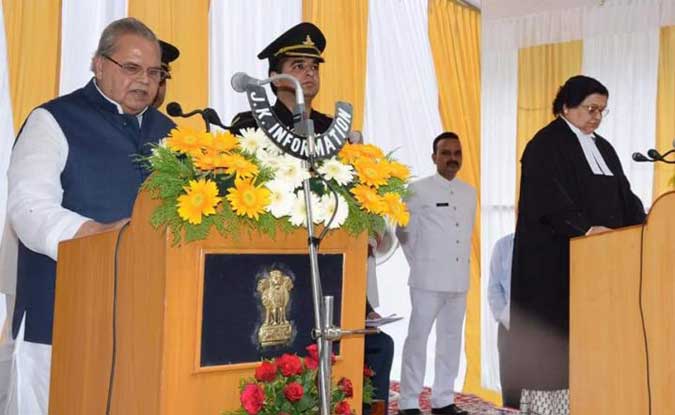
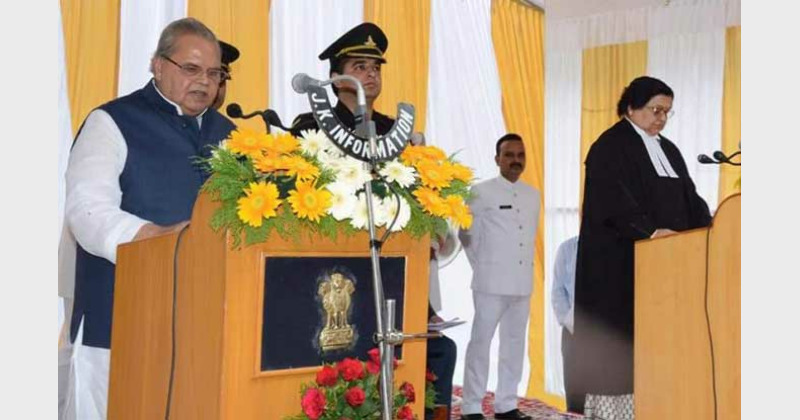
Satya Pal Malik assumes office as 13th Governor of J&K
Kashmir witnessed one of its most violent and bloodiest Bakrid in the recent time; just a day after the announcement was made of the appointment of a new Governor of the State. Was it a co-incidence or a planned effort to send a few signals to the new head of the state, first political figure to be appointed to that post almost after 51 years? Violence after Eid prayers is not unusual in Kashmir but its intensity and audacity this time was different from the past. There are a few deductions from the happenings of this Bakrid which may ultimately emerge as challenges for the new Governor.
Hizbul Mujahidin (HM) has claimed credit for most of the killings. Syed Salahuddin, the head of HM and chairman of United Jihad Council (UJC) continues to live in a haven in POJK under the patronage of Pakistan Army and the ISI. Thus, a clear-cut connection exists between the killings and Pakistan’s hidden hand behind it. Change of regime in Pakistan is not going to make any difference as far as violence in Kashmir is concerned.
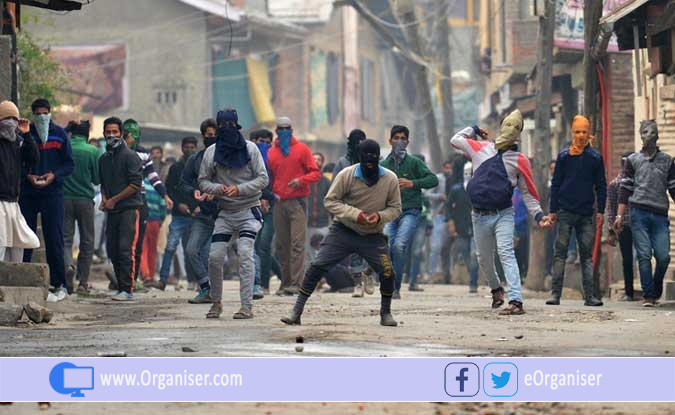
The Bakrid celebration in Jammu and Kashmir was marred by clashes in parts of the valley. Militants killed a Special Police Officer (SPO) in Shopian and a BJP activist in Pulwama
The new Pakistan Premier Imran Khan does not have the mettle and political experience to challenge the ‘K Policy’ of the Military-Mullah-Militant troika. Pakistan has no respect for religion or Islam. Bloodshed in Kashmir on the joyous and pious occasion of Eid-ul-Zua does not perturb the troika in Pakistan but emboldens it since it suits their sinister design of keeping Kashmir on the boil. The troika does not want the Kashmiris to live in peace and enjoy the dividend of development and progress in the rest of the nation. The troika aims to keep Kashmir in a constant state of conflict so that it can tie down the Indian Army in counter infiltration and counterterrorism operations so that it does not pose a major threat on its western borders.
Brutual Killings and IS
Brutal killings of a political worker and a couple of police officers are a serious cause of worry. The jihadi terrorists are motivated by ISIS ideology. Islamic State in Iraq and Syria (ISIS), when on the rise, became notorious for its violent operations and Salafi-jihadist ideology. ISIS may not have footfall in Kashmir, but its ideology has penetrated the other jihadi terrorist groups active in the valley. The ideology justifies the use of violence as a necessity to defend Islam and as an obligation for the true Muslim believer. Islamic State believes in the concept of a “Caliphate”. Democracy and the Nation-State are not compatible with the Salafi-jihadist ideology. So, anyone serving the nation or believing in democracy is enemy of Islam as per this ideology. It is the reason for targeting the members of the police or armed forces and political workers. ISIS is no threat to Bharat, but its ideology is, which is also responsible for the spread of radicalisation.
The IS ideology also threatens the Kashmiri society. The culture in Kashmir is a blend of three religions, namely, Hindu, Buddhism and Islam. Kashmiri culture that once was proud of its oneness irrespective of religion is in danger of being overshadowed by Salafi-jihadist ideology that preaches a return to true Sunni Islam and justifies the use of violence and terror to realise political objectives. It is a major challenge the civil society in Kashmir has to accept and unite to fight against it lest Kashmir also becomes another Syria.
Growing Radicalisation
Another fall out of Salafi-jihadist ideology is radicalisation. It is spreading in Kashmir like poison. The violence resulting into stone-throwing on police personnel on duty, display of ISIS flags and Musa Army banners, attack on Army posts and heckling of Dr Farooq Abdullah at Jama Masjid are all manifestations of radicalisation. Zakir Musa is also emerging as a new cult and poster-boy terrorist in Kashmir. His message on the eve of Eid to the terrorists was full of venom and warned of Ghazwa-e-Hind, a threat which re-emerges year after year for reasons not understood. The entire concept of Ghazwa-e-Hind is nothing but a religious fantasy to raise the morale of Sunni Muslim jihadists. Radicalisation promotes a thinking process of transition from true Islam to Islamic State. Zakir Musa is spreading this concept in Kashmir which appears to be attracting the youth towards it.
Was it a signalling exercise intended at the incumbent governor? To me, it appears so. Fiery speeches were made on Article 35A and other anti-national issues before and after the Eid prayers. It aroused the sentiments of the youth who were motivated by paid goons to move out and indulge in a show of force (using pre-dumped stones) against the police personnel deployed there on duty. It goes to the credit of police officers that they did not get provoked and retaliated with non-lethal weapons of crowd dispersal despite grave provocation. The policemen were being provoked to open fire that may lead to an escalation of violence in other parts of the state.
Lack of adequate knowledge about religion or distorted knowledge of religion amongst the youth also leads to radicalisation because “vacuum of knowledge” leaves them ill-equipped to reject extremist ideology. It is the reason that hate-speeches delivered by the Maulvis after Friday prayers or during other religious congregations as well as the venom spread by Maulvis in certain Madrasas act as a catalyst to radicalisation. ISIS has deliberately tailored its propaganda to appeal to those with little religious knowledge. Radical preachers and hard-core Salafi-jihadists, when kept together in the prisons with juvenile stone-pelters, radicalise them beyond redemption. Therefore, to give amnesty to such youth and return them to the mainstream is like playing with fire which has proved unsuccessful time and again because the same youth gets re-cycled into ‘sangbaazi’ (stone-pelting).
In a society that has been engulfed by a state of conflict for the last three decades, paternal absence and exposure to the messages of radical preachers could also lead to radicalisation. “Key-pad jihadists” spreading radical ideology can be another source of radicalisation. In Kashmir, perceived sense of discrimination, false promises by politicians, denial of justice, harassment by security forces and fear of losing their monolithic culture are also driving the youth towards radicalisation. What the new governor can do immediately to counter radicalisation is to have a check on the “maulvis” and other religious preachers. Majority of them are non-locals who spread Salafi-Wahabbi ideologies using the precincts of religious places and madrasas. The local preachers who follow and preach Sufism have been side-lined by them through the power of petrodollars. The Salafi-Wahabi preachers need to be replaced by Sufi preachers and the former ordered to return to their respective native states.
(The author is a Jammu based political commentator, columnist, security and strategic analyst)