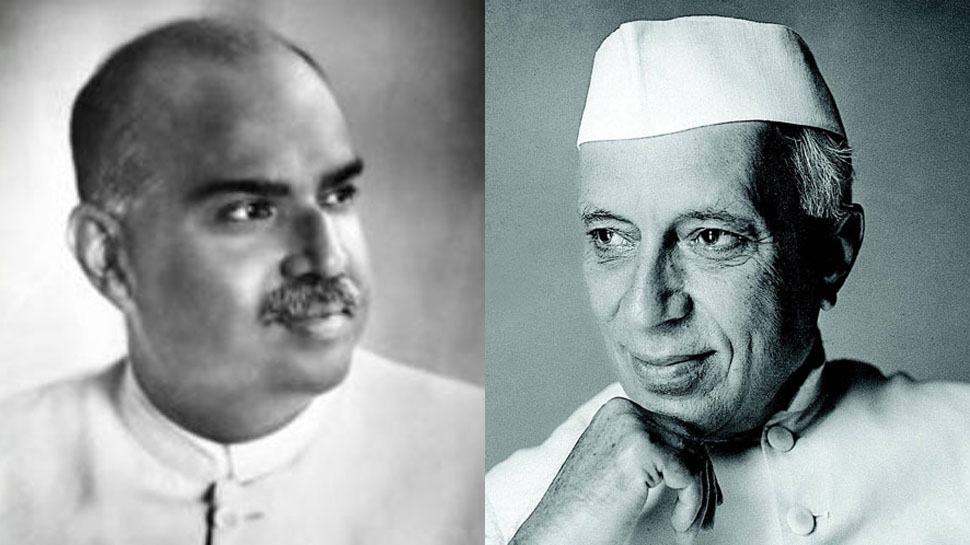
Dr. Syama Prasad Mookerjee formed the Jan Sangh when Congress was the dominant political party. He formed the Jan Sangh as an alternative ideological pole. Today the BJP has replaced the Congress as the key ideological pole in Indian politics. Today, as we pay homage to Dr. Mookerjee, I recall a forgotten chapter where Dr. Mookerjee’s advocacy of ‘Akhand Bharat’ led Pt. Nehru to amend the Constitution restricting Dr. Mookerjee’s free speech.
Free Speech & the Constitution
The Constitution guarantees to all citizens the Right to Freedom of Speech and Expression under Article 19(1)(a). Under Article 19(2), the State can make laws restricting the exercise of this right subject to certain conditions. The conditions on which this right could be restricted were very minimal as drafted by the Constituent Assembly. However, the first amendment to the Constitution in 1951 and the Sixteenth amendment in 1963 imposed further conditions on the Right to Free Speech. Whereas restrictions in the interest of sovereignty and integrity of India, public order or to prevent the incitement of an offence are understandable, the one raises several questions relates to a restriction which can be imposed in the interest of “friendly relations with foreign states”.
This restriction did not exist in the original Constitution as adopted in 1950. This was introduced by the first Amendment to the Constitution in 1951 and approved by the Parliament which as a central assembly was duplicating earlier as a Constituent Assembly. Needless to mention that this was prior to the election of India’s first elected Parliament in 1952.
The circumstances which led to this amendment have been discussed in detail in a book “Republic of Rhetoric – Free Speech and the Constitution of India” authored by Abhinav Chandrachud. The book traces the history of the entire debate on free speech from the Constituent Assembly till the publication of the book in 2017. It is a legal literature which lawyers and lawmakers need to read. After reading the relevant chapter of this book, I went through the entire Parliament debate and the Select Committee recommendations in 1951 which prompted this amendment.
Why This Amendment
The restriction is very broadly worded. It empowers the State to prohibit free speech if it adversely impacts “friendly relations with foreign states”. The State can even make the exercise of speech in this regard as a penal offence. The same would be constitutionally justifiable. The world is consistently changing and so are the global alignments. Erstwhile opponents become allies or vice versa. Relations between foreign States can be based amongst others on historical and cultural factors, geographical proximity, security considerations or even trade relations. There are several other considerations which can impact our relations with foreign States. A debate in any liberal democracy on the policy that the Government of the day follows would be perfectly permissible. Governments can be cautioned or appreciated for the course that they follow. They can even be criticized. In the absence of debate and even criticism, there would be only one opinion expressed which is detrimental to a democracy. Why then was this provision introduced?
The partition of India led to a huge exodus of population from India to Pakistan and vice versa. After the first few months, the tense situation started calming down. But in 1949-50, where on the one hand the raiders had invaded the State of Jammu and Kashmir, on the other hand there were many communal riots in East Pakistan which led to Hindu refugees migrating from East Pakistan into West Bengal.
Prime Minister Pt. Nehru and the Pakistan Prime Minister Liaquat Ali Khan signed an agreement which is popularly known as “Nehru Liaquat Pact” or the “Delhi Pact”. Ostensibly it was aimed at confidence building measure, securing peace so that the minorities in both the countries are protected. East Pakistan had a 30% Hindu population which was rapidly decreasing. There were many in India who were opposed to the very idea of partition. Amongst the leading opponents undoubtedly was Dr. Syama Prasad Mookerjee. He was one of the key advocates of a united India which he referred to as “Akhand Bharat”. Two days before the “Nehru-Liaquat Pact” was to be signed in April, 1950, Dr. Mookerjee, who was Industry Minister in the First Cabinet as a Hindu Mahasabha representative, resigned from the Cabinet in protest and took strong public position against the “Nehru-Liaquat Pact”. He spoke extensively in Parliament and outside opposing the pact and advocating his philosophy in brief of “Akhand Bharat”. Pt. Nehru over-reacted to Dr. Mookerjee’s criticism. He interpreted the very idea of “Akhand Bharat” i.e. united India as an invitation to conflict since the country could not be reunited other than by war. He, therefore, advised Sardar Patel to consider what action would be taken. After consultation with Constitutional experts, Sardar Patel’s opinion was that he could not prevent Dr. Mookerjee from propagating his idea of “Akhand Bharat” under the Constitution and if the Prime Minister wanted him to stop this, the Constitution needed to be amended. Dr. Mookerjee, on the contrary, claimed that Pakistan wanted a war and was already at war with us having captured a part of our legitimate territory of Jammu and Kashmir and, therefore, to suggest that his speeches on “Akhand Bharat” would lead to a war was not acceptable.
The Parliament Proceedings
The Bill to amend the Constitution which, amongst others, contained the restriction relating to “friendly relations with foreign states” was introduced in Parliament. There were some amendments which had been necessitated because of the judgement of the Supreme Court quashing the ban on certain publications. The Bill was referred to the Select Committee of Parliament. Those days Ministers’ could also be a Member of the Select Committee. The Prime Minister himself became a Member of the Select Committee. The Select Committee submitted a report within a week alongwith a note of dissent. The report of the Select Committee was debated in the Lok Sabha on 29th May, 1951.
Several senior members such as H.V. Kamath, Acharya Kripalani, Dr. Mookerjee and Naziruddin Ahmad, amongst others, questioned the need for this amendment. They argued that such a provision does not exist in any Constitution in the world. It was too widely worded and could even prevent a legitimate debate of foreign policy issues. It was argued that the Constitution had been in force for only sixteen months and it may not be prudent to bring a hurried Constitution amendment. But Pt. Nehru was determined to go ahead. His principal response was if you criticize a Head of a State or a foreign State, that country may launch a war against us. This would adversely impact India’s sovereignty. He argued that “we cannot imperil the sovereignty of the whole nation in the name of some fancied freedom which puts an end to all freedoms”. Dr. Mookerjee argued that such widely worded amendment could prevent a legitimate debate on issues pending with Pakistan, not merely on the treatment of minorities or what was happening in Jammu and Kashmir, it would also prevent us from commenting on issues relating to evacuee property etc. The Bill was eventually passed and it became a part of the Indian Constitution.
The Paradox
Was this intolerance against Dr. Mookerjee and his philosophy which triggered this Constitution amendment? The answer is obvious. Panditji and Dr. Mookerjee were ideological opponents. Panditji had once commented that he would crush the Jan Sangh, Dr. Mookerjee had retorted that he would crush the crushing mentality. Their views on Jammu and Kashmir were diametrically opposite. History and subsequent developments have vindicated Dr. Mookerjee’s position on Jammu and Kashmir.
Since this provision was not a part of the original Constitution and has come by way of an amendment it could be put to a challenge. I do seriously believe that it could be vulnerable to a challenge based on the basic structure theory. Unquestionably free speech is a part of basic structure of the Constitution and if an amendment dilutes it through an unreasonable restriction, it will be liable for challenge on the ground of violation of the basic structure.
But the major paradox today is that the essence of this amendment was that a mere speech advocating “Akhand Bharat” or of united India is a threat to the country, it can be an incitement to a war and, therefore, any talk of the same could be prohibited. It could even be made a penal offence. The paradox in our jurisprudential evolution is that we have applied a different yardstick to those who want to dismember India and commit an offence of sedition. This debate recently came into forefront during the “Tukde Tukde” agitation at the Jawaharlal Nehru University. The 1962 judgement of the Supreme Court in Kedarnath Singh’s case was repeatedly cited. The Supreme Court held while disagreeing with an earlier privy council’s decision on Article 124 (A) with regard to promoting dissatisfaction against the Government established by the law was to be followed, the same would be inconsistent with Article 19(2). The court interpreted Article 124(A) of the IPC to mean that utterances would be punishable under section only if it intended to incite violence or had a reasonable tendency to create disorder or disturbance to public order by resorting to violence. A speech per seadvocating disintegration would not be sedition unless the element of violence was apparent.
Where it would stand today?
In the past 70 years, this country has witnessed a change in the situation where Pt. Nehru amended the Constitution so that a demand for “Akhand Bharat” could incite a war and therefore should be prohibited. On the contrary, we all were told that to advocate a breakup of the country without inciting violence is legitimate free speech.