 The lessons of the militant attack on Sunjuwan army camp have been gathering dust. It is time to implement them in all seriousness before Sunjuwan 3 takes place
Brig (Retd) Anil Gupta
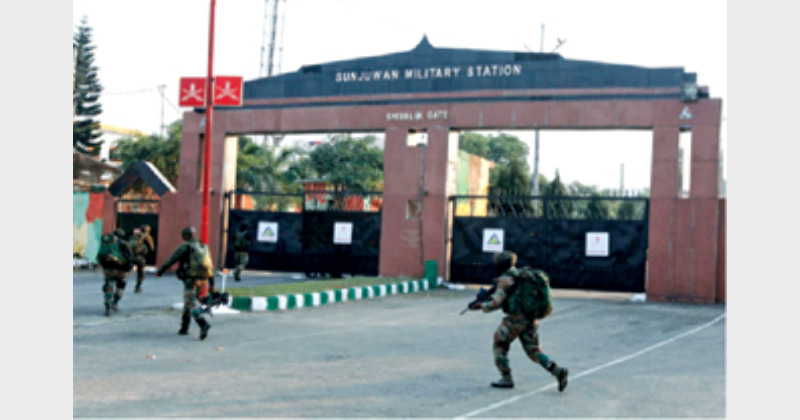
Sunjuwan 1 took place in 2003 during the rule of NDA 1 after the troops returned to barracks on termination of a year-long stand-off in battle positions with Pakistan referred to as “Operation Prakaram.” At that time I happened to be inside the Sunjuwan Military Station fighting the terrorists who had managed to sneak in and take hostage more than a platoon of unarmed men in the residential barracks of jawans after neutralising the sentries at the unit’s Quarter Guard.
Fifteen years after that dastardly incident, what happened now is a near mirror image of what happened then. Lanyard loyalties hushed up many facts that time yet an in-house analysis had revealed many loopholes in the security of the garrison and measures were initiated to plug them. But, from the available inputs on Sunjuwan 2.0, it is obvious that over a period of time most of these measures have either been ignored or a sort of complacency had set in.
The time-tested method of adherence to Standard Operating Procedures (SOPs) is the best way to deal with any crisis situation, and their non-adherence and violation have serious implications. It is well appreciated that routine adherence of SOPs can lead to boredom or complacency but both are dangerous since they lead to slackness and short-cuts. Commanders should inculcate the habit to analyse and correct past mistakes before they paralyse their future.
Sunjuwan Military Station has many peculiarities. It has a large area with heavy concentration of troops and their families. It has allied facilities like an Army School and Kendriya Vidyalaya and other amenities required at a family station. The demography in and around the military station has been a cause of worry. Coupled with this are the settlements of illegal Rohingya and Bangladeshi immigrants in the periphery of the military station. Religious places with high minarets have also sprung around the periphery along with many high rise buildings which look deep inside the station and can observe all activities inside. The area being huge, it is virtually impossible to provide fool-proof security through the system of sentries and guards. The two nallahs flowing from North to South and flowing through the military station add to its vulnerability.
Large Sarkanda (tall grass) growth after the monsoons, if not cut, can easily provide cover to any intruder. Sarkanda cutting is a herculean task and requires both manual and mechanical effort. Notwithstanding all this, the commanders are duty bound to ensure the safety of their troops. There definitely have been serious lapses which should not be condoned.
There is going to be no let up as far as the enemy is concerned. In fact, indicators point to a spurt in such activities in the coming days. The need of the hour is to act post-haste to avoid another Sunjuwan 3.0 and not wait for the report of the newly-ordered security audit. Raising of wall heights is no answer as it would only strengthen the “Fort Mentality”, thus providing a false sense of safety. The area should be well lit for the sentries to observe while ensuring that bright light directly in the eyes of a sentry should not blind his observation. Thorough scrutiny of guests staying in the family quarters should be done. The area in and around the periphery should be kept under surveillance and dominated by Area Domination Patrols to be launched at different timings so that a routine pattern does not set in. The morning and evening “stand to” must be held daily at varying times. Area Domination Patrols should carry out a search of abandoned and unoccupied huts or houses in their area of responsibility. The surveillance equipment authorised in the unit’s war establishment should be deployed and used in the peace stations as well. All sentries must be armed with ammunition and provided Night Vision Devices. The seasonal nullah beds should be covered with field obstacles like Punjabis (pointed bamboo or iron picket) so that these are not used as routes of ingress/egress by the intruders.
There is a dearth of manpower with the units because they have to provide guards in the operational area and for formation duties as well. At present the Indian Army soldier, the one who is at the end point, is on duty practically every night. It is well-nigh impossible for men to keep awake every night and hence an alternative model for the security of military garrisons needs to be evolved. It is proposed that the security of the outer perimeter should be outsourced or given to Defence Security Corps (DSC). To my mind outsourcing is a better alternative. Units should be responsible to secure their own unit lines and family quarters. They should not be burdened with extra duties. While the outer perimeter defence can be based on the existing wall and observation towers, the inner ring (unit lines and family accommodation) defence should be tactically laid out. The sentries should be deployed tactically. Rather than sitting in fixed sentry posts, the sentry’s position should be dynamic and the tactical sentry must use natural cover from fire and visibility. At night he must remain in dark and force the terrorist to look for him. He should avoid setting up a pattern.
There is a need to switch to the smart security of garrisons at the earliest. Multi-layered security using modern technology should complement the physical security. The recommendations of Philip Campose Committee report should be implemented and executed without losing any further time. We have alread lost valuable time of one full year since Pathankot. A central control room with state of the art facilities should become the hub of security in a military station.
Such terror attacks cannot succeed without local support. To address demography of a military station is an internal matter of the Army and by now the issue would have been flagged by the concerned branches at the Army Headquarters. The civil administration and Ministry of Defence need to work in unison to ensure that all buildings within 500 metres of these military stations and other defence installations are demolished without much loss of time. The issue of removing illegal immigrants also needs to be addressed on priority.
Nothing can be more appropriate, to sum up than Winston Churchill’s famous quote, “All men make mistakes, but only wise men learn from their mistakes”.
(The author is a Jammu-based commentator and strategic analyst)