 Due to the ruthless exploitation of Indian resources, India’s share of world income dropped down from 27 per cent in 1700 to 3 per cent in 1950
Achyut Railkar
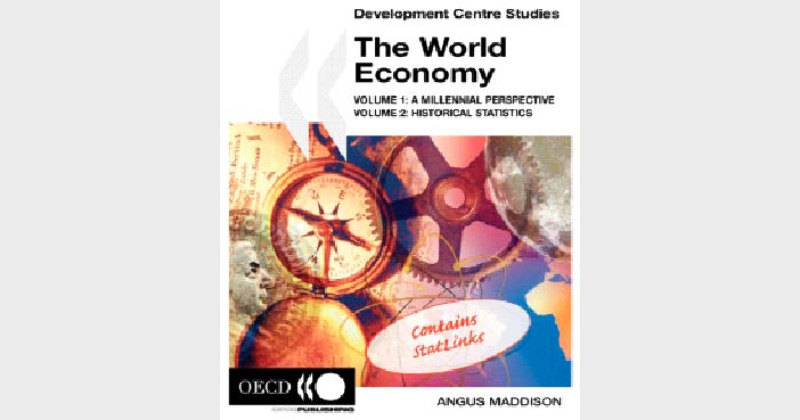
The Organisation for Economic Co-operation and Development (OECD) came into force on September 30, 1961. The original member countries of the OECD are United Kingdom, other 18 European countries and the United States. Subsequently, more countries like Japan, Australia joined the Organisation. The OECD Development Centre was established on October 23, 1962. The centre promotes comparative development analysis and policy dialogue, as described at: www.oecd.org/dev. Angus Maddison an adorned British economist had undertaken the OECD’s task of writing a book titled “The World Economy – A Millennial Perspective”. His work was published in 2001 by OECD. The organisation provided him funds for the mission and furnished all types of equipment and assistance through a team of research scholars for the studies to be done.
Golden Epoch of Bharat
Angus had several objectives in his work, such as to investigate the economic performance of nations over a long term, to identify the forces that explain the success of the rich countries and explore the obstacles that hindered the advances in regions which lagged behind. He discovered the growth and levels of the world population. Since 1000 AD, World population has increased 22 times, per capita GDP 13 times and world GDP nearly 300 times. The beneficiaries have been Western Europe, North America, Australia and Japan. The gap between the richest USA and the poorest Africa is now 20:1. But in 1000 AD, today’s rich countries were poorer than Asian-African countries.
Everybody understands GDP (Y) means the sum of private
consumption (C), investment (I), government spending (G) and net difference of export (X) and import (M). In short Y = C + I + G + (X – M). Angus covered very exhaustive conclusions in his dissertation on the world history of economics for the full period of Christian era 1 to 2000 AD.
Angus narrated in his conclusion that India’s GDP value was world’s 34 per cent and it remained in 1st position in the year 1 AD and maintained it in the years 1000 AD, 1500 AD and 1600 AD. China was in 2nd position but it got the 1st position in 1400 AD. The western countries and USA had GDP less than 2 per cent in the period. Angus endorsed that India’s prosperity and the economy collapsed only because of colonisation and awful exploitation.
Indus Valley civilisation flourished during 3500 – 1800 BC. It depended significantly on agriculture, domesticated animals, sharp tools and weapons made of copper, bronze and tin. It traded with many countries for terracotta pots, gold, silver, coloured gemstones, metals and pearls. Around 600 BC, the Mahajanapadas minted punch marked silver coins. This signified its intensive trade activity and urban development.
The Maurya Empire (321 – 185 BC) united most of the Indian subcontinent. The political unity and military security allowed for a common economic system and enhanced agricultural productivity, trade and commerce. The empire spent on building roads throughout India. In the next 1500 years, India produced its classical civilizations which generated wealth in huge amount. During first 17 centuries AD, India is estimated to have had the largest economy of the ancient and medieval world, controlling one-fourth to one-third of the world’s wealth.
During the Mughal period (1526 – 1858 AD) India experienced unprecedented prosperity. An estimate of India’s pre-colonial economy puts the annual revenue of Emperor Akbar’s in 1600 at 17.5 million pounds sterling. In 1700 AD the exchequer of Emperor Aurangzeb reported annual revenue of more than 100 million pounds.
The Beginning of Decline
The British connection with India started in 1600 with East India Trading Company. By the middle of the eighteenth century, the main exports were textiles and raw silk from India and tea from China. Purchases of Indian products were financed mainly by exports of bullion.
The British Company gradually expanded in India from 1757 onwards. It used huge revenue generated by the provinces under its rule for buying Indian raw materials, spices and goods. Indian Industry’s phase of decline set in. The continuous inflow of bullion that used to come into India on account of foreign trade stopped altogether. The colonial government used the land revenue for waging wars in India and Europe leaving little for the development of India.
In a short span of 80 years (1780-1860) under colonial rule, India changed from being an exporter of processed goods to an exporter of raw materials and a buyer of manufactured goods. More distinctly in 1750, India exported fine cotton and silk to Europe, Asia and Africa. While in 1850 India started exporting raw cotton, opium and indigo. The ruthless exploitation under British colonial rule completely devastated India’s economy. As per British economist Angus Maddison, India’s share of world income dropped from 27 per cent in 1700 (compared to Europe’s share of 23 per cent) to 3 per cent in 1950.
The word RUPAYA is derived from Sanskrit word RUPA. It means a coin of silver and also means shape. Arthashastra by Chanakya, Prime Minister to the first Maurya Emperor Chandragupta (340-290 BC) mentions silver coins as RUPYARUPA. Other types of coins were gold coins as SUVARNARUPA, copper coins as TAMRARUPA and lead coins as SHISARUPA. The exchange rate of Rupee when India got independence on August 15, 1947, was 1 US dollar = 1 Indian Rupee. Gradually the value of rupee further declined because of Indian government’s inability to sustain.
The glorious picture of true Indian history was not at all taught to all of us. On the contrary, it was intentionally shown having a lot of poverty, backwardness in the ancient period. We, the new generation should now question our seniors why the true picture was hidden from us and why India was shown in such a negative light. The glory of Science and technological developments achieved in the past would certainly inspire us to build our nation back to the past.
(The writer is an engineer)