 A single mention of Baluchistan by PM Modi has generated a storm. Organiser presents a series on the unexplored and neglected territory
Santosh Verma
In a major policy shift Prime Minister Narendra Modi in his Independence Day speech first time raised the issue of Baluchistan and human rights violations in the region. In this context, it is worthy to revist the history of Baluchistan.
In today’s Pakistan, the Baluchistan is the largest part in geographical point of view, 3,47,000 square km area of Baluchistan which consists nearly 43 per cent of total area of Pakistan. The province is strategically located in a region of immense geo-political importance. It is surrounded by countries like Afghanistan, Iran, and Arabian Gulf Sheikhdoms which are rich in oil and gas reserves. While on the one hand it is located in the midst of oil and gas reserves, on the other, most important international sea routes pass by the Baluchistan coast. It has the potential to become the centre of international trade and politics in the coming years. Despite these huge deposits of mineral wealth, the area is one of the poorest regions of Pakistan. A vast majority of its population lives in deplorable housing conditions.
Before the Partition of India and Pakistan, Baluchistan consisted of four princely states under the British Raj. These were Kalat, Lasbela, Kharan and Makran. Two of these provinces, Lasbela and Kharan, were fiduciary states placed under Khan of Kalat’s rule by the British, as was Makran which was a district of Kalat. At the eve of independence The Khanate of Kalat, which coveres the substantial area of 53,995 square miles, and has a population of 253,305 was an important princely state headed by Ahamad Yar Khan. The Khanate of Kalat existed from 1666 and faced various ups and downs in due course of time. They suffer by aggressive policies of their neighbours who also have in volatile political conditions. With Iranian expansionism in Baluchistan on the rise, the British decided to adopt the policy of appeasement towards the Iranians to dissuade them from the Russian influence. In 1871, the British agreed to the Iranian proposal for the division of Baluchistan and appointed a Perso-Baloch Boundary Commission with Maj. General Goldsmith as its Chief Commissioner. The ‘Goldsmith Line’ thus arbitrarily divided the cultural, social, and economic unity of Baluch people while excluding the concerns of the people and Government of Baluchistan. Later in 1893, the areas of Outer Seistan and Registan were handed over to Afghanistan by the ‘Durand Line’, further aggravating the Baluch anger.
During British Raj, Baluchistan did not enjoy the status of a province but comprised of four princely states namely: Makran, Kharan, Lasbela and Kalat and some small principalities. The state of Kharan was established in about 1697 CE as a vassal state of Kalat and The State of Las Bela was founded in 1742 by Jam Ali Khan I. In 1876 Sir Robert Sandeman Chief Commissioner of Baluchistan concluded a treaty “Treaty of Mastung” with the Khan of Kalat and brought his territories which included all four princely states under British suzerainty. The treaty between the Khan of Kalat and Robert Sandeman accepted the independence of Kalat as an allied state with British military outposts in the region. Prior to this through Mastung Treaty dated July 13, 1876 all tribal chiefs of Sarawaan, Jhalawan and Lasbela had accepted the suzerainty of Khan of Kalat.
Around 1940 the political conditions of country become more and more complicated gradually. On March 23, 1940 Muslim League under the leadership of Jinnah passed the “Pakistan Resolution” and commited to follow “Two Nation theory” more ardently. After the Shimla Conference of 1945 and Cabinet Mission plan the division of country and formation of Pakistan was quite inevitable due to Muslim League’s venomous policies and actions for achieving their desired goals.
Khan of Kalat had a strong will to remain independent and sovereign. In 1942, Khan wrote to the Cripps Mission and forwarded the case of an independent Khanate of Baluchistan. And after Cabinet Mission plan he appointed Muhammad Ali Jinnah as his advisor for tackling legal hurdles to fulfill his desire to be independent which turned into greatest blunder by Khan in his lifetime. He also sought support of Chamber of Princes and the Prime Minister of Kalat, Muhamed Aslam, went to meet the Nawab of Bhopal, the Chancellor of the Chamber of Princes, in December 1946 to discuss the future status of Kalat state. Meanwhile in the partition plan of June 3, 1947, discussing the future of Kalat, Lord Mountbatten said that he would meet the representatives of the other Princely states and suggest to them that they should adhere to one or the other of the Dominions as the Union of India had reduced its demand for adherence to the states only to the subjects of Defence, Communications and Foreign Affairs.
And at this point Jinnah came again and he argued that paramountcy would lapse with the transfer of power, and states would become independent de jure, but de facto very few were likely to benefit from it. He said that adherence to a Dominion was the only way of maintaining some form of relationship between the Crown and the states. He advised Kalat that although it had liberty of choice, it should associate with Pakistan on some terms. The Prime Minister of Kalat, Aslam Khan responded that the Khan of Kalat wanted to come to an amicable settlement with Pakistan, which would be of mutual benefit. On June 17, 1947 Jinnah announced that with the British departure all Indian states would become independent and free to decide their future course of action.
A series of meetings between the Viceroy, as the Crown’s Representative, Jinnah and the Khan of Kalat followed, which resulted in a communiqué on August 11, 1947. The communiqué stated that:
The Government of Pakistan recognizes Kalat as an independent sovereign state in treaty relations with the British Government with a status different from that of Indian states. Legal opinion will be sought as to whether or not agreements of leases will be inherited by Pakistan Government. Meanwhile, a Standstill Agreement has been made between Pakistan and Kalat. Discussions will take place between Pakistan and Kalat at Karachi at an early date with a view to reaching decisions on Defence, External Affairs and Communications. But by October 1947, Muhammad Ali Jinnah had a change of heart on the recognition of Kalat as an “Independent and a Sovereign State”, and wanted the Khan to sign the same form of instrument of accession as the other states, which had joined Pakistan. The Khan was unwilling to abandon the nominally achieved independent status but ready to concede on Defence, Foreign Affairs and Communications. By February 1948, the discussions between Kalat and the Government of Pakistan were coming to a head. Jinnah wrote to the Khan of Kalat to join Pakistan without further delay. In March 1948 Kharan which was headed by Nawab Habibullah Khan Baluch and Las Bela headed by Ghulam Qadir Khan the regions which were claimed by Kalat acceded to Pakistan while Makran a district of Kalat wanted to do the same. On March 17, 1948 the Pakistan Foreign Ministry sent a telegram to London announcing that Kharan, Las Bela and Mekran had applied for accession to Pakistan and their accession had been accepted. After the accession of these regions into Pakistan, Kalat was reduced to more than half of its claimed land without having any access to sea. This is an act of great betrayal. By the Treaty of Mastung, Kharan and Lasbela are recognized as subordinate principalities under Khan of Kalat and how could they sign on instrument of accession separately?
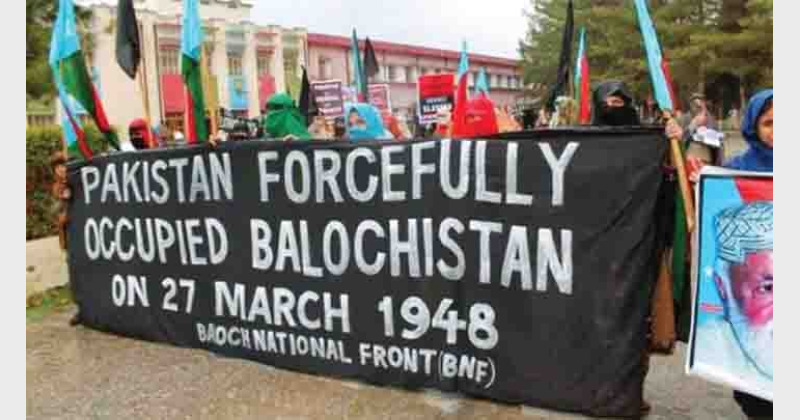
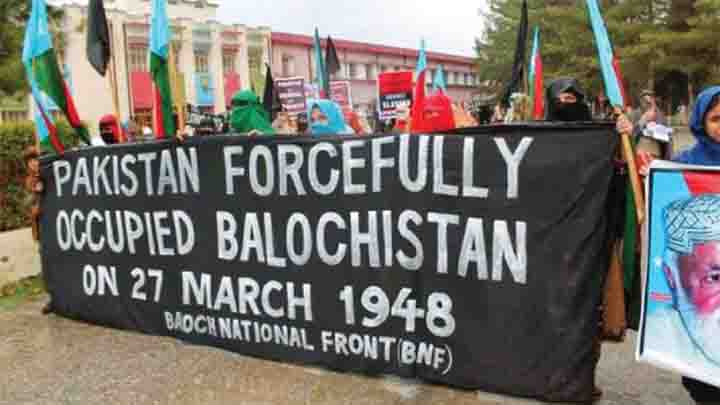
And at last after a diplomatic fumble made by Indian leadership Pakistan gained the most desired impetus for accession of Kalat. On March 27, All India Radio broadcasted a report of a press conference by VP Menon, the secretary in the Ministry of States: “Menon revealed that the Khan of Kalat was pressing India to accept Kalat’s accession, but added that India would have nothing to do with it.”
On the same night Lt. Colonel Gulzar of the 7th Baluch Regiment under GOC Major General Mohammad Akbar Khan invaded the Khanate of Kalat. Khan of Kalat was brought to Karachi and forced to sign on the instrument of accession. This incident was reported in “On the Shadows of Afghanistan” a book by Selig Harrison. The Khan of Kalat signed the accession papers on March 28, 1948. Mr. Jinnah signed them on March 31, 1948.The Khan was then detained, his cabinet was dissolved, a large number of Baluch “dissidents” were arrested and the army assumed full control of the province.
(The writer is a Researcher on Pakistan related issues)