Cover Story : Give them the Voice
July 9, 2026
  • Read Ecopy
  • Circulation
  • Advertise
  • Careers
  • About Us
  • Contact Us
Android AppiPhone AppArattai
Organiser
  • ‌
  • Bharat
    • Assam
    • Bihar
    • Chhattisgarh
    • Jharkhand
    • Maharashtra
    • View All States
  • World
    • Asia
    • Europe
    • North America
    • South America
    • Africa
    • Australia
  • Editorial
  • International
  • Opinion
  • RSS @ 100
  • More
    • Op Sindoor
    • Analysis
    • Sports
    • Defence
    • Politics
    • Business
    • Economy
    • Culture
    • Special Report
    • Sci & Tech
    • Entertainment
    • G20
    • Azadi Ka Amrit Mahotsav
    • Vocal4Local
    • Web Stories
    • Education
    • Employment
    • Books
    • Interviews
    • Travel
    • Law
    • Health
    • Obituary
  • Subscribe
    • Subscribe Print Edition
    • Subscribe Ecopy
    • Read Ecopy
  • ‌
  • Bharat
    • Assam
    • Bihar
    • Chhattisgarh
    • Jharkhand
    • Maharashtra
    • View All States
  • World
    • Asia
    • Europe
    • North America
    • South America
    • Africa
    • Australia
  • Editorial
  • International
  • Opinion
  • RSS @ 100
  • More
    • Op Sindoor
    • Analysis
    • Sports
    • Defence
    • Politics
    • Business
    • Economy
    • Culture
    • Special Report
    • Sci & Tech
    • Entertainment
    • G20
    • Azadi Ka Amrit Mahotsav
    • Vocal4Local
    • Web Stories
    • Education
    • Employment
    • Books
    • Interviews
    • Travel
    • Law
    • Health
    • Obituary
  • Subscribe
    • Subscribe Print Edition
    • Subscribe Ecopy
    • Read Ecopy
Organiser
  • Home
  • Bharat
  • World
  • Operation Sindoor
  • Editorial
  • Analysis
  • Opinion
  • Culture
  • Defence
  • International Edition
  • RSS @ 100
  • Magazine
  • Read Ecopy
Home Bharat

Cover Story : Give them the Voice

Cover Story : Give them the Voice

Archive ManagerArchive Manager
Jan 25, 2016, 01:27 pm IST
in Bharat
Follow on Google News
FacebookTwitterWhatsAppTelegramEmail

If we really want to address the Maoist problem of Central Bharat then we have to differentiate between a real Maoist and a Maoist supporter.
Most of the times, we consider a person roaming in jungle in uniform with a gun in his hand a Naxal. But the real Naxal does not roam around in uniform and rarely can be seen with a gun. Naxal is the one who believes in Maoist thinking of changing the system through violent means. Like Gandhism, Capitalism, socialism, this is also an ideology with corresponding strengths and weaknesses.
The people who believe in Maoist ideology are found more in urban areas, while the problem of Naxalism is boiling in the Vanvasi areas of Central Bharat. Why did this happen? Whenever there is an attack by a Naxal mob, media report that hundreds of Naxals attacked so and so place, while the reality is that in the mob only couple of people are real Naxals, rest of them are Naxal supporters.
Then the question arises why a mob of Naxal supporters goes behind these couple of Naxals, that also with a gun. The solution to this violent problem lies in getting answer to this pertinent question. Most of these Naxal supporters are Vanvasis. They are part of the Naxal infantry and most of the time they only take part in the violent actions. But they do not understand Maoism.
In Maoist parlance, most of these Naxals are from the downtrodden sections of the Vanvasi communities. We need to dissect and understand the class differences within the Vanvasis.
In 2005, when the Salwa-Judum  (meaning “Peace March” or “Purification Hunt” in Gondi language) experiment was done in Chhattisgarh, whenever I visited any Vanvasi village I certainly asked them question about how many of the villagers have joined Naxals and how many of them are with Salwa-Judum. After getting the answer, I used to analyse their family conditions. Usually, almost cent-percent, the picture was that people with land holding and bit educated anything more than 8th standard, were with the Salwa-Judum, while landless or having a very small land holding and less educated were with the Naxals.  This differentiation itself speaks a lot.
After Independence, we have created a half-educated Vanvasi section. Very few of them can converse in Hindi, English is out of question. Some of them are part of the mainstream; they follow us after getting the benefits of Constitutional provisions. Still, we could not reach to the section, which is more backward, who does not know roads, who cannot speak Hindi. But Naxalites, Christian Missionaries and some traders have got in touch with them.
In June 1980, seven groups of 7-8 naxalites reached the forest of Dandakaranya through the same route; British soldiers reached Bastar in the 19th century. Maoists did not get into the region to propagate their ideology but to hide themselves. As they were well educated, compare to Maoist followers, they assumed that as the Vanvasis do not understand global politics, real revolution cannot take place in this region.
Till 1990, out of 49, only 25 Maoists remained in Dandakaranya and very few people joined them. Most of the Maoist lost their heart in the struggle and went back their homes. After 1990, government started Salwa-Judum kind of campaign and attacked Maoist supporters through upper class Vanvasis.
Now Vanvasis had to choose between the options available and most of the downtrodden Vanvasis decided to join the Naxals. It is necessary to understand that they were pushed towards Naxals and they did not join on their own. Naxalites lived with them, spoke in their language, fought with Patwaris, police and traders for them. Naxalites provided Vanvasis with many rights which Constitution guarantees them and for which they need not have to fight.
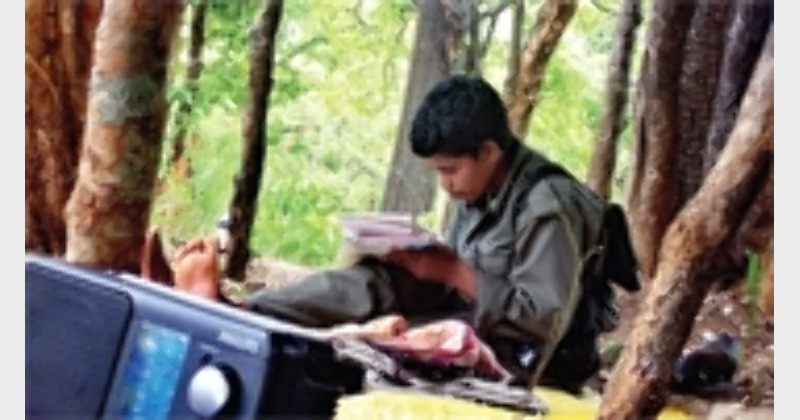
Can we ensure those Constitutional rights to them? Can we communicate them with dignity in their language? It may be possible that we cannot go to those jungles and stay there but communication can be initiated. Technology can help us in this process. Waves of Radio can reach to places where roads and electricity is not reached; still there is no major programme in Gondi language which is common in most of these Vanvasi areas. Christian Missionaries on the other hand tactfully use short-waves to propagate Christianity. This communication should be with dignity and equal treatment. Mere broadcasting programmes in Gondi or Kuduk from Delhi or Raipur would not suffice. One way of communication will not help much.
As our politics is being democratised, media also should become more democratic. Equal participation of all should be ensured in this field. Mobile and internet can be useful instruments in this process. Now mobile is reaching the interiors of Vanvasi areas. We need to think about starting a broadcasting cooperative, a kind of community radio.
Through this open radio, people from far-flung villages also can convey their messages, problems in their language, they can sing their songs, and they can tell their problems. After translation, our government officials can address their issues as per the provisions. Besides communication, we need to ensure basic amnesties related to education and health in the remotest of villages. This is the way to eradicate this problem.
Shubhranshu Chaudhary  (The writer is a journalist &
 founder of CG Net Swara)
ShareTweetSendShareSend
✮ Subscribe Organiser YouTube Channel. ✮
✮ Join Organiser's WhatsApp channel for Nationalist views beyond the news. ✮
Previous News

Cover Story : Development along with Security

Next News

Cover Story : Learning from Andhra Model

Related News

Dignitaries on the stage on the occasion of 90 years of Rashtra Sevika Samiti and celebration of birth anniversary of its founder Lakshmibai Kelkar

Lakshmibai Kelkar Birth Anniversary | The need is not to give strength to women but to awaken it: Alka Inamdar

UP transformed from an electricity-deficient state to a model of household electrification and power reforms over the past decade

Ten Years of Power Reforms in UP: How electricity schemes transformed the state’s energy landscape

A representative image

Poshan Tracker: How India’s real-time nutrition monitoring platform is transforming nutrition governance

Melbourne [Australia], Jul 09 (ANI): Prime Minister Narendra Modi and Australian Prime Minister Anthony Albanese exchange a handshake, in Melbourne on Thursday. (@narendramodi X/ANI Photo)

India, Australia launch new era of strategic cooperation with uranium pact

ABVP's National General Secretary Dr Virendra Singh Solanki hoisted the flag at ABVP Lucknow Office on occasion of National Students' Day

ABVP’s 78th Foundation Day: World’s largest student organisation reaffirms its commitment to service & nation-building

T. Satisan speaks. L/R: E.N. Nandakumar, K.G. Venugopal, Adv. K. Ramkumar, Kummanam Rajasekharan and Sunil Vadayar

Keralam: RSS karyakartas in Kochi remember Emergency, honour anti-Emergency struggle veterans

Load More

Latest News

Dignitaries on the stage on the occasion of 90 years of Rashtra Sevika Samiti and celebration of birth anniversary of its founder Lakshmibai Kelkar

Lakshmibai Kelkar Birth Anniversary | The need is not to give strength to women but to awaken it: Alka Inamdar

UP transformed from an electricity-deficient state to a model of household electrification and power reforms over the past decade

Ten Years of Power Reforms in UP: How electricity schemes transformed the state’s energy landscape

A representative image

Poshan Tracker: How India’s real-time nutrition monitoring platform is transforming nutrition governance

Melbourne [Australia], Jul 09 (ANI): Prime Minister Narendra Modi and Australian Prime Minister Anthony Albanese exchange a handshake, in Melbourne on Thursday. (@narendramodi X/ANI Photo)

India, Australia launch new era of strategic cooperation with uranium pact

ABVP's National General Secretary Dr Virendra Singh Solanki hoisted the flag at ABVP Lucknow Office on occasion of National Students' Day

ABVP’s 78th Foundation Day: World’s largest student organisation reaffirms its commitment to service & nation-building

T. Satisan speaks. L/R: E.N. Nandakumar, K.G. Venugopal, Adv. K. Ramkumar, Kummanam Rajasekharan and Sunil Vadayar

Keralam: RSS karyakartas in Kochi remember Emergency, honour anti-Emergency struggle veterans

Hindu Munnani protesting against the temple demolition move

Tamil Nadu: Hindu Munnani protests Rajakaali Amman Temple demolition in Ramanathapuram, alleges TVK is targeting Hindus

A representative image

How India turned a toy import crisis into a 152 Million US dollar trade surplus: Inside the Toy Story

NIA conducted a fresh search at Abdul Salam's Ballari residence, seizing a mobile phone in an ongoing online radicalisation probe

Karnataka: NIA raids suspected terrorist Abdul Salam’s house in Ballari in radicalisation case; Mobile phone seized

A representative image

Higher Education enrolment hits record 4.5 crore in 2023-24; GER reaches 30, shows AISHE Report

Load More
  • Privacy
  • Terms
  • Cookie Policy
  • Refund and Cancellation
  • Delivery and Shipping

© Bharat Prakashan (Delhi) Limited.
Tech-enabled by Ananthapuri Technologies

  • Home
  • Search Organiser
  • Bharat
    • Assam
    • Bihar
    • Chhattisgarh
    • Jharkhand
    • Maharashtra
    • View All States
  • World
    • Asia
    • Africa
    • North America
    • South America
    • Europe
    • Australia
  • Editorial
  • Operation Sindoor
  • Opinion
  • Analysis
  • Defence
  • Culture
  • Sports
  • Business
  • RSS @ 100
  • Entertainment
  • More ..
    • Sci & Tech
    • Vocal4Local
    • Special Report
    • Education
    • Employment
    • Books
    • Interviews
    • Travel
    • Health
    • Politics
    • Law
    • Economy
    • Obituary
  • Subscribe Magazine
  • Read Ecopy
  • Advertise
  • Circulation
  • Careers
  • About Us
  • Contact Us
  • Policies & Terms
    • Privacy Policy
    • Cookie Policy
    • Refund and Cancellation
    • Terms of Use

© Bharat Prakashan (Delhi) Limited.
Tech-enabled by Ananthapuri Technologies