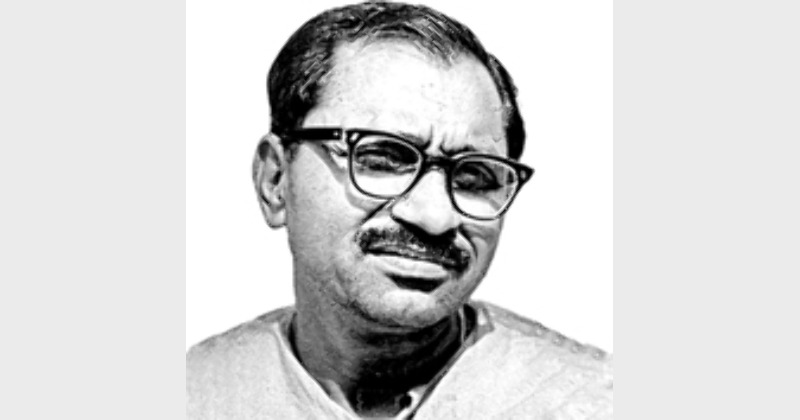
Reproduced here is a highly relevant article that Pundit Deendayal Upadhyaya wrote in Organiser issue dated January 25, 1960.
They country is passing through critical times. There is no sphere of our national life, and no section of the society, which is not faced with problems unsurpassed in magnitude and unthought-of in kind. The first flush of freedom has long since ended. Hopes raised throughout our long struggle for Independence have been belied. There is disillusionment all round. But it has not created a sense of realism, or a determination to take up the challenge. Instead there has grown a feeling of frustration, a sense of cynicism. People have no faith in the leadership or in the policies they pursue, and in the principles they propagate. The problem today is to re-establish this faith. It is more important than the problem of Chinese aggression or of economic reconstruction. Without it we cannot solve either the one or the other. In needs some bold thinking and revolutionary steps.
Another Cover Story : Key to Holistic Well-Being in the Globalised World
Where J.P. & J.L. Go Wrong?
The present all–round degradation is not accidental. It is the culmination of a series of acts and policies followed by the Congress leadership. The people got the greatest shock of their life when the country was Partitioned. The iconoclast succeeded in breaking the idol of Bharatmata, and we simply acquiesced. It demolished the basis of our nationalism, viz intense love for the motherland. Bharat’s Independence was nothing more than transfer of political power. It had no idealistic base to inspire the people—or even those who assumed power to selfless service and greater sacrifice. Not only the nitty and integrity of Bharat was destroyed, but everything associated with our age–old culture and tradition was looked down upon. Instead the Government tried to put before the nation ideals of secularism and socialism. These, however, have remained empty slogans. They have not enthused the people. Instead, they have created a vague tendency resulting not a sacrifice, austerity and service, but in self-aggrandisement, indolence and indulgence; not in greater assimilation and emotional integration, but in communalism. casteism, regionalism and disruption.
The whole thing cannot be readied simply by institutional changes. Shri Jayaprakash Narain and other Sarvodaya leaders have suggested some such changes. There are others who have advocated formation of a national coalition at the Centre to give an appearance of national unity. Community Development schemes have been there and have failed to vitalize the masses. Decentralisation Acts are being passed with a view to give more powers to the people so that it may develop initiative in them. But the aim is not likely to be realised. It is simply decentralising corruption and groupism. The change has to be basic ideological.
Another Cover Story: Relevance of Integral Humanism
Dr Sampurnanand’s Wise Analysis
Dr. Sampurnand in his note to the Congress Ooty Seminar on planning, made a reference to this fact when he wrote: “The other day the Working Committee passed resolution about Tibet. In that resolution it made a reference to certain things which have come down to us from time immemorial and have become part of our consciousness. This reference was heartening. I feel that if we addressed our appeal to the nation on the lines of those things which are fundamental components, on which our whole attitude towards life is based, we would meet with success. People would get the inspiration that they need. They should see before them something that is worth living for, striving for and, if necessary–dying for.” It is ‘Dharma’ in the common language of the people. Unless ‘Dharma’ forms the basis of all our activities, social or individual, it is not possible to sublimate the base nature of man, or to strike a balance between the needs of the society and the aspirations of the individual.
Another Cover Story : Simple Living, High Thinking
Bharatiya Jana Sangh was born out of this realisation that the party in power, or even others in the opposition, had completely neglected this fundamental basis of Bharat’s life and culture. In their attempt to modernise the country, they were trying to devitalise it by changing its age–old values. If they posed as reformers, they were only deluding the people, and themselves, Dayanand and Gandhiji were great reformers, they brooked no social evil, but they never decried Dharma or minimised its importance. On the contrary they appealed in the name of Dharma, and they succeeded.
To Jana Sangh, indivisibility of the country, oneness of its people, and unity of their culture, is fundamental concept of our Rashtra Dharma. It was on this basis that the whole country fought the Britishers unitedly. This unity permeates our whole history, life and literature in spite of outward diversities. It is because of this faith that Jana Sangh opposed the idea of plebiscite in Kashmir, or discrimination between the people there and in the rest of the country in their rights of franchise and justice. In keeping with our traditional outlook of tolerance and respect for all religions we stand for full freedom to every citizen in the matter of worship and faith, but we consider it unnational to differentiate in politics on the basis of anybody’s religious persuasion. We do not recognise minorities based on religion, in the sphere of politics. We would like Christians and Muslims to give up their separatism and be integral parts of the Nation. Their insistence on right of minorities in matters of services, language, ministerial appointments, elections, etc. are a negation of the One-Nation theory. Congress, by trying to champion their misconceived cause, is only obstructing the process of national integration, to suit its party ends.
Another Cover Story : Man Closely Watched in the West
Dharma is the Key
In order that every individual may lead his life in accordance with ‘Swadharma’, it is essential that he should be provided with gainful employment. Full employment, therefore, should be the basis of all economic planning. It means that we cannot import foreign patterns of industrialisation. We should evolve our own technology to suit our factor-availability. Small-Scale Industries, mechanised and power-driven, will suit us most. Almost all consumer goods can be produced by them. Producer goods should be manufactured by large-scale
concerns.
Socialism and capitalism are both foreign concepts. Jana Sangh rejects both. It is only when we take to large–scale enterprises that these ideological questions assume some importance. If, however, our industrial structure is broad–based on a decentralised family, self-employed or on small co–operative pattern, it will not materially affect social relationship, if most of the other industries are left to individual enterprise under state regulation and supervision. The State should of course step into such field as are not likely to be explored by individuals or should not, in the interest of security, be handed over to them. Family has been in Bharat the primary and most important unit of society. If it can be made a unit of production, and not only a unit of consumption, its place can be restored. With well-organised family, it will not be difficult to inculcate other values of Bharatiya culture, the individual merging him self in the family, can, without destroying his individuality, sublimate himself into a social constituent.
I need not go into the details of the Jana Sangh programme. Its opposition to cooperative farming, to planning in a totalitarian manner—without taking into consideration the realities of the situation, the resources available and needs of the nation—are well know. Its opposition to a policy of appeasement towards Pakistan and not towards China, even at the cost of national honour and integrity needs no reiteration. What we need today is to reaffirm faith in the principles that people have kept before them throughout the ages. Nothing but these ideals can catch the imagination of the people. Secondly, the people should develop a faith in the party. Emergence of new parties, by defection or amalgamation, may be hailed by some, but it confuses the masses, especially when the top leaders of these parties can hardly give cogent reasons for their new step. It is not polarisation. Alliances at the top hardly broaden the base. All party fronts or national coalitions will only lead to greater chaos in the political field, will not educate the people, and will thus harm the cause of democracy.
Besides principles, policies and programmes, the personnel of the party also matters to the people. More than the Congress policies and programmes, it is the behaviour of the individual Congressman that has discredited the organisation. The people have, to utter disgust, discovered that the gods they worshipped are tin gods with feet of clay. They have lost faith in political workers. Jana Sangh has to re-establish this faith. Idealism and stead-fast devotion of our workers to their cause can do this miracle. Acts of apostacy though rare and ineffective as far as the organisational strength is concerned, greatly diminish people’s confidence in the organisation. While, therefore, recognising the need of increasing its numerical strength, Jana Sangh emphasises more on qualitative aspect of its cadre. Discipline in the party will lead to discipline in the nation. The problems before the nation may be great and many, the danger imminent and grave, but there is no short cut to tide over them. It may be possible to achieve some electoral victories by political alliances and adjustments. Congress may be replaced in some provinces, or even at the Centre. But that will not lead to better results unless the new comers can place before the people principles and programmes in line with the national ethos and inspire them by their example of service and sacrifice. Jana Sangh intends to combat the present situation in this positive manner, and from the support that it is getting from the people, it should not be surprising if its seemingly long cut may turn out to be the shortest cut possible.
Deendayal Upadhyaya