Intro: India should not look to the developed countries for investments. They are passé. The Greece crisis is tip of the iceberg. More is to follow. We must look inwards rather than taking help from the developed countries.
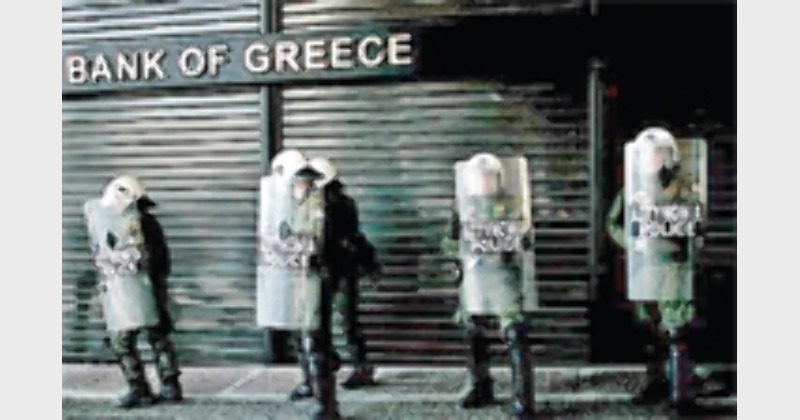
Greece has not paid dues of USD 1.5 billion to the International Monetary Fund (IMF). Another USD 3.5 billion is due to be paid to the European Central Bank on July 20. This too will not to be paid. The Government has closed the banks for one week to prevent depositors from withdrawing their monies and creating a run on the banks leading to the collapse of the country’s banking system. Shops have closed. Food has disappeared from the shelves. The country is into a full blown crisis.
Roots of the crisis lie in the loss of competitiveness of the developed countries vis-à-vis the developing countries. The developed countries were inventing new technologies like the motor car in the twenties, nuclear reactor in the fifties, jet airplanes in the sixties, computers in the eighties and internet in the nineties. They were selling these advanced technologies to developing countries at a high price and paying huge salaries to their workers on the strength of this income. The invention of such new technologies has ebbed in the last decade. The developed countries do not today have many hi-tech products that they can sell to the developing countries. As a result manufacturing activity has mostly migrated to the developing countries which are now making cars, TVs, clothes and almost all other products at cheaper price.
Developed countries like Germany, UK and the US are still doing okay. Germany still has competitive edge in many technologies like electrical switchgear. UK continues to be the global financial hub. The US is borrowing huge amounts from the market to stay alive. The smaller developed countries like Greece, Italy, Ireland and Portugal do not have such special advantages. These countries are sinking into a financial crisis. The crisis had hit Greece first since it was perhaps the weakest among the developed countries just as a disease like diabetes hits the weakest part of the body first.
The IMF and the World Bank have repeatedly provided emergency loans to Greece over the last three years. But the conditions attached to these loans have only made things worse. The IMF required Greece to raise taxes, cut government spending like the homemaker reducing expenditures when the breadwinner loses the job. It was thought that these measures will enable Greece to generate income and repay the loans that had been taken. But result was quite the opposite. Increase in taxes led to Greek goods becoming expensive in the global market. Eighteen per cent of Gross Domestic Product (GDP) of the country comes from tourism. Increase in taxes priced out Greek destinations for global tourists. As a result there has been a threefold increase in unemployment that has reached 26 per cent and the GDP has contracted by 29 per cent since the austerity measures imposed by the IMF took place. A similar crisis took place in Argentina a decade ago but it did not lead to such negative results. Argentina too defaulted on the loans. But, unlike Greece, this was followed by devaluation of their currency. The devaluation made Argentina goods competitive in the global market. Argentina was back in business in a few years.
Greece could not follow that prescription because it is part of the European Monetary Union. To clarify, the European Union has two levels of membership. First level is that of the European Union (EU). This membership provides for free movement of goods and people between countries. The second level of membership is of European Monetary Union (EMU). Members of the EMU have disbanded their own currencies like the French Franc and German Mark and have adopted the Euro as their currency. The UK is member of the EU but not member of the EMU. It maintains its own currency—the Pound. Members of the EMU like Greece do not have the opportunity to devalue their currency because they do not have their own currency.
The only pathway available to Greece for generating income to repay the loans was to raise taxes as advised by the IMF; and reduce price of its goods to compensate for the increase in taxes. But such a reduction in price of goods is not possible because prices have to be cut in the entire supply chain. The vegetable producer, the transporter, and the linen washer—all have to reduce their rates in order for the hotelier to be able to reduce his tariff. Such a coordinated reduction in rates is not possible.
There is a fundamental difference between adjustment by devaluation and adjustment by taxation. Every member of the supply chain is simultaneously effected by a devaluation. Let us say, Greece devalued its currency, the Drachma, by ten per cent. This will result in the entire chain of suppliers to the tourism industry losing ten per cent of their incomes. The vegetable producer, the transporter, and the front desk manager, will all lose ten per cent of their incomes. The price of a room to the tourist will also decline by ten per cent without any adjustment in prices being required. More tourists will come and they will pay more taxes. The budget of the Government will get balanced soon.
An increase in taxes works in the opposite direction. Imposition of more taxes led to the price of a hotel room increasing for the foreign tourists. Greek goods became expensive and the economy collapsed. Hence, policy suggested by the IMF failed. The same logic applies to government spending. The IMF is correct in telling Greece that it should reduce government expenditures. But it is politically very difficult to make a cut in the salaries of government servants. The same reduction can be attained with less pain by devaluation coupled with inflation.
The IMF has pushed Greece to increase taxation rather than quitting the EMU because that protects the interests of the lenders. In case Greece exits the EMU, it may ask that the loans be repaid in the devalued Drachma rather than the Euro. That would lead to a huge loss to the IMF and other lenders. IMF is insisting on increase in taxes and reduction in expenditures, not to lift Greece out of crisis but to recover the monies even. The way forward for Greece is to come out of the EMU, recreate its own currency the Drachma, devalue the Drachma, make its economy competitive and bounce back. Remember that Switzerland is not even a member of the EU, let alone EMU. UK too is not member of the EMU. Yet these countries have vibrant economies.
India should not look to the developed countries for investments. The developed countries are passé. The Greece crisis is tip of an iceberg. More is to follow. We must look inwards rather than taking help from the developed countries.
Dr Bharat Jhunjhunwala ( The writer is former Professor of Economics at IIM Bengaluru)
(July 19, 2015 Page : 28-29)