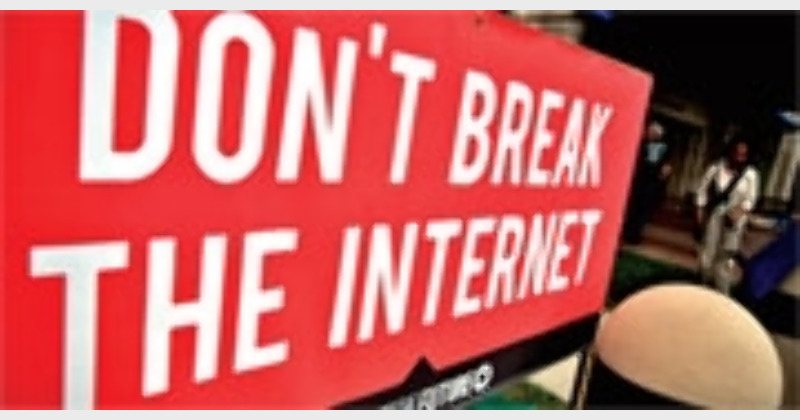
Intro : It is important to ensure internet remains a level playing ground in India; equally important is to see internal security concerns are aptly addressed.
Imagine a pizza – with different toppings that you have especially ordered. Along comes the delivery boy, and tells you that depending on how much you pay, you get to pick the slice with the toppings you want. No, you can’t have the whole pizza though earlier you got it for a price. Now each slice is priced differently.
| Net-Neutrality in other nations : USA After a huge uproar and debate by the activists to save the Internet, US regulator FCC has published its rules that will likely enforce net neutrality from June. It’s pro net neutrality stance has major backing from large technology players such as Google and Amazon. Europe The European Commission has decided to bring the OTT players like WhatsApp and Skype under some kind of regulatory framework for creating a level playing. |
As India wakes up to net neutrality, it’s hard to imagine that the Internet is being priced like the pizza. And soon it could become a reality if some of the telecom companies in the country have their way.
India is the second largest user base of Internet services after China, with over 60,000 users getting added every day with one or the other social media platform. The reach of Internet can be gauged from the fact that in the 2014 Lok Sabha elections, all the parties and especially BJP fought many of its campaigns on the social media platform. So much so that many political pandits attributed the Modi wave to the party’s massive campaign on the social media. In this context the debate on net neutrality has acquired centre stage for netizens.
Why the battle over Net Neutrality?
Earlier this year, a debate started on net neutrality. Two giant telecom companies decided it was unfair to them that some websites and applications were using their infrastructure, and in some cases, offering the same services as these telecom companies for free while using the telecom company’s infrastructure.
So off they went to the Telecom Regulatory Authority of India (TRAI), alleging business losses and the need for the Internet to be regulated like telecom companies. In a letter, the telecom companies argued that they were suffering due to these over-the-top service providers like WhatsApp and Skype. Over-the-Top (OTT) refers to video, television and other services provided over the Internet rather than via a service provider’s own dedicated, managed IPTV network.
In response, on March 27, 2015, telecom regulator TRAI floated a consultation paper of 117-odd pages on Regulatory Framework for OTT services/Internet services and Net Neutrality. The twenty questions TRAI asked the public in the consultation paper pertained to whether the hitherto unregulated over-the-top services, typically apps such as Skype and Facebook that ride on telecom networks, need regulation.
Views have also been sought regarding net neutrality, the principle of data equality that has over the years ensured the Internet remained a level playing ground.
The issue seemed to have touched nerves though. In less than a week’s time, more than 9 lakh emails were sent to TRAI to save the “free” Internet. Worried netizens came up with websites like savetheinternet.in and netneutrality.in, a video by All India Bakchod, a start-up firm, went viral talking about net neutrality. It was much like the USA, where a British comedian John Oliver started a show on net neutrality and started a debate on net neutrality and flooded the The Federal Communications Commission (US regulator) with emails from users demanding a neutral Internet.
Why do ISPs want to carve up the Internet?
The argument put forth by Airtel and Facebook is that they will offer free use of those websites and applications listed with their platform, like the toll free number in case of voice telephony.
As per the email sent to users by Airtel, the company clarifies, “Airtel Zero is a technology platform that connects application providers to their customers for free. The platform allows any content or application provider to enroll on it so that their customers can visit these sites for free. Instead of charging customers we charge the providers who choose to get on to the platform.”
It then says, “Our platform is a technology platform and is open to all application developers and their customers. Our platform only provides a choice of how the data that is consumed is paid for by any of the two – the application provider or their customer.”
How does it affect users?
At present, as an Internet user, you pay for the plan which consists of a set amount of allotted data that can be utilised within the given period of time. This can be used to access any Internet based services which is lawful, be it a Skype video call to relatives abroad, messaging on WhatsApp 24*7 or watching a video on YouTube.
However, if the Airtel Zero or Internet.org format is allowed by TRAI, users will have to pay separately for different apps and web based services. For instance, if Facebook is on one platform and Skype is on the other, then the user will end up paying separately for getting on to both platforms to enjoy uninterrupted services of Facebook as well as Skype, which clearly violates the principle of net neutrality.
More importantly, it takes away the choice to opt for any service or application you want. It also rings the death knell for start-ups and other small companies. India though is still at a nascent stage in its Internet avatar, nearly 85per cent of the population is still waiting to get connected to the Internet. People have however realised the commercial potential of its reach, with many Internet based start-ups hoping to be the next Google, Facebook or Amazon of India.
A few questions
The sentiments are noble no doubt. And it’s wonderful to take a pledge. But who’s holding Airtel accountable to the pledge? In 2012, Google-backed Measurement Lab (M-Lab) reported that Airtel and other ISPs had been throttling BitTorrent traffic in India for years. That is just an example of how differentiation can happen.
As the Savetheinternet.in page points out, it shifts the model of the Internet from a situation where a consumer pays Airtel to access whatever he wants, with the whole Internet being accessible, to where a company pays to allow its app or service to be accessible to Zero users, and access to the rest being limited.
In effect, these platforms change the way the Internet works by reducing consumer choice by fencing them in, making Internet companies’ dependent on telecom operators for discovery and access of their services.
Beyond Net Neutrality
There is a side beyond net neutrality. Even as the Internet provides a level playing field to start-ups and other such businesses, security remains an issue. There have been many instances of cyber crime and frauds in India in the recent past after the technology became prevalent in all spectrums. From application forms of competitive exams to mobile phone recharge, we are dependent on the Internet mostly. Last but not the least, is inability to trace and intercept the terrorist and criminal activities carried out using these OTTs.
Consumer forums are flooded with complaints against Internet frauds due to many websites and web based applications are running on the network without any regulations.
Conversely, there are many websites and applications asking for your personal details as well as your credit/debit card details for financial transactions. A few months ago RBI issued a guideline to all service operators and consumers to be cautious about financial transactions made online. The reality is that most of the web based applications are running without any license or regulations. In case of any fraud or misuse of personal information, the culprits cannot be traced as the government has no records of such OTTs due to lack of any set guidelines and regulations.
While net neutrality cannot be denied, a framework to regulate and protect consumer interests is needed. PM Modi has said that everyone should have access to the internet. TRAI can make a recommendation under TRAI act but the final decision rests with the government.
Priyang Pandey (The writer is a researcher writes on governance related issues)