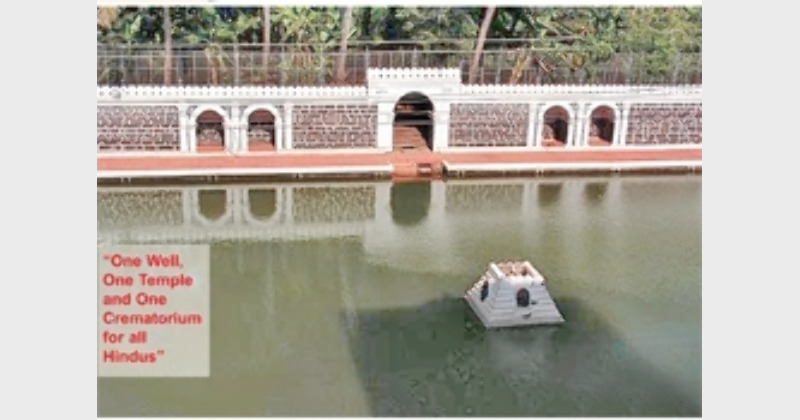
Intro: In this changing political context where ‘new’ politics is at the center stage, call of the RSS “one temple, one well, one crematorium” comes with a strong message of unification at levels of spiritual, social and cultural interactions.
The postcolonial academic set up in India has been ideologically motivated towards the unrestricted criticism of Hinduism. One of the key ingredients of this criticism was based upon the social anomalies and the role of castes in the social set up. The fact that Hindu Dharma has sustained successfully even with such anomalies reflects the power and resonance existing within the religion. The fundamental premise on which I intend to articulate my perspective is; Hinduism has traditionally been endowed with the power of strategic self-correction. The authorship of Ramayana and Mahabharata by Maharishi Valmiki and Ved Vyas ji respectively cannot merely be coincidental. Not to forget the emergence and significance of saints such as Kabir, Ravidas and Dadu Dayal in the religious ecosystem to deal with the existing aberrations. The uniform strand in the socio-religious reform movements in the pre-independence era also indicate towards the tendency of voluntary course correction of Hindu Dharma.
Recently RSS in its annual meeting of representatives of different organisational outfits at Nagpur adopted a historical call, “One Temple, One Well and One Crematorium” for all the Hindus. Traditionally, RSS through its various activities and discourses have successfully attempted to dislodge the conflicts stemming from the social cleavages. RSS has earlier also provided an interface between the scholars and practitioners of untouchability to deliberate on the reasons behind the social evil and to gradually discontinue with such practices. Through this piece, I will attempt to analyse the visionary resolution in the context of constitution and from the perspective of a political activist.
Creating an atmosphere of antagonism is not a pragmatic solution to problems arising out of social stratification. Encouraging dialogues and deliberations within social folds without compromising on the larger interest of Dharma holds the key to infuse synergy between the groups. Coming from a socially charged and politically conscious state of Bihar, I have had my own share of experiences. Witnessing the JP movement as a student of labor and social welfare substantially molded my thinking on caste in our society. Empowerment of the socially disadvantaged groups is a gradual process that is still undergoing. Dividing the process of empowerment, we find that Stage I of empowerment dealt with ‘Sitting’ symbolising that the people from various section started sharing space in the social sphere. The Stage II of empowerment dealt with ‘Meeting’ symbolising that people across the sections were deliberating and legislating in parliament thanks to the visionary zeal of the constitution makers.
The last stage, which I believe will gather a positive momentum after this resolution, is “Witting”. Witting in particular is symbolic of greater integration and assimilation in society. I strongly believe that the future narrative of empowerment of Dalits will be pivoted around the democratization of the witting process. Witting may include high-level deliberation in the spheres of society, polity and economy. Unfortunately, the decision making lies at the top of the citadel, which is still beyond the access of the socially deprived sections. The top pyramid of bureaucracy, judiciary and the industry is yet to witness the participation of Dalits. The helm of affairs is still impervious to the principles of social democracy. Yes, there are some encouraging trends that are emerging with the socio-economic thinking of the present dispensation. Small and Medium Enterprises substantially participates and majorly contributes in the national economy. The OBC’s, SC’s and ST’s have historically dominated SME’s. Creation of MUDRA bank (Micro Unit Development Refinance Agency) promises to support and reinvigorate the entrepreneurial instincts of the socially deprived sections of our society. Ideating economic empowerment through encouraging entrepreneurship with support base of state would definitely gain traction with the last man of the line.
The needle of Indian politics has always moved between token welfarism and genuine empowerment. As the general elections of 2014 emphatically proved, India has vociferously discarded the traditional approaches of welfare mechanism. There is an imminent need to explore newer avenues of empowerment beyond the conventional contours of the Indian Constitution. The rise of several Dalit leaders and most recently Jitan Ram Manjhi in Bihar is also indicative of a similar trend. Manjhi always had the easier path of continuing as the premier of the state but he chose respect and dignity over subversion and indignation. Politics of mere opportunism and symbolism is now a thing of the past for the Dalits. This is truly the moment of resurgence at the level of political awakening. The Manjhi episode has emboldened the strength and forces within the subaltern. Thinking beyond political reservations is also pertinent for empowerment; Dalits should now be encouraged to contest elections from unreserved constituencies. I have flagged a similar idea during the last year’s parliamentary elections for myself of which the party took due cognizance.
In this changing political context where ‘new’ politics is at the center stage, the call of the RSS comes with a strong message of unification at levels of spiritual, social and cultural interactions. “Temple”, “Well” and “Crematorium” are emblematic of the harshest forms of discrimination faced by Dalits in our society throughout history and therefore it is commendable that RSS chose these three images to send the message of unity to Hindu society. Social consciousness at large will be impacted by the Nagpur resolution. It seeks to alter the fundamental aberration that has plagued our society. The resolution will doubtlessly stir the collective conscience. With long-term ramifications in the political and social ecosystem, I am sure of an aspirational upsurge in which Dalits will endeavor to venture beyond the comforts of“status quoism”.
Undoubtedly, every Indian regardless of his or her social origin will welcome the resolution in letter and spirit. Efforts will be made to ensure that the underlying message reaches every nook and corner of our society. A glorious future awaits us where dignified existence will certainly not be an entitlement for select few but for every single member of the society regardless of any social obligations. With this, I would like to rest my submissions with a hope to see the nation ushering in the period of equitable growth and justice.
Dr Sanjay Paswan (The author is a Former Central Minister and Member, National Executive, BJP He can be contacted at [email protected])