Revisiting the Minority Question
July 23, 2026
  • Read Ecopy
  • Circulation
  • Advertise
  • Careers
  • About Us
  • Contact Us
Android AppiPhone AppArattai
Organiser
  • ‌
  • Bharat
    • Assam
    • Bihar
    • Chhattisgarh
    • Jharkhand
    • Maharashtra
    • View All States
  • World
    • Asia
    • Europe
    • North America
    • South America
    • Africa
    • Australia
  • Editorial
  • International
  • Opinion
  • RSS @ 100
  • More
    • Op Sindoor
    • Analysis
    • Sports
    • Defence
    • Politics
    • Business
    • Economy
    • Culture
    • Special Report
    • Sci & Tech
    • Entertainment
    • G20
    • Azadi Ka Amrit Mahotsav
    • Vocal4Local
    • Web Stories
    • Education
    • Employment
    • Books
    • Interviews
    • Travel
    • Law
    • Health
    • Obituary
  • Subscribe
    • Subscribe Print Edition
    • Subscribe Ecopy
    • Read Ecopy
  • ‌
  • Bharat
    • Assam
    • Bihar
    • Chhattisgarh
    • Jharkhand
    • Maharashtra
    • View All States
  • World
    • Asia
    • Europe
    • North America
    • South America
    • Africa
    • Australia
  • Editorial
  • International
  • Opinion
  • RSS @ 100
  • More
    • Op Sindoor
    • Analysis
    • Sports
    • Defence
    • Politics
    • Business
    • Economy
    • Culture
    • Special Report
    • Sci & Tech
    • Entertainment
    • G20
    • Azadi Ka Amrit Mahotsav
    • Vocal4Local
    • Web Stories
    • Education
    • Employment
    • Books
    • Interviews
    • Travel
    • Law
    • Health
    • Obituary
  • Subscribe
    • Subscribe Print Edition
    • Subscribe Ecopy
    • Read Ecopy
Organiser
  • Home
  • Bharat
  • World
  • Operation Sindoor
  • Editorial
  • Analysis
  • Opinion
  • Culture
  • Defence
  • International Edition
  • RSS @ 100
  • Magazine
  • Read Ecopy
Home General

Revisiting the Minority Question

Archive ManagerArchive Manager
Feb 2, 2015, 12:00 am IST
in General
Follow on Google News
FacebookTwitterWhatsAppTelegramEmail


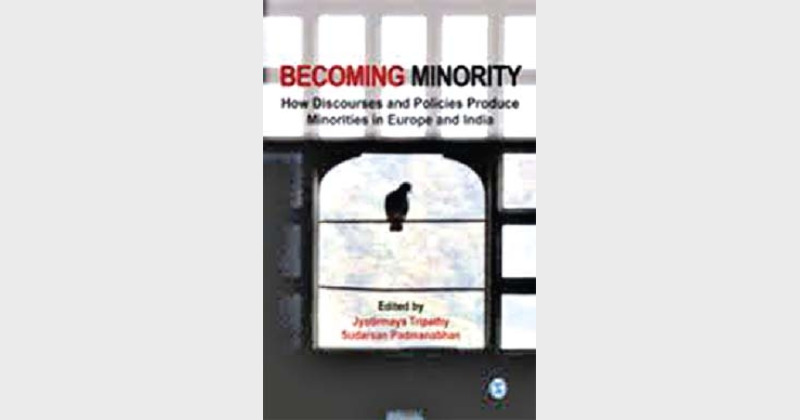
Becoming Minority: How Discourses and  Policies Produce Minorities in Europe and India; Jyotirmaya Tripathy and Sudarsan Padmanaban (Eds.);  Sage Publication;  Rs 795.00; Pp 353

Intro: The book is an effort to provide answers to the vexing issues of minority and minortisation. It addresses a common platform from where both India and Europe can articulate themselves vis-à-vis their minority practices.

In order to answer the complexities of minority and minoritisation, the different contributors to this volume, which has been ably edited by two professors of Social Sciences has drawn upon European and Indian experiences of cultural diversities because these regions are two of the most culturally diverse regions of the world to engage with diversity from within a democratic framework. Some of the Social Science concepts – like minority, ethnicity, inclusion, exclusion and self-determination, among others – are addressed in order to create a common platform from where both India and Europe can articulate themselves vis-à-vis their minority practices.
In the first part of the book, titled ‘The Making of Minority’, the two editors, Tripathi and Padmanabhan, discuss minority politics in post-Cold War Europe and post-Independence India where, during the time of elections, opportunities are created for politicians and intellectuals to accentuate the minority difference for their personal gains. Chapter 2 presents Barabara Franz’s article which focuses on the minorities of Central Europe, emphasising the importance of certain ethnic minorities within the processes that led to the creation of modern nation states. Chapter 3 by Lajwanti Chatani explores the framework of justice on which the rights of minorities rest and argues that justice can be discursive and any attempt to free it would rid it of its empowering credo.
Chapter 4, in the second part of the book, by Abdoulaye Gueye explains the presence of racial minority with emphasis upon blackness in contemporary France and argues that blackness is less an essence than a sociological outcome. Chapter 5 by Ulf Morkenstam analyses Swedish Sami politics during the current century while specifically focusing on how the indigenous Sami people have been constructed in discourse. Chapter 6 outlines how the 1997 devolution for Scotland proved an institutional resource for the Scottish national movement. Chapter 7 maps the rivalry between the Greek Orthodox majority and a Turkish/Muslim minority in Western Thrace on the northeast border of Greece. Chapter 8 argues that social construction of “thick minority identities in Denmark in the 1990s” can be seen in relation to the cultural war of value strategy aimed at domestic political opponents. Chapter 9 shows that migrant hostile policies and dominant discourses in The Netherlands create fertile breeding ground for “ethno-manufacturing”. Chapter 10 says that speeches by Enoch Powell in the late 1960s reflected a “traditional” stance towards immigrants as well as a concern for the demographic change taking place in England from the mid-1950s.
In Chapter 11, Part 3, B.N. Mohapatra analyses the historical contacts through which discourses on minorities evolved in India. Chapter 12 by Mohammed Mehdi discusses the concept of hurt religious feelings and the corresponding politics of outrage in relation to what it means to be Muslim in the Indian context. Chapter 13 by Malavika Menon complains that members drafting the Indian Constitution gave Indian minorities certain rights but stopped short of addressing the crucial question as to who a minority is. Chapter 14 by Shireen Mirza links urban space and Waqf properties to describe the creation of a segregated Shia Muslim quadrant in Hyderabad’s old city. Chapter 15 by Anjana Raghavan deals with the ideological construction and production of minor-ness, both as a category and an identity marker vis-à-vis the mythologised and origin narratives of Tamil identity.
The book is reader-specific and meant essentially for policy-makers and research scholars in social sciences.
Manju Gupta (The reviewer is former Editor of NBT)

ShareTweetSendShareSend
✮ Subscribe Organiser YouTube Channel. ✮
✮ Join Organiser's WhatsApp channel for Nationalist views beyond the news. ✮
Previous News

Resolving Modern Moral Questions

Next News

Saraswati

Related News

A representative image

UDAN 2.0 takes flight: How Rs 28,840 crore scheme will connect next 100 airports across Bharat

NEET aspirant Rushi Mehra, exposes mob violence in Delhi Protest

Jantar Mantar CJP Protest: “Five goons around every genuine student,” terrified NEET aspirant exposes mob violence

Bhagat Singh

The Immortal Saga of Sacrifice: Bhagat Singh’s life, ideas & message of patriotism for youth

Chhattisgarh CM Vishnu Deo Sai (Left), Rahul Gandhi During the protest at PM House (Right)

“Exploiting students for cheap politics”: Chhattisgarh CM slams Rahul Gandhi’s regrettable PM house protest

The Muslim couple identified as Twana H.S. and Asia R.A. during the trial on May 19, 2026

Germany convicts ISIS couple for enslaving, raping and forcing two Yazidi girls to convert to Islam

Sonam Wangchuk offers to end hunger strike on three conditions: What are they?

Sonam Wangchuk offers to end hunger strike on three conditions: What are they?

Load More

Latest News

A representative image

UDAN 2.0 takes flight: How Rs 28,840 crore scheme will connect next 100 airports across Bharat

NEET aspirant Rushi Mehra, exposes mob violence in Delhi Protest

Jantar Mantar CJP Protest: “Five goons around every genuine student,” terrified NEET aspirant exposes mob violence

Bhagat Singh

The Immortal Saga of Sacrifice: Bhagat Singh’s life, ideas & message of patriotism for youth

Chhattisgarh CM Vishnu Deo Sai (Left), Rahul Gandhi During the protest at PM House (Right)

“Exploiting students for cheap politics”: Chhattisgarh CM slams Rahul Gandhi’s regrettable PM house protest

The Muslim couple identified as Twana H.S. and Asia R.A. during the trial on May 19, 2026

Germany convicts ISIS couple for enslaving, raping and forcing two Yazidi girls to convert to Islam

Sonam Wangchuk offers to end hunger strike on three conditions: What are they?

Sonam Wangchuk offers to end hunger strike on three conditions: What are they?

NEET Paper Leak Row: PM Modi announces fast-track courts; “Nothing is more important than our youth’s future”

On Bharatiya Mazdoor Sangh Foundation Day, India celebrates Dattopant Thengadi's vision of nationalism, dignity of labour and nation-building

Bharatiya Mazdoor Sangh Foundation Day: An ideology of nationalism, dignity of labour and nation-building

A representative image

How India is building a future-ready workforce: Govt’s skill development initiatives explained

FCRA

Holding NGOs accountable: Govt tightens FCRA rules to stop unregulated foreign cash & safeguard national security

Load More
  • Privacy
  • Terms
  • Cookie Policy
  • Refund and Cancellation
  • Delivery and Shipping

© Bharat Prakashan (Delhi) Limited.
Tech-enabled by Ananthapuri Technologies

  • Home
  • Search Organiser
  • Bharat
    • Assam
    • Bihar
    • Chhattisgarh
    • Jharkhand
    • Maharashtra
    • View All States
  • World
    • Asia
    • Africa
    • North America
    • South America
    • Europe
    • Australia
  • Editorial
  • Operation Sindoor
  • Opinion
  • Analysis
  • Defence
  • Culture
  • Sports
  • Business
  • RSS @ 100
  • Entertainment
  • More ..
    • Sci & Tech
    • Vocal4Local
    • Special Report
    • Education
    • Employment
    • Books
    • Interviews
    • Travel
    • Health
    • Politics
    • Law
    • Economy
    • Obituary
  • Subscribe Magazine
  • Read Ecopy
  • Advertise
  • Circulation
  • Careers
  • About Us
  • Contact Us
  • Policies & Terms
    • Privacy Policy
    • Cookie Policy
    • Refund and Cancellation
    • Terms of Use

© Bharat Prakashan (Delhi) Limited.
Tech-enabled by Ananthapuri Technologies