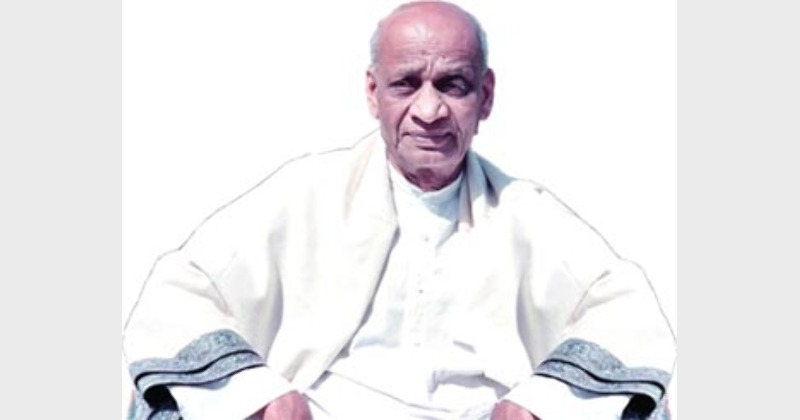

Sardar Vallabhbhai Patel has been, as no other leader, unpersoned by Jawaharlal Nehru and his successors’ dynasty, in the same fashion, as some ruling leaders of the Communist Party of Union of Soviet Socialist Republics (USSR) unpersoned their predecessors, by appropriating all the achievements the country made, for themselves.
Three times during his life time, Sardar Patel stepped down from becoming the President of the Indian National Congress (INC), every time to make way for Jawaharlal Nehru, even though no Pradesh Congress Committee was forthcoming to support Nehru. Mahatma Gandhi prevailed upon Patel every time to withdraw in favour of Nehru. In 1945 when India’s Independence was imminent and the new President in place of Abul Kalam Azad was to be elected, all Pradesh Congress Committees proposed Patel to be the President with the intention that he would become the Prime Minister. Not one Committee proposed Nehru’s name; yet on Gandhiji’s advice, Patel withdrew in favour of Nehru. The fear was that if he did not become the Prime Minister, he would leave the Congress or split it the way Congress socialists like Jaya Prakash Narayan did. Because Gandhiji feared this would be disastrous, in 1928, for the first time Sardar Patel’s name was proposed as President of the INC. Nehru’s father Motilal Nehru requested Gandhiji to make his son succeed him. On Gandhiji’s advice Patel withdrew his candidature. In 1959 again, Indira Gandhi was made President of Congress at the insistence of Jawaharlal Nehru.
After Indepen-dence, Nehru invited members of the Muslim League and its leaders who remained in India after splitting the country, to
join the Congress. They joined in large numbers and since then the Congress has become more or less a Muslim-caring party. Sardar Patel had also invited the Rashtriya Swayamsevak Sangh (RSS) members to join the Congress but they did not; they have been paying a big price for it.
Patel’s contribution
The 600 and odd princely states in India had the choice to join either Pakistan or India or be independent. When Patel gave his consent to Mountbatten’s proposal for the division of India, he put the condition that he that is Patel and not Mountbatten should deal with the Princes and Nawabs and Mountbatten had agreed. This effort helped Patel to persuade almost all the Princes not only to accede to the Indian Union but also for their consolidation into viable units like Patiala and East Punjab States Union (PEPSU), etc. Later on, all these were integrated into the Indian Union during his short life of less than two and half years after Independence.
Junagarh’s Muslim Nawab acceded to Pakistan but under Patel’s guidance, there was a people’s movement against that accession. The Nawab fled and Junagarh then became part of Saurashtra that later merged in Gujarat.
Unfortunately, Jawaharlal Nehru did not allow Patel to deal with Jammu & Kashmir (J&K). Nehru was under the influence of the Mountbattens, and therefore, J&K remains a problem costing us a great amount in men and money.
In another incidence, the Nizam of Hyderabad was in collusion with Pakistan. He wanted to be independent. Mountbatten, as the Governor General with the tacit approval of Nehru wanted to give a special status, but not accession to Hyderabad-The Nizam and his Razakars wanted that it should be an Islamic state in alliance with Pakistan following which there was a Standstill Agreement. Patel waited for Mountbatten to leave India in June 1948. By that time, every attempt to have some settlement or the other with the Nizam including Mountbatten’s and Nehru’ offer of special status failed. Then unlike Nehru in Kashmir, Patel decided on police action. In a matter of four days on September 17, 1948, the Nizam, his army and his Razakars were worsted, and the territory was integrated with the rest of Bharat.
After all this, Patel was portrayed as the one being against Muslims. But, he was far from it. Unlike Nehru and secularists, he was not flattering Muslims or attributing non-existent patriotism to them. He gave priority for the re-settlement of the millions of Sikhs and Hindus who were squeezed out of Pakistan, and wanted their immediate rehabilitation in and around Delhi. On the other hand, Nehru was urging Muslims in Delhi and Uttar Pradesh not to go to Pakistan although they were responsible for the division and the carnage afterwards. In fact, he also asked Sri Prakasa, India’s High Commissioner in Pakistan to persuade Muslims who had gone there to come to India. Patel did not like this but he did not prevent Nehru’s actions. In his addresses both before and after the Hyderabad police action, he told Indian Muslims in plain terms not to sail in two boats. He assured them that all loyal citizens of India irrespective of religion will have equal rights and treatment but if the League’s partitionist, separatist, militant two-nation theory mentality continues to be nurtured, every act of disloyalty and defiance would be put down. This plain talking is interpreted as Patel’s enmity towards Muslims.
In the period 1949 to 1951, Communists in India instructed by Communist Information Bureau, the coordinating body of communist parties everywhere under the hegemony of Stalin took to arms to throw out the newly independent Nehru-led government, describing it as a lackey of Anglo-American imperialism and establish “people’s democracy”-their name for the dictatorship of the communist party in the name of proletariat. To suppress this movement, Patel imprisoned hundreds of above-ground communists under Preventive Deten-tion Act. His successor, Govind Vallabh Pant later finished the insurgency of the communists and their war against Indian Army in Telengana by September 1951.
Post this incident, Communists infiltrated not only into Congress but they were also able to take over the labour movement. Patel was again instrumental in founding the Indian National Trade Union Congress (INTUC) to distinguish it from the All India Trade Union Congress (AITUC) which became a communist controlled labour union. When a Committee which included Nehru found that communists were acting under the direction of the international communist movement, he expelled them from the All India Congress Committee (AICC).
It were these actions of Sardar Patel which made him persona non grata with the Nehru dynasty and Communists and their fellow-travelling “intelligentsia” and their “eminent” historians. Apart from Patel, Netaji Subash Chandra Bose was another potential rival to Nehru. He won the Presidentship of the Congress despite the opposition of Gandhi. Nehru who called himself a socialist cooperated with Gandhiji to see that Bose does not continue as Congress President. Bose left Congress in disgust and founded the Forward Block. Clearly it was Gandhiji’s patronage that built up Nehru and excluded Patel and Bose from leadership of the Congress.
The single party majority that Bharatiya Janata Party (BJP) secured in the elections to the Lok Sabha in 2014 can be considered to herald the Second Republic of India. The first Republic-the Nehruvian Republic made us effete. It has been taken over by unIndian elements from within and outside the country.
To commemorate the success of Second Republic, all those who mightily contributed to the freedom movement and our nationhood and integrity of this state should be honoured. In a first, Sardar Patel’s Jayanti is being celebrated with the involvement of the government of India.
Persons like Tanguturi Prakasam Pantulu, Purushottam Das Tandon, JB Kriplani, Rajaji not to talk of Subhash Chandra Bose, Bal Gangadhar Tilak, Lala Lajpat Rai and Bipin Chandra Pal should all be given honours due to them.
-Dr TH Chowdary
?(The writer is a senior columnist and Chairman-Pragna Bharti, Andhra Pradesh)