 ?Intro: India does not need US as a jury in determining India’s place in the Asian region or world affairs. But Washington should learn to look at India with all the seriousness it deserves. ?
The world’s two largest democracies, India and US, may have much in common. The huge convergence on issues such as democracy, supremacy of the judiciary, respect for pluralism and independence of the media and above all zero tolerance to terrorism are some of the many commonalities. But far from common interests, India-US relations have undergone a series of ups and downs, stresses and strains. These issues are more likely to persist for a longer time but the resilience in Indo-US relationship is such that regardless of irritants, New Delhi and Washington can cosy-up at the earliest opportunity.
The US was probably the last country to recognise, albeit grudgingly, the overwhelming victory of Narendra Modi. Notwithstanding the fact that “Defining relationship”, “Strategic Partnership” has been the choicest phrase to describe Indo-US ties- the ties that went sour more than once.
| The race for development and supremacy is something that the Asian countries will themselves settle. None of these countries need the US as a jury. ? |
Be it the 1971 Bangladesh liberation or the nuclear test by NDA-I under Vajpayee, US had no compunction in testing India’s patience. Therefore, the US should not expect political changes in India to cast out overnight the causes for the bitterness. The US was singularly responsible for the souring of “defining relationship” of the 21st century through the Seventh Fleet, sanctions, and the arrest and strip-search of Indian diplomat Devyani Khobragade.
Yet, in the aftermath of the crisis triggered by the Khobragade issue, the US, instead of picking up the pieces to mend relations, is bent upon provoking another crisis by imposing trade “enforcement action” (meaning “sanctions”). This retaliatory strike-on behalf of US business, especially Big Pharma-against India’s position on patents is the latest in a string of actions that can only worsen the already-damaged bilateral ties. US Trade Representative (USTR) Michael Froman, evidently under pressure from US business, wants to arm-twist India into undoing its patent regime to enable US multinationals to make a killing in the domestic market here and block Indian pharma companies from succeeding in the US. Hence, the threatened trade-related sanctions on the basis of the dubious Special 301 Report.
The spectre of India being put on the 301 List is nothing new. In 1991-92, then USTR Carla Hills had threatened similar action without the fluff of intellectual property rights or legalese about investment climate. She declared that the US would “use Section 301 as a crowbar to prise open the Indian market” for American business.
Although the US has no justifiable basis to challenge the Indian patent regime, which has been upheld by the Supreme Court, the issue is not the merits of the case. Washington is always quick to punish countries when their conditions go against US business interests. The issue here is how such action impacts bilateral ties and why the US keeps picking new bones for contention at a juncture when the need is for positive inputs.
Recently, the US Food and Drug Administration (FDA) harshly penalised Ranbaxy and Wockhardt. Close on the heels of the FDA’s punitive strikes, the US Federal Aviation Authority (FAA) downgraded India’s air safety ratings. Since India-US relations are in a “strictly-reciprocal” phase, the directorate general of civil aviation lost no time in announcing safety checks for foreign aircraft flying into India.
By their actions, the USTR, FDA and FAA are scuttling efforts to strengthen ties. Besides economic and trade issues, the major differences between the two democracies concern their respective outlook on Pakistan, Iran, Afghanistan, Syria, WTO issues, The Doha Round and climate change—only to name a few.
In spite of Pakistan’s role in terrorism, its policy of running with the hare and hunting with the hound, its double standards in international and nuclear policies and above all its role in upsetting the US applecart in Afghanistan, the Obama administration seems to overlook all the acts of commission and omission on the part of Islamabad. Worst still is the unrealistic policy of equating India and Pakistan on every forum and balance of power equations by the US. India does not need US as a jury in determining India’s place in the Asian region or world affairs. But Washington should learn to look at India with all the seriousness it deserves.
Chinese Premier Li Keqiang had once said that there was “friction” with the United States, and the world”s two biggest economies must respect each other”s core interests. “It”s a fact that some friction exists in the course of cooperation, but this is the trouble with cooperation,” Li told a news conference at the close of China”s annual Parliamentary session. “Of course, China and the United States, because their history and cultural background are different, and their stage of development is different, there are differences on some issues.”
“As long as we respect each other, respect each other”s core interests and major concerns, control well our differences, have equal consultations, and especially pay particular attention to expanding our common interests, then (we will) be able to enhance the level of our bilateral relations,” Li said.
The basic parameters of Sino-US relations can be applied to India as well. The history and cultural background of India and the US are different too. As in the case of China, India too expects US to respect each other’s core interests and major concerns. India’s energy security cannot be overlooked by the US while calibrating their Iran policy. Nor can US expect India to accept China as first among equals in Asia. The race for development and supremacy is something that the Asian countries will themselves settle. None of these countries need the US as a jury. The global policeman role of the US would have limited or no appeal eventually in this region as more and more countries picks up speed in growth trajectory.
India-US relations have never been at a low point as it is now since 1998 in the aftermath of the Pokharan test. Now that it is so bad, it can only get better provided, of course the US administration recognises what needs to be done, and actually does it.
Modi”s emergence as India’s prime minister is not just a change of government or parties in government. Rather it heralds a transformation. His emergence marks the rise of new Indian socio-political realities and a new cultural assertiveness driven by the urge to put economic development at the centre of politics; and ensure that such development is aided by responsive and transparent governance.
Therefore, it is of utmost importance that the US must view Modi through a different prism; and India under Modi through a larger prism of the same type. Otherwise Washington may not grasp the transformation set to sweep this country and thereby the region.
India-US relations cannot be a one-issue affair whether it is the civil nuclear deal, the push to protect the interests of Big Pharma, US trade and economic protectionism, defence contracts, weapons purchases or the US obsession of seeing other countries as merely markets “to be prised open with a crowbar”.
Also Read : Indian American’s Eagerly Waiting For Modi
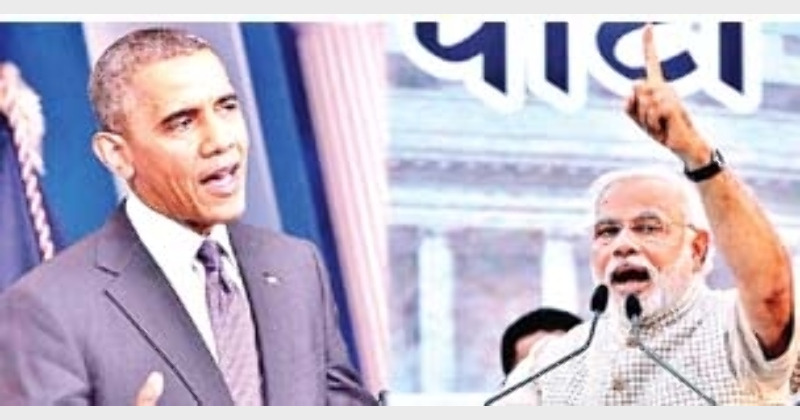
The aspirational India of today in Modi’s mandate during his visit to US will have to find a place in Obama”s priorities, as a political priority. Only then can the many issues that have wrecked bilateral warmth be resolved to move forward. Obama has to convincingly demonstrate that henceforth, he would be hands on when it comes to US policy and relations with India. This is necessary because all parties in India are of the view that India fell off the US radar and map since Obama took office. Doubtless, in large measure, the relationship suffered because Bush “spoiled” India with unprecedented warmth and attention rooted in an extraordinary personal rapport with Manmohan Singh. In contrast, the US has rubbed Modi on the wrong side, although Modi, because of the compulsions of power, would unabashedly rise above personal pique to restore the lost equilibrium in India-US ties.
America has a dream. India too has a dream, a world mission. The US must recognise that India”s independence in world affairs is because of the country it is, and not because of its economic or military clout. The reasons are cultural and historical, and these reasons would be even more to the fore under Narendra Modi’s leadership.
-Seshadri Chari? (The writer is Director of Forum for Strategic and Security Studies and Secretary General of Forum for Integrated National Security(FINS).?