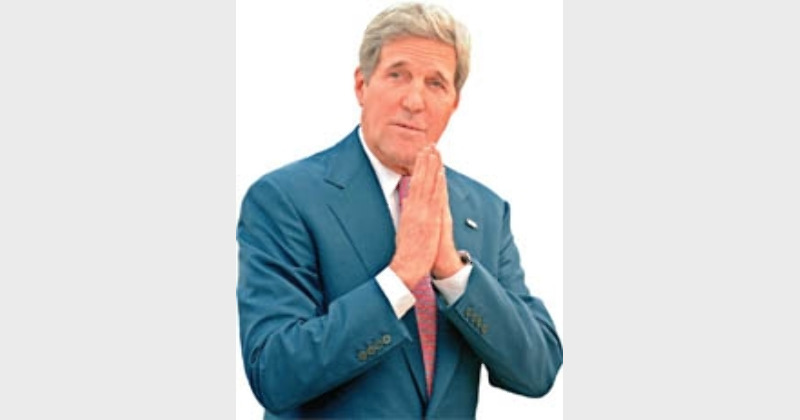
Folded Hands, but fingers crossed?
Intro:When the Obama Administration is trying hard to rectify its equations with the Modi Government, deadlock on WTO negotiations has emerged as a major roadblock.
?
 Narendra Modi government has told World Trade Organization (WTO) that it will not ratify the Trade Facilitation Agreement (TFA) at the WTO unless its concerns on food security are addressed. India has made it clear to WTO that “To jeopardize the food security of millions at the altar of a mere anomaly in the rules is unacceptable”. This stand of the government has created a situation of a near face off between US and India. To understand and appreciate government”s concern on the whole issue we will have to look at the history of the issue(s) in question.
The whole issue of food security concerns in WTO occurred at developed countries raising the issue of India exceeding the threshold limit of 10 percent of total value of food production, which could be given as subsidies. Matter gained importance after passage of food security legislation by India, ensuring provision of food grains to nearly 67 percent of population at a very low price of rupees 3 per kilogram for wheat and rupees 2 per kilogram for rice. Fact of the matter is that India has not never ever exceeded the threshold limit of 10 percent, nor it is expected to exceed this limit even after full implementation of Food Security Act. The reason why this issue has arisen is the fact that at the time of signing of WTO agreement, the base price has been pegged at prices of food grains prevailing in the year 1986-88. This would imply that if the government pays a support price of 1400 per quintal today (between 1986 and 1988- the support price was Rupees 380 per quintal then), the subsidy part would be calculated as 1020, which is highly inappropriate. If the same rule continues then threshold limit of 10 percent of total production is bound to increase. What Indian side in WTO wants is this simple correction in the rule that this anomaly is rectified and the base year is revised.
 Addressing a press conference on December 5, 2014 at Bali, Indonesia at the occasion of Ninth Ministerial Conference of WTO, then Commerce Minister Anand Sharma said, “I would like to make this absolutely clear that we have not come here as petitioners to beg for a peace clause … That it is binding on us to accept 1986 to 1988 prices and make ourselves vulnerable to disputes and calculations? The answer is a firm “NO”. This is a fundamental issue, we will never compromise.”
Under the interim solution, or the peace clause for four years, no country will challenge another at the WTO if there was a breach of the 10% cap on domestic support given through minimum support prices. But, India rejected the four-year peace clause offer.
Compromise at Bali
In WTO”s Ninth Ministerial Conference at Bali, Indonesia, the agreement, reached after extending the conference by one more day, states that, “In the interim, until a permanent solution is found, provided that the conditions set out below are met, members shall refrain from challenging through the WTO dispute settlement mechanism compliance of a developing member with its obligations under Articles 6.3 and 7.2(b) of the agreement of agriculture (AoA) in relation to support provided for traditional staple food corps in pursuance of public stockholding programmes for food security purposes existing as of the date of the decision.”
It is notable that developed countries were trying to pressure India to make further gains in WTO negotiations by saying that India subsidies beyond the threshold limit by way of support for public food grain stockholding for food security, against which they can raise disputes.
It was imperative for the government not to buy that argument, as the whole food security programme under the much-celebrated food security act would have been in doldrums. This agreement was celebrated by the then government and was termed as a big victory for the government. The official version was that by virtue of this agreement, international trade-related hurdles with regard to food security programme have been removed, as developed countries have agreed not to dispute about support for public stockholding of foodgrains for food security exceeding the threshold limit of 10 per cent of the total value of agricultural produce.
Present Issue
Now in WTO the Indian side wants that the agreement which was reached in Bali should be taken ahead and efforts are made towards finding a permanent solution in this regard. However, the developed countries want binding commitments from India with regard to Trade Facilitation Agreement (TFA), without really making any commitment towards finding a permanent solution regarding food security issue.
It is notable that TFA as pushed by the developed world could hold significant administrative and institutional burdens on Least Developed Countries (LDCs) and other developing countries. Meeting the obligations, as proposed, is likely to involve significant cost for the developing countries including India. Apart from building huge infrastructure (both soft and hard) including airports, sea ports, dedicated corridors and roads, it would also involve automation of customs system. It is unfortunate that no cost assessment has been made by the government about implementing the provisions of trade facilitation. The fact is that meeting this cost would mean a huge diversion of resources from public services such as health care, food security and education to customs administration.
Legitimacy of India”s Demand
Insistence for long term solution to the issue of disputes on food security as a bargain for agreeing to TFA is also in no way unjustified. It is notable that the disputes being raised by US against India with regard to so called “trade distorting subsidies” is a clear attack on our sovereign right to protect food security of our poor. We must understand that the agreement on agriculture signed earlier has been highly skewed in favour of rich nations, as we find that after this agreement developed countries have not only continued with huge subsidies to their agriculture, but have increased the same manifold, by simply renaming and reclassifying the same as green box subsidies. Hence, it cannot be called unjust to find a solution to the possible disputes at a future date as a bargain for what the opposite party wants. Signing of TFA is going to cost India both directly (building infrastructure both soft and hard) and indirectly (in terms of flooding of imports into the country).
-Dr Ashwani Mahajan ?(The writer is Associate Professor, PGDAV College, University of Delhi, [email protected])
?