Indo-Japanese Relations: Scaling New Heights?

With Prime Minister Narendra Modi reportedly making Japan the first foreign country he intends to visit following his taking over the reins of power and with the likelihood of Japan’s Prime Minister Shinzo Abe wishing to call on Delhi, the prospects of Indo-Japanese relations rising to new heights seems very much in the running. Interestingly there seems to be an unbelievable rapport between the two leaders that is hard to explain unless it be on astrological grounds: both are Virgos, with Modi born in September 1950 and Abe four years later in September 1954.
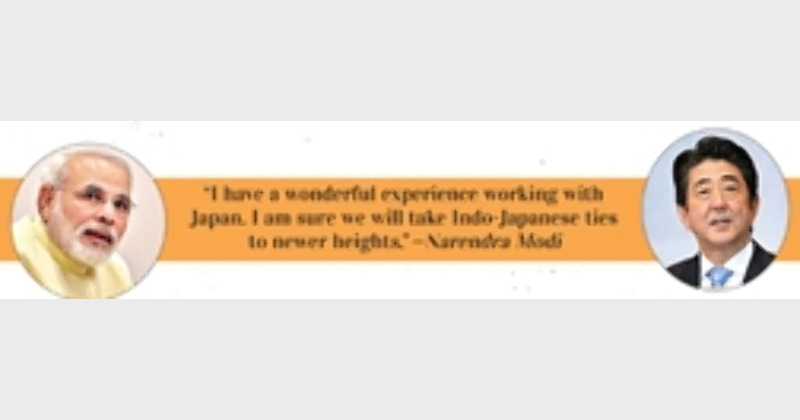
| I have a wonderful experience working with Japan. I am sure we will take Indo-Japanese ties to newer heights.” —Narendra Modi? |
In 2007 when Abe visited India as Japan’s Premier, Modi took the initiative to fly down to Delhi to meet him. That same year, Modi visited Japan and reportedly he then took the opportunity to make a deep study of Japan’s technical achievements. Modi’s visit to Japan was closely followed up by a visit to Gujarat by close to 120 Japanese investors on January 18, 2012. He showcased them how Gujarat was handling the two essentials of industry – water and power – and his presentation, it is said left the investors highly impressed. On March 22, 2012 he received the Japanese Ambassador to India, His excellency Saiki along with the heads of two large Japanese corporations. Inevitably Modi received an invitation to re-visit Japan and this he did accompanied by a 25-member delegation.
The four days he spent in Japan were hectic. Not a minute was wasted. Later an Indian official was to say that “at every place and forum, at every meeting and reception, the Japanese response was unimaginable, showing the keenness of Japan to understand Gujarat as a lucrative location to live in.” Such has been the closeness between Japan and Modi’s Gujarat that following the NDA’s victory in the elections just gone by, Japan’s Premier Abe called Modi personally to congratulate him.
The great thing about India and Japan is that the two countries never had any major conflict except briefly when India exploded its first set of nuclear weapons which is perfectly understandable given Japan’s history. But all that is forgotten. Japan is the fourth largest foreign investor in India contributing 8 per cent of total FDI inflows. Japan pitched in with 1.6 billion dollars in fiscal 2013-14 raising the total between 2000 and 2014 to 16.2 billion dollars. Presently there are 374 Japanese companies who have set-up business in India employing 7,500 Japanese expatriates making their presence felt, which is a beginning, considering that there are 23,000 Japanese companies functioning in China with 40,000 Japanese under employment. India and Japan have a long way to go.
According to media reports, Japan has expanded its currency swap arrangement with India to 50 billion dollars from a low 15 billion dollars last year, contributing to New Delhi’s efforts to arrest the rupee’s free fall. Importantly India today is the largest recipient of Japan’s International Cooperation Agency’s (JICA’s) overseas assistance programme.
According to Economic Times, Tokyo is Delhi’s closest strategic and economic partner in East and South East Asia and many mega infrastructure projects in India – from Delhi’s Metro to the 90 billion dollar Delhi-Mumbai Industrial Corridor – are being executed with help from Japan. It is also playing an important role in the construction of the Western Dedicated Freight Corridor (DFC) and the Chennai-Bengaluru Industrial Corridor. India has been slow in reaching out to Japan even when Japan and India have had a happy relationship for years. Among visitors to Japan in the past have been none less than Rabindranath Tagore and Swami Vivekananda. It was incidentally another Bengali, Radhabinod Pal who refused to condemn Gen. Tojo at the World War II International Military Tribunal in the face of Western Tribunal Members who must have been aghast at an Indian Judge’s courage to give an independent judgment – and the only one to do so. It was Japan, again which during World War II was willing to assist Subhas Chandra Bose in his brave fight against the entrenched British in India.
But things are changing. Right now China which is having several differences with Japan must be viewing current development in Indo-Japanese relations with concern. One can expect a quantum jump in the fields of trade and commerce and technology.
(The writer is a senior columnist and former editor
of Illustrated Weekly)
?