





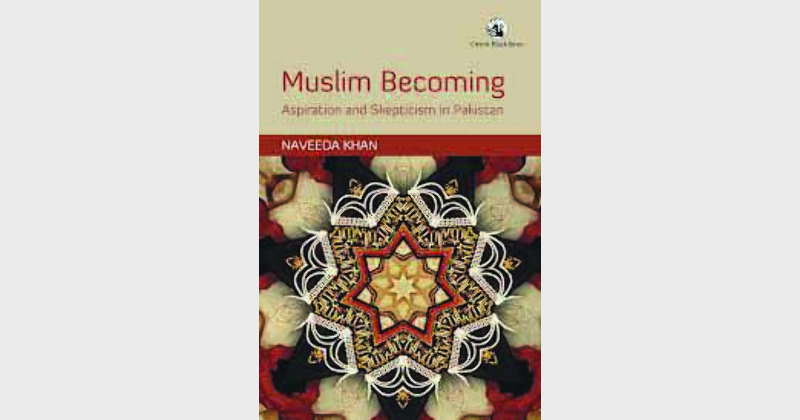
Muslim Becoming: Aspiration and Skepticism in Pakistan , by Naveeda Khan Duke University Press, Durham & London, 2012, Rs 1,473 in India
Pro VonoPublico
 Naveeda Khan, an anthropologist from Pakistan, married to an American, went back to her country of origin on an academic assignment. There started her search for the identity of “Muslimhood” of the people of Pakistan. Her book, ‘Muslim Becoming’ is the outcome of that search.
Khan started with the project — integration of Islam into the state administration and the national imagination through the study of mosques built after the formation of Pakistan in 1947. In her earlier trips, she had found the common people describing Pakistan as a mosque. So the mosques and their administration became the central core of her research.
On a visit to a library for data on local mosques, she came across four librarians, all Muslims, but from different sects, viz. Shi’a, Deobandi, Barelavi and Ahl-e-Hadis. Each embodied his individualmaslak(sect) almost to the point of stereotype. Once, their conversation on offering prayer at the Prophet’s mosque at Madina turned into a brawl. Flabbergasted by this intense intolerance for the co-religionist’s path, Khan’s quest for the Muslim identity began.
The argument of the librarians remains proof of the failure of Pakistan to develop a clear, consistent relation to Islam.
Khan traced histories of mosques built in recent times. It led her to understand that there was intense struggle for the takeover of these mosques by competing sectarian communities. She narrates an incident of an armed struggle when a group of young men carrying weapons forced their way into a mosque, ejected its imam and replaced him with another. It was a clear case ofqabza– forceful takeover of a mosque, prevalent all over Pakistan.
Theqabzamentality permeates other levels too. Khan writes about a study circle, where women taught Qur’an voluntarily and the students, loosely affiliated with a specific mosque, too came voluntarily. She narrates, “My landlady in Lahore told me that women in her Qur’an study circle were demanding to learn from a specific aim because they felt that the older women leading the circle weremisinforming them, perhaps deliberately leading them astray.”
A sort of sectarian untouchability exists as people retract from offering prayers in a mosque of a different sect. Then there are the bread and butter mosques which are a front for land grabbing and commercialisation of Islam but are, in fact, breeding places of sectarian violence.
Under these conditions that lead to constant disruptions in the common man’s daily life, Pakistani society has developed intense dislike for the religious class. They, however, take a dig at the mullahs and even newspapers caricaturisethem.
It is this sectarian struggle that has led many to say that Pakistan is a mosque under illegal occupation by four socio-political groups — the State (read Army), venal religious figures (read mullahs of different hues), unscrupulous lay Muslims (powerful people in the neighbourhood) and the sectarian groups.
Munir Commission’s failure to identify a Muslim
The author traces the roots of sectarian intolerance in Pakistan to the first decade of its existence. During the Constitution Assembly deliberations, the members had to define the Muslim identity. The first axe fell on the Kadianis or Ahamadias. Though they professed to be the followers of Islam, considered the Koran as their only sacred book, accepted Prophet Mohammad and followed all the Islamic rituals, they accepted Gulam Ahamad as their Prophet. That was enough to deny them their Islamic identity. People demanded that Ahmadias be declared non-Muslims and the Constituent Assembly member Chaudhari Zafarullah Khan and many other top level Ahamadias be removed from key Government positions as non-Muslims are forbidden from doing so in an Islamic State.
In order to resolve the problem of ‘Who is a true Muslim?’, a commission was constituted in 1953 under Justice Mohammad Munir. After an extensive search through personal interviews and 3,600 pages of written statements from people from almost all walks of life, Munir Commission came up with startling results.
It stated: “If we attempt our own definition as each learned divine has done and that definition differs from that given by all others, we unanimously go out of the fold ofIslam. And if we adopt the definition given by any one of theulama, we remain Muslim according to the view of thatalimbutkafirs according to the definition of everyone else.”
The Munir Commission could not arrive at any one definition for the Muslim citizens of Pakistan, but all theulamasagreed that Ahamadias werekafirs. The Commission, however, was firm on the conclusion that “Pakistan was not an Islamic state, nor it should seek to become one”.
The problem remained unresolved. In 1973, a new Constitution was declared which proclaimed the Islamic Republic of Pakistan. With the amendment made in this Constitution in 1974, Ahamadias passed out of the legal category of Muslims and became non-Muslims. By 1984, for Ahamadias to claim Muslimhood became a punishable offence. They became frequent targets of group violence.
Khan deals extensively with Allama Iqbal’s views on the Islamic state. Iqbal, one of the tallest intellectuals of the Muslim umma,wroteSare jahan se achcha Hindositan hamara but later turned into a propagandist for a separate Pakistan. Iqbal too was of the opinion that the Ahamadias needed to be expelled from Islam. Incidentally, he had a spat with Jawaharlal Nehru on the mistreatment of Ahamadias way back in 1935.
Root cause of intolerance
The Muslim world is heading towards internal sectarian conflicts on a major scale, not only in Pakistan but also in Iraq, Syria, Egypt and other countries. The Shi’a-Sunni conflict in the Middle East and the tussle between the Saudis and the Iranians over hegemony of the Muslim world are some examples. The fault lines lie in sectarian intolerance. Each act of violence in these countries is attributed by theulamas to Islamic scriptures. It seems the root of these conflicts too can be searched in scriptures only.
A quote of Maulana Yusuf Ludhianvi, a noted Deobandi scholar, in this context is revealing: “The nature of competitive exchange is to set aside cajoling, explaining patiently, waiting to be understood, qualities central to being a good Muslim in favour of the urge to slay one’s opponents to win the argument.” That’s what is happening in Pakistan today with sectarian conflicts becoming bloodier by the day.
Even during the days of the Prophet, differences existed within the Saudi tribal society over religious matters. Even then, the dissent was not tolerated but eliminated.Khan states: “The Prophet anticipated these differences as well, specifically in thehadisin which he was reported to have said that hisummawould fragment into 73firqasi.e. sects, of which only one would be rightly guided. He was also reported to have said that except for the rightly guided one, all others would espouse such desires and delusions that would spread like contagion…” As Khan implies, eachmullah,imam,alim ends up considering his own faith as the seventy-third correct, a rightly guided faith and rest others as misguided and ultimately leading to hell.
Today, the entire non-Muslim world is asking the Muslimumma, is there is no truth in any other religion. And which sect among the Islamicummais treading the righteous path?
The well-researched book makes an interesting read as it vividly portrays the strife-torn society of Pakistan and explains why is it so. It should motivate a Muslim reader of any sect to do some soul-searching.
(The reviewer is an expert on Islam and can be contacted at email: drpvthak@yahoo.co.in )
Books Received
Apocalypse Pakistan an anatomy of ‘the world’s most dangerous nation’ Foreward by Ayesha Siddiqa, Francesca Marino, Beniamino Natale, Pp 180, Rs 395, Published by Niyogi Books, D-78, Okhla Industrial Area, Phase – I, New Delhi: 110 020
Pakistan Under Arma Rule by MM Khajooria, Pp 252, Rs 760, Published by Gyan Books Pvt. Ltd. Gyan Kunj, 23 Main Ansari Road, Daryaganj, New Delhi :110 002
Interactive Media and Society by Neeraj Khattri (ed.) published by Kalpaz, Rs 950 Pp 318 Gyan Books (P) Ltd., Gyan Kunj, 23 Main Ansari Road Daryaganj, New Delhi: 110 002
The Priceless Gift by Hemalatha Gnanasekar , published by Kalpaz, Rs 210, Pp 139 Gyan Books (P) Ltd.Gyan Kunj, 23 Main Ansari Road, Daryaganj, New Delhi :110 002
Untouchable Chandals of India The Democratic Movement by SK Biswas, published by Gyan, Rs 1,125, Pp 400 Gyan Books (P) Ltd. Gyan Kunj, 23 Main Ansari Road, Daryaganj, New Delhi : 110 002






Comments