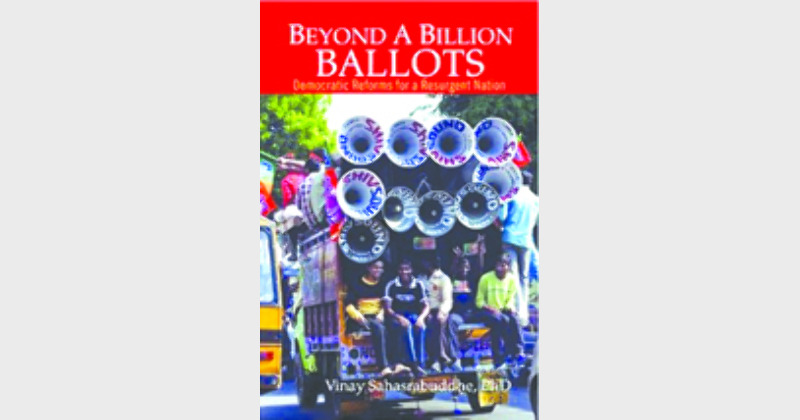
Beyond a billion ballots: Democratic reforms for a resurgent India, Vinay Sahasrabuddhe, Wisdom Tree, Pp 328, Rs. 795
Naveen Kumar
 Once George Bernard Shaw announced, “Democracy is a device that ensures we shall be governed no better than we deserve.” It is all about resolving contradictions without which the modern life can not be imagined and democracy fulfills it. While casting vote on the polling day, we think, we are going to make a person our ruler; rather we also have a feeling of solving own problems. On the other hand, there is a hard reality where politics is seen more as a vocation, not a path to serve the people. This burden of philanthropic serving is left now to flourishing NGO industry and some international funding agencies. As ballots hardly matter for us beyond a point, we tend to be pathetic about it.
In this backdrop, Vinay Sahasrabuddhe explores all possible realities ‘beyond ballots’ as a person walked through as from a student activist, journalist, institutional head to a Party functionary. Primarily, focusing on the efficacy of delivery of democracy, Sahasrabuddhe admits that there is no alternative to participatory democracy but insists that the success of democracy should be judged not only in the percentage of ballots but on the basis of its effective delivery system.
It has become necessary when voters have become rebellion in Brazil, Turkey, Italy and Egypt because they were not satisfied with the delivery of democracy and governance. In India also, voters are disgruntled because of a failure of the political class to meet their rising expectations. The anti-corruption movement and subsequent rise of the Aam Aadmi Party are exemplary in this regard.
There are entrenched political elites in democracy. Vinay Sahasrabuddhe tries to alarm them and appealed them successfully for correcting political culture, bringing electoral reforms, balancing populism with building the effective delivery system and breaking vicious circle of electoral compulsions. Resultantly, the Book Beyond a Billion Ballots is not a mere perspective or analysis but in a real sense, it is blueprint for resolving the core contradictions of Indian democracy.
The book is divided into seven chapters and mainly focuses on strengthening delivery mechanism of democracy. The distinctiveness lies in the prescription for reforms not on traditional academic line but on noble and grounded foundations of democracy, politics, political system and electorates.
In the chapter, “The Democratic World”, Vinay Sahasrabuddhe checks the current trends of democracy as he analyses consolidation of democracy, delivering democracy, performance and limitations of democracy.
In the chapter, “Parties: The Forgotten Karta of Democracy”, he searches the appropriate organisations, structures, political system and leadership which can deliver in democracy and rectify the apathetic situation. He tries to find the doer in the system or institutions which go beyond the personalities.
In his detailed arguments under the chapter of “Political Culture in India”, he analyses the political milieu, namely state, functions and compulsions of political parties, in which they function. As the ideological distinctions are getting blur, parties under the same political culture lack conviction and credibility. Resultantly, people see no great difference among available parties.
Vinay Sahasrabuddhe defines the political parties from people’s voice to empty vessels when he is discussing the issues like a review of the role of parties in shaping public opinion, its relationship with ideological clarity, organisational health of a party and the changing nature of party-public interface. Thereafter, more interestingly, in the chapter, “The Lethal Cocktail: Populism and Electoral Compulsions” he focuses on populism which turns democracy non-performing mechanism. This book has more systematically defines populism in India which is quite relevant in the era of populist gimmicks for electoral gains. With an abundance of regional, linguistic and religious diversity, parties find it convenient to evoke primordial identities to ensure the support of the voters.
It is very rightly articulated that power-driven parties are more likely to succumb to populist pressures. Thought the case of AAP is a recent addition in adopting the populist agenda, other national and regional parties have also went for such measures and lost their traditional votes, this is more true for BJP and Congress in case of UP. While discussing long range of recommendations and popular suggestions for electoral reforms, he wants to break the vicious circle what he himself observes from inside and outside of political party.
Vinay Sahasrabuddhe as an activist-researcher has been heading South Asia’s only training and research academy for elected representatives and voluntary social workers, Rambhau Mhalgi Prabodhini (RMP), Mumbai, for the last twenty-five years. As a student activist, he had offered satyagraha against Emergency and was behind bars in 1975. He was also a member of the Senate and Management Council of the University of Mumbai for several years. For over a decade, he was in-charge of the National Training Cell of the Bharatiya Janata Party (BJP).
Vinay Sahasrabuddhe wants to test such consolidation and aberrations in democracy, such as debatable rise of AAP, in larger perspective and insists on the change in political culture and efficacy of governance. It is safe to say that the rise of AAP is not only result of anti-Congress sentiments but also because feeling cheated with the existing political culture. The author warns that new entrants like AAP will not be able to bring about true transformation without altering the “present mould of Politics”. Though the book was written well before emergence of the AAP phenomenon, it has made right predictions and prescriptions.
On the day of the launch of this book, Sh. Narendra Modi described trust as the precondition of good governance and he stressed term ‘servants’ (sewaks), not rulers for all those who serve in the Government. Now there is a need to read all painted walls. From Tahrir Square in Egypt to Jantar Mantar in Delhi, people are demanding democracy that delivers. Therefore, the author, Vinay Sahasrabuddhe concludes strong visionary leadership with organisational skills and strategic thinking supply both on the banks of the Nile and the Yamuna.
Respect swadeshi values
Manju Gupta
Prosperous India, Prof. P. Kanagasabapathi, Vivekananda Kendra Prakashan Trust, Pp 160, Rs 100.00
So far we have been studying India from narrow western paradigms, especially those that relate to the economy and society of our country, with pessimism. The author, a professor and UGC Research Fellow, points out in this book of his that the reality in India was different in the past. India’s contemporary progress as seen today is driven by factors that have deep roots in both economic and social backgrounds. In fact the emergence of India as an economically stable nation after 60 years of Independence is due to the strong foundations laid by the native systems of economy that have helped the country not only in economic, but also in social, cultural and political fields since ancient times.
Through this scholarly study, the author tries to dispel the notion that thousands of years of slavery afflicting India has kept her economically poor; that there was no orderly system of production or distribution of goods and services which have kept the nation backward. Quoting facts and figures, he proves that as far back as the Indus Valley Civilisation, Indians had an orderly system of production and distribution as also of trade and who can forget that India was the richest country in the world contributing the highest share of global wealth till the East India Company and the British rulers looted and impoverished the country.
This, however, does not mean that Indians themselves can be absolved of all blame for its backwardness. The author says that ironically enough, even after 60 years of Independence, India has failed to regain her pre-eminent status as an economic power because its political leaders and architects of modern India “were guided by imported ideologies, like socialism or capitalism, which were unsuited to the Indian conditions and a mismatch with India’s healthy tradition.” If only the leaders had shown the ingenuity to build upon the sound foundation of India’s age-old, well-established economic system, the country would have achieved the supreme position which she had occupied during pre-British days.
The author points out the basic difference between the economic system of the West and India. According to him, while the Western system has been either Government driven or supported by the Government, in India the economy was influenced by social factors. Here the Government at best acted as a facilitator, while the Indian families inculcated the habit of saving their earnings by leading a frugal and simple life. This and social networking helped industrial families and communities to embark upon various economic initiatives through pooling in of their resources to start not only cottage and small-scale industries, but also large-scale industrial and commercial enterprises, thus bringing about India’s prosperity. The author quotes from the Arthashastra, the first comprehensive book of economics in the world and which advised the king to be “ever active in the management of the economy because the root of wealth is economic activity; inactivity brings material distress.”
India had as superior system of agriculture and here the author quotes from the Taittiriya Upanishad, “Endeavour, so that there be a great abundance of food. That is the inviolable discipline of mankind.” It was no wonder that the British were struck by the techniques adopted by Indian farmers.