
The low cost sanitary napkin invented by Coimbatore based high-school drop-out A Muruganantham shakes the MNCs monopoly
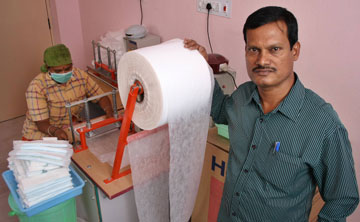 A recent AC Nielsen study revealed that 88 per cent of women in India resort to using dirty rags, newspapers, dried leaves and even ashes during their periods, because they just can’t afford sanitary napkins. Typically, girls who attain puberty in rural areas either miss school for a couple of days, a month or simply drop out altogether. In cities, the napkin market is virtually monopolised by two multinational giants, Procter and Gamble (makers of Whisper) and Johnson & Johnson (makers of Stayfree and Carefree), making napkins unaffordable for majority population. At the time when these MNCs are selling their napkins at Rs 22 for a packet of eight, Coimbatore based high school fail Arunachal Muruganantham exposed many false claims of the MNCs and invented a low cost napkin which costs only Rs 9.15 for a packet of eight. Another significant aspect of his invention is that he has provided employment to millions of rural women in 25 states. He hopes to make India a 100 per cent napkin using country within the shortest span.
Pramod Kumar
Growing at 24 per cent year after year, the sanitary napkin market in India might have exceeded Rs 2,000 crore annually, the fact which exhorts deeply is that around 88 per cent women in the country, especially in rural areas, are still forced to use dirty rags, newspapers, dried leaves and even ashes during their periods, because they just can’t afford sanitary napkins. Since the manufacturing of branded napkins is virtually monopolised by multinational companies like Procter and Gamble and Johnson& Johnson, the high cost napkins are out of reach for the low income family women. The profit in the trade is so much high that now many Indian and foreign companies too have landed in the business to tap the rural market.
But the recent invention of Coimbatore based Arunachalam Muruganantham is going to foil many game-plans of high profit making companies in this business. The machine invented by him produces a set of eight napkins for Rs 9.15 only, which is normally provided at Rs 22 by the MNCs. His machine costs only Rs1,25,000, while the machines used by the multinational companies for producing the same product costs around Rs 3.5 crore. The women who used the napkins produced by Muruganantham-invented machine claimed that they did not find any difference between those napkins and also those produced under big brands.
A Muruganantham’s research into the matter began when he once questioned his wife about why she was trying to furtively slip away with a rag. She responded by saying that ‘buying sanitary napkins meant no milk for the family’. Those words shook him so much that he became ‘mad’ for finding ways for cheaper napkins for his wife. During the research, he conducted so many experiments that they almost destroyed his family life and all members including his wife and mother, left him. “When I saw the sanitary napkins of popular brands, I thought why couldn’t I create a low cost napkin for (my wife)?’ says Muruganantham. That thought kick-started a journey that led to him being called a psycho, a pervert, and even had him accused of dabbling in black magic.
Muruganantham first tried to get his wife and sisters to test his hand-crafted napkins, but they outrightly refused and also criticised his efforts. Then he tried to get female medical students to wear them and fill out feedback sheets, but no woman wanted to talk to a man about such a taboo topic. His wife thought his project was all an excuse to meet younger women. After repeated unsuccessful research attempts, he eventually hit upon the idea of distributing free napkins to the students and collecting the used ones for study. That was the last straw for his mother. When she encountered a storeroom full of bloody sanitary napkins, she left too. But the man just wouldn’t give up.
Analysing branded napkins at laboratories led to Muru-ganantham’s first breakthrough. “I found out that these napkins were made of cellulose derived from the bark of a tree,” he said. A high school dropout who initially worked as a helper in a welding workshop, he taught himself English and pretended to be a millionaire to get US manufacturers to send him samples of their raw material. Demystifying the napkin was only the first step. Once he knew how to make them, he discovered that the machine necessary to convert the pine wood fiber into cellulose cost more than half a million US dollars. It’s one of the reasons why only multinational giants have dominated the sanitary napkin making industry in India. It took Muruganantam a little over four years to create a simpler version of the machine, but he eventually found a solution. Powered by electricity and foot pedals, the machine de-fibers the cellulose, compresses it into napkin form, seals it with non-woven fabrics, and finally sterilises it with ultraviolet light. He can now make 1,000 napkins a day.
Despite achieving such a breakthrough and also acquiring patent for his invention, Muruganantham doesn’t sell his products commercially. “It’s a service,” he says. His company, Jayaashree Industries, helps rural women buy one of the $2,500 machines through NGOs, government loans, and rural self-help groups. “My vision is to make India a 100 per cent napkin-using country,” he says. “We can create 1 million employment opportunities for rural women and expand the model to other developing nations.” Today, there are about 1,000 machines deployed in 25 states across India and in a few countries abroad like South Africa, Nigeria, Ethiopia, Kenya, Uganda, Nepal, Mauritius, Nepal and Bangladesh.
Muruganantham’s machine and business model help create a win-win situation. A rural woman can be taught to make napkins on it in three hours. Running one of the machines employs four to ten women in total, which creates income for rural women. Customers now have access to cheap sanitary napkins and can order customised napkins of varying thicknesses for their individual needs. Overall, Muruganan-tham’s model offers livelihood, hygiene, dignity and empowerment to women all over the world. And it does so using a sustainable business framework.
Murugunantham is satisfied with his invention and also with the response that he received from people across the world. But he feels that the real issue is to fight against the taboos prevailing in society with regard to the napkins. Therefore, he is fighting at many fronts at a time—fighting against taboos by educating women, imparting training to rural women how to operate the machine, sell the product, earn money for their families and ultimately create awareness about hygiene. “Only women can do that,” he says. “If a unit is set up in a village, the first thing its members do is talk to women there about its importance. Since the product is priced between Re 1 to Rs1.50, the women don’t hesitate to buy them.” It’s not necessary that customers buy the entire packet — the ‘resident dealers’ also sell napkins singly. “A woman can buy as many napkins as she wants,” says Muruganantham
Though Muruganantham has been honoured by former President of India Smt Pratibha Patil and by many other dignitaries, the encouragement that he received from Dr APJ Abdul Kalam recently motivated him to touch new heights. And he has treaded the step towards those heights.
(Contact: A Muruganantham at 09283155128 or
[email protected] www.newinventions.in)