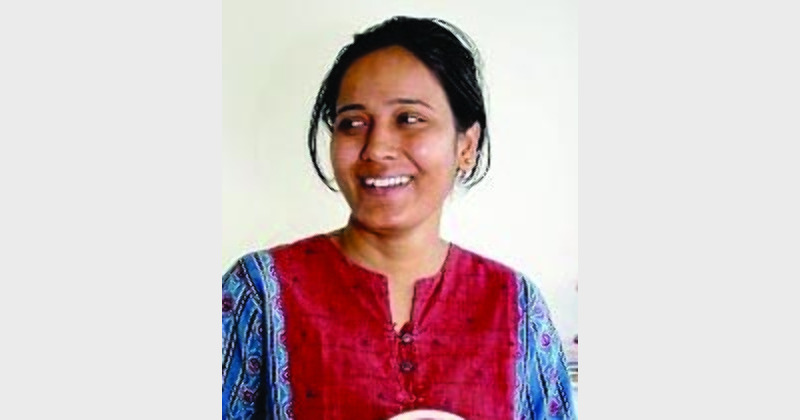
Mittal Patel’s fight for an identity to nomadic communities in Gujarat
 British notified them as ‘habitual criminals’ through the Criminal Tribes Act, 1871. Though we abolished the discriminatory law in 1952, over 200 nomadic communities are still treated as a ‘threat’ to the settled society. Consequently, around 80 million people of these communities keep on wandering from one place to another—deprived of all constitutional safeguards. The modern development only robbed them of their traditional livelihood. In this situation, Mittal Patel of Ahmedabad came as a devdoot for these people. Thanks to her efforts, over 60,000 nomads from 28 nomadic and 12 denotified groups got voting right in 47 blocks under nine districts of the State. She has successfully transformed the lives of over 23,000 nomadic families.
Pramod Kumar
Without ascertaining whether the benefits of its schemes are really reaching the target beneficiaries or not, the UPA government hurriedly announced another scheme—Food Security—on July 3. While bringing an ordinance for it, the government never thought how the people who do not have ration cards or any other document showing them Indian citizen will get benefit of the scheme. Around 8 crore people of 500 nomadic communities, who have been living in the country since centuries, are going to be deprived of the benefits of this scheme also as they were deprived of other schemes. Despite being 7 per cent of the total population these people ‘don’t exist’ for the governments.
They have nothing—no birth certificate, no ration card, no land deeds, no school admission record, nothing. Consequently, they are completely left out of all government schemes including the MGNREGA. Even if a nomad person wants work under the scheme, he can’t get it, because to be eligible for the scheme one needs to be a resident of a village. But village Panchayats routinely refuse to let them be registered as part of the village population. So what if they have lived on the outskirts of a particular village for 20 or more years, they are treated as nomads only, who don’t belong.
The nomadic communities are spread over multiple states mostly in Maharashtra, Rajasthan and Gujarat. In Gujarat, they are about 40 lakh—roughly the population of Singapore or Ireland. They are divided into about 300 groups who follow different ways of worship, practice different occupations and have different customs and beliefs. The Dafer, for instance, are typically employed to guard ripening crops. The Saraniyas are knife sharpeners. The Kangsia are bangle sellers and traders. The Nat and Nataniyas are performers—bards, musicians, acrobats, dancers, fire-eaters and so on. The Vansfoda work with bamboo and sell bamboo products. The Vadis are snake charmers; the Madaris work with monkeys.
It was in these circumstances that Mittal Patel, a gold medalist from Gujarat University’s Department of Journalism, started giving voice to 28 nomadic communities and 12 denotified groups of Gujarat in 2006-07. From helping them claim their land rights to getting voter ID cards, setting up schools for their children and fighting with bureaucrats to extend welfare benefits to them — she has been doing every possible for them. The impact of her work can easily be witnessed in 47 blocks of nine districts—Patan, Mehsana, Amreli, Rajkot, Ahmedabad, Sabarkantha, Gandhinagar, Banaskantha and Surendranagar, where she enrolled over 60,000 people in voters’ list and brought 23,000 families into the mainstream.
“In 2005, I started working with Janpath, a local voluntary organisation. I had no idea of nomadic communities, their occupation, their issues and problems. There was no data or information available on them. It was then that I decided to bring their existence to the notice of not only the government but also of the civil society groups,” says Mittal, while explaining how she got engaged in this field. Over 30 lakh nomads did not figure in any government record at that time. She and her team spent months travelling far-flung rural areas to locate such settlements and gather details to get them official identity. During 2007 Assembly polls, she made a presentation about such nomads to the then Chief Electoral Officer of Gujarat, VK Babbar, who promptly ordered their registration as voters and provide them voters’ ID cards. Thanks to that intervention, over 20,000 people from various settlements then got the right to vote. Since then about 3,000 persons are enrolled every year.
Later, Mittal formed her own voluntary organisation, Vicharata Samudaya Samarthan Manch, in 2010 to intensify the work. Presently, with a team of three dozen workers, she has set up 31 alternate schools, enrolling close to 2,500 children. “Initially, we had enrolled some children in government primary schools in their respective villages, but since they had spent their lives wandering, they found it difficult to sit for a couple of hours at a school. They were also not comfortable with other children, so we decided to set up alternate schools in order to make them accustomed to schooling,” she emphasised.
Mittal is involved so deeply in the cause that she has prepared a detailed report on each of these communities, their traditional occupations, present situation, the main settlements located in Gujarat and the main issues they face. This is a fact that these nomads and denotified communities used to provide a range of essential services like sharpening of knives and farm equipments, making utensils, brooms, entertainment like snake charmers, singers and dancers. But due to modernisation and the advent of technology, their traditional skills have been largely made redundant. Television and cinema killed the demand for traditional entertainment, legislation killed the livelihood of those who work with animals, plastic replaced bamboo and other materials. In the past, people in villages waited for the nomads to show up on their annual routes, trading goods, services and entertainment. Now, there is no demand, literally making them out on the streets.
Mittal seriously focused on updating their skills. The children were encouraged to have compulsory education and those above 16 years of age were arranged jobs in some private companies. Those who are traditionally involved in entertainment were trained for modern entertainment. “Our all efforts are aimed at arranging respectable means of earnings for them,” Mittal adds. The interesting part of her struggle is that she is satisfied with the response from State government. Noted kathakar Morari Bapu encouraged her by organising a special event for the nomads in 2011, which helped put focus on these communities.
Mittal’s struggle continues. “We have so far covered only 60,000 people. We will not stop till we bring all 40 lakh nomads into the mainstream. It is a big target for us in this birth,” she says.