The wretched life of immigrants facing ethnic cleansing
June 12, 2026
  • Read Ecopy
  • Circulation
  • Advertise
  • Careers
  • About Us
  • Contact Us
Android AppiPhone AppArattai
Organiser
  • ‌
  • Bharat
    • Assam
    • Bihar
    • Chhattisgarh
    • Jharkhand
    • Maharashtra
    • View All States
  • World
    • Asia
    • Europe
    • North America
    • South America
    • Africa
    • Australia
  • Editorial
  • International
  • Opinion
  • RSS @ 100
  • More
    • Op Sindoor
    • Analysis
    • Sports
    • Defence
    • Politics
    • Business
    • Economy
    • Culture
    • Special Report
    • Sci & Tech
    • Entertainment
    • G20
    • Azadi Ka Amrit Mahotsav
    • Vocal4Local
    • Web Stories
    • Education
    • Employment
    • Books
    • Interviews
    • Travel
    • Law
    • Health
    • Obituary
  • Subscribe
    • Subscribe Print Edition
    • Subscribe Ecopy
    • Read Ecopy
  • ‌
  • Bharat
    • Assam
    • Bihar
    • Chhattisgarh
    • Jharkhand
    • Maharashtra
    • View All States
  • World
    • Asia
    • Europe
    • North America
    • South America
    • Africa
    • Australia
  • Editorial
  • International
  • Opinion
  • RSS @ 100
  • More
    • Op Sindoor
    • Analysis
    • Sports
    • Defence
    • Politics
    • Business
    • Economy
    • Culture
    • Special Report
    • Sci & Tech
    • Entertainment
    • G20
    • Azadi Ka Amrit Mahotsav
    • Vocal4Local
    • Web Stories
    • Education
    • Employment
    • Books
    • Interviews
    • Travel
    • Law
    • Health
    • Obituary
  • Subscribe
    • Subscribe Print Edition
    • Subscribe Ecopy
    • Read Ecopy
Organiser
  • Home
  • Bharat
  • World
  • Operation Sindoor
  • Editorial
  • Analysis
  • Opinion
  • Culture
  • Defence
  • International Edition
  • RSS @ 100
  • Magazine
  • Read Ecopy
Home Bharat

The wretched life of immigrants facing ethnic cleansing

HERE is a study, which shows the difficulties new inhabitants face when accepting a new city which has been ethnically cleansed by the German population. It presents the ?demographic revolution? that occurred after 1945 when the German Breslau

Archive ManagerArchive Manager
Feb 23, 2013, 11:38 am IST
in Bharat
Follow on Google News
FacebookTwitterWhatsAppTelegramEmail


$img_titleNidhi Mathur

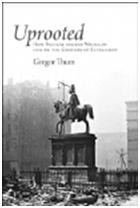
Uprooted: How Breslau Became Wroclaw during the Century of Expulsions, Gregor Thum, Princeton University Press, Pp 400, £ 24.95

 HERE is a study, which shows the difficulties new inhabitants face when accepting a new city which has been ethnically cleansed by the German population. It presents the ‘demographic revolution’ that occurred after 1945 when the German Breslau was converted into Polish Wroclaw and whose more than 600 thousand inhabitants were expelled and replaced by Polish settlers, who find themselves in a place not only unfamiliar to them but utterly repulsive given Wroclaw’s Prussian-German appearance and war-time destruction.

The book studies the consequences of forced migration through the lens of a single location – that of Wroclaw, the largest city in the German territory ceded to Poland after the war and the largest city ever to experience a total population exchange of this kind.

The study provides answers to certain pertinent questions like how could Wroclaw, which was devastated in the World War—II and lost its entire established population, become a thriving city? How did the Polish settlers and their descendants not only overcome their feeling of foreigners and establish roots in the former German city, but also develop a sense of civic pride unsurpassed anywhere in Poland? And how was it possible to make of Worclaw not merely a city in Poland but also a truly Polish city in the course of an extended process that is going on till today?

The book sheds light on an epoch of Wroclaw’s history that has long been neglected by focusing essentially on the forced population exchange and its aftermath, particularly the fundamental changes caused by the great political upheaval of 1989. The ‘demographic revolution’ leading to the rupture of 1945, the new inhabitants’ lack of roots in the city and the psychological problems of moving into new homes and taking over the workplaces of those expelled from the city has a sustained impact on Wroclaw’s  post-war development.

Secondly, Polish settlers did not encounter the German legacies in Wroclaw with indifference, but rather within the context of conflict-laden German-Polish relations, which experienced its darkest phase during the Second World War. Many Poles moved into the apartments of their tormentors or had the opportunity to leaf through the private papers of political opponents from Germany. The German past of Wroclaw had a meaning for most Poles and the author demonstrates that with increasing distance from the Second World War and diminishing political tension between Germany and Poland, an initially interested and ultimately “respectful encounter” developed between the Polish city and the German Breslau.

The author finds Wroclaw as a particularly fascinating case for investigating the case of expulsion because it was the site of several forced resettlements – the expulsion of Germans, the settlement of Poles from Polish territories lost to the Soviet Union, the settlement of Ukrainians deported from southeast Poland in 1947 and the arrival of tens of thousands of Polish Jews, most of whom had survived the holocaust in the Soviet Union and subsequently who fled the rampant anti-Semetism in post-war Poland to the country’s western territories.

Resettlement for Poles was a psychologically different situation as, despite getting to live a more modern and luxurious new residences, the settlers missed their former homes in East Galicia or Volhynia to which they were tied through personal memories and a sense of tradition going back generations. This sense of uprootedness had psychological repercussions which can be overcome only after decades of cultural processes.
 
Normally in the process of rebuilding, new construction is so ruthlessly indulged in that anything regarded as old farmland is pulled down. In many war-ravaged towns, historic buildings were destroyed. In Wroclaw city, the residents attempted to historically to reconstruct “their devastated city, which they had never known in its intact state. They first had to search out the architectural traditions they wished to revive in the reconstruction process.”
 
In post-war Wroclaw, the gradual transformation of a heterogeneous migration society into a unified citizenry had much in common with the nation-building process. One of the tasks was the “invention of tradition”. This led to formation of a common cultural memory capable of creating one community and a sense of belonging, which would make a foreign place a home.

The immediate consequences of resettlement were an unstable society, a high crime rate, rapid depletion of building material and economic stagnation. What is however important is how the Poles reinvented their city of Wroclaw for the second time to make it their own since the Second World War.

Though voluminous, this is a highly moving and touching description displaying the fighting spirit of man against heavy odds.

(Princeton University Press, 41, William Street, Princeton, New Jersey – 08540).
ShareTweetSendShareSend
✮ Subscribe Organiser YouTube Channel. ✮
✮ Join Organiser's WhatsApp channel for Nationalist views beyond the news. ✮
Previous News

A realistic conversation in hell

Next News

Tell Pakistan to behave or face consequences

Related News

US: Anshul Kuncha’s death exposes anti-India racist racket; Assaulting the community that powers American economy!

Security forces undertake anti-Maoist campaign in Odisha in Kandhamal and Malkangiri and seize huge cache of arms

Odisha: Security forces recover caches of weapons of Maoists in Kandhamal and Malkangiri in last three days

Kashmiri Pandits at Kheer Bhawani Temple(File Photo)

J&K: Exiled Kashmiri Pandits throng temples amid enhanced security; Crowd peaks on Jyestha Ashtami at Kheer Bhawani

Global Peace Index Farce: Does the GPI penalise democracies fighting terrorism? India’s case explained

Five Ayush hospitals cum medical colleges to come up in Uttar Pradesh (This is an AI generated image)

Uttar Pradesh plans five integrated AYUSH Colleges and Hospitals to expand traditional healthcare and medical education

(Left) Site of the protest (Right) NIA team in JNIMS hospital

Manipur: NIA starts forensic probe of abduction and killings of 6 Naga civilians by Kuki militants

Load More

Latest News

US: Anshul Kuncha’s death exposes anti-India racist racket; Assaulting the community that powers American economy!

Security forces undertake anti-Maoist campaign in Odisha in Kandhamal and Malkangiri and seize huge cache of arms

Odisha: Security forces recover caches of weapons of Maoists in Kandhamal and Malkangiri in last three days

Kashmiri Pandits at Kheer Bhawani Temple(File Photo)

J&K: Exiled Kashmiri Pandits throng temples amid enhanced security; Crowd peaks on Jyestha Ashtami at Kheer Bhawani

Global Peace Index Farce: Does the GPI penalise democracies fighting terrorism? India’s case explained

Five Ayush hospitals cum medical colleges to come up in Uttar Pradesh (This is an AI generated image)

Uttar Pradesh plans five integrated AYUSH Colleges and Hospitals to expand traditional healthcare and medical education

(Left) Site of the protest (Right) NIA team in JNIMS hospital

Manipur: NIA starts forensic probe of abduction and killings of 6 Naga civilians by Kuki militants

Prime Minister Narendra Modi

The MODI Era: Legacy of 4399 days of Transformation

Late Laxmananda Saraswati (File Photo)

Missing Swami Laxmananda murder judicial inquiry report triggers FIR in Odisha; BJP targets Naveen Patnaik

4,399 days of Prime Minister Narendra Modi

The Meaning of 4,399 Days: Why Even the Opposition Must Now Play by the New Rules Set in the Modi Era

Keralam: Audit finds gold and silver ornaments missing from nearly 20 temples under Neyyattinkara Devaswom sub group

Load More
  • Privacy
  • Terms
  • Cookie Policy
  • Refund and Cancellation
  • Delivery and Shipping

© Bharat Prakashan (Delhi) Limited.
Tech-enabled by Ananthapuri Technologies

  • Home
  • Search Organiser
  • Bharat
    • Assam
    • Bihar
    • Chhattisgarh
    • Jharkhand
    • Maharashtra
    • View All States
  • World
    • Asia
    • Africa
    • North America
    • South America
    • Europe
    • Australia
  • Editorial
  • Operation Sindoor
  • Opinion
  • Analysis
  • Defence
  • Culture
  • Sports
  • Business
  • RSS @ 100
  • Entertainment
  • More ..
    • Sci & Tech
    • Vocal4Local
    • Special Report
    • Education
    • Employment
    • Books
    • Interviews
    • Travel
    • Health
    • Politics
    • Law
    • Economy
    • Obituary
  • Subscribe Magazine
  • Read Ecopy
  • Advertise
  • Circulation
  • Careers
  • About Us
  • Contact Us
  • Policies & Terms
    • Privacy Policy
    • Cookie Policy
    • Refund and Cancellation
    • Terms of Use

© Bharat Prakashan (Delhi) Limited.
Tech-enabled by Ananthapuri Technologies