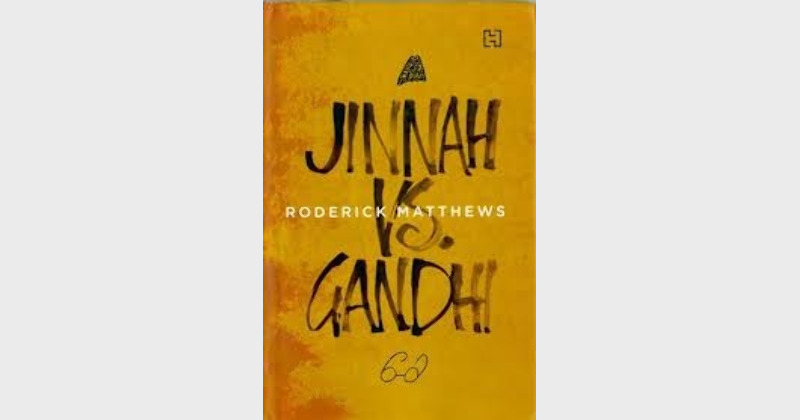
Jinnah vs Gandhi, Roderick Matthews; Hachette India; Pp 330, Rs 499?
MV Kamath? THERE must be a large cupboard full of books on Mohandas Karamchand Gandhi but one cannot think even of a shelfful on Mohammad Ali Jinnah. The founder of Pakistan has seldom attracted attention – and forget Jaswant Singh. Gandhi wrote a lot, besides leaving behind the papers he edited like Young India and Harijan. But Jinnah never wrote his autobiography or political testament that might reveal the private thoughts behind the public personae. Both Gandhi and Jinnah have a Gujarati background but while Gandhi was proud of his mother tongue, Jinnah was a seldom heard to speak in it.
What this book has done is to compare and contrast these two leaders and they way the functioned. That is what makes it endlessly fascinating. Matthews sounds like a psycho-analyst or psychiatrist, which he is not. He is a historian but his characterisation of two of India’s leading lights invites attention. He naturally traces the political lives of Gandhi and Jinnah, the trials and tribulations they both underwent in considerable detail. But what comes as a surprise is the very poor attention he has given to the Nagpur Congress late in 1920, which many think has a historic significance.
By then Gandhi had come to be known as Mahatma – an honour bestowed on him by Rabindranath Tagore. It didn’t go well with Jinnah. In his address to the Congress he kept referring to Gandhi as Mr Gandhi even when his audience loudly insisted that Gandhi should be addressed as Mahatma. This went on for quite some time. There was booing…. Things came to such a pass that Jinnah finally had to quit, greatly offended. Many believe that that was to be the turning point in his anti-Congress career. Matthews writes that “it is tempting to interpret the proceedings at Nagpur as a clash of ambitions between the two men and further that the” events of 1920 convinced him (Jinnah) that there was no longer a way forward to Muslim equality through the Congress”. That may be partly true.
What happened at the Nagpur Congress was that Jinnah’s ego was deeply hurt and emotionally he must have sought revenge. He became a communalist, through and through. To him, thereafter, Muslims came first and foremost, though in his early years he was, in Sarojini Naidu’s words, “ambassador to Hindu-Muslim unity”. One suspects that basically Jinnah was not a communalist and it was the Nagpur Congress that temporarily drove him to become one. Matthews refers to the many Hindu friends that Jinnah had. Indeed, once India was partitioned and Jinnah got at least a part of what he sought, he sounded as if he wished to go back to his early secularism.
In his famous speech on August 11, 1947 his commitment to wide tolerance came through clearly. Said Jinnah; addressing those who had overnight become Pakistanis: “You are free; you are free to go to your temples, you are free to go to your mosques or to any other place of worship. You may belong to any religion or caste or creed – that has nothing to do with the business of the state”. But it was too late. Jinnah had damned himself, knowingly or unknowingly. He had destroyed the unity of India. He had revenged the insults poured on him in Nagpur. But could things have been better if there was more understanding of Jinnah’s proclaimed demands by the Congress and Gandhi? One must give credit to Matthews on this point. Much as he sounds more sympathetic towards the Mahatma’s role in politics between 1920 and 1942, he is fair in his study.
The Congress, alas, had also made mistakes for which the country was to pay dearly. It just refused to be accommodative, in a constructive way as suggested by C Rajagopalachari. Perhaps Jinnah could have been brought in line, considering that early in 1946 he had suggested two parallel states in India living under a weak central body but with one undivided army. In retrospect, one wonders whether there would have been a different India if Gandhi, not Congress, had his way. The chapter on Plans and Partition is particularly instructive – and heart breaking. Credit must be given to Matthews: his analysis of events from 1941 to 1946 has the stamp of objectivity. But to go back to his assessment of both Jinnah and Gandhi. Here are a few quotes:
* Gandhi always worked from small to large, from inside to outside; Jinnah always worked backwards.
* Jinnah was committed to ends without great regard to means. For Gandhi non-violence was the key to moral elevation.
* Gandhi began his career looking for a way to realise his religious aims in political term while Jinnah made his carreer looking for a way to fulfil his political aims in religious terms.
* While Gandhi excelled as an active protestor, Jinnah was the most skilful of passive opponents. Gandhi was a leader by example, Jinnah a leader by inspiration.
* Jinnah was more the warrior and Gandhi more the sage; Jinnah wanted to lead from above, Gandhi from below. Jinnah was essentially urban and technical, Gandhi, rural and instinctive.
* Jinnah garnered the widest possible support base, but his was the leadership of momentum, not of foresight. Gandhi had the right kind of virtues to found a nation, Jinnah ultimately did not.
As Matthews saw Gandhi, for a spiritual leader, social critic and oppositional figure, Gandhi’s main achievement, surprisingly, was political. He took the Indian National Congress, an organisation founded on western concepts and turned it into an unmistakably Indian institution. Gandhi converted weakness into strength by defying the powerful to use their power without proving their own moral bankruptcy. But, says Matthews, Jinnah “has to take a great deal of responsibility for so relentlessly terrifying Muslims about the perils of Hindu raj, for unleashing ‘Direct Action’ without adequate discipline.”
Matthews goes even one step further to say that “India was fortunate to inherit the best of Gandhi (while) Pakistan has had to do with the worst of Jinnah”. To that, Matthews adds: “Even if we cannot hold Jinnah responsible for everything that has happened in Pakistan, the granting of his wish that it be created has given him a great deal to live down”. As for Gandhi, Matthews says that “Fate was kind to the Mahatma”. “He never achieved his dream and so, unlike Jinnah’s it has remained unsullied by failure”. As was stated at the beginning, there are hundreds of books on Gandhi but this work by Matthews will always remain outstanding for its startling and yet fair comprehension of the Mahatma and his vicious opponent.
(Hachette India, 4th/5th Floors, Corporate Centre, Plot No. 94, Sector-44, Gurgaon:-122 009)
?