A comparative study of three legendary men
December 12, 2025
  • Read Ecopy
  • Circulation
  • Advertise
  • Careers
  • About Us
  • Contact Us
Android AppiPhone AppArattai
Organiser
  • ‌
  • Bharat
    • Assam
    • Bihar
    • Chhattisgarh
    • Jharkhand
    • Maharashtra
    • View All States
  • World
    • Asia
    • Europe
    • North America
    • South America
    • Africa
    • Australia
  • Editorial
  • International
  • Opinion
  • RSS @ 100
  • More
    • Op Sindoor
    • Analysis
    • Sports
    • Defence
    • Politics
    • Business
    • Economy
    • Culture
    • Special Report
    • Sci & Tech
    • Entertainment
    • G20
    • Azadi Ka Amrit Mahotsav
    • Vocal4Local
    • Web Stories
    • Education
    • Employment
    • Books
    • Interviews
    • Travel
    • Law
    • Health
    • Obituary
  • Subscribe
    • Subscribe Print Edition
    • Subscribe Ecopy
    • Read Ecopy
  • ‌
  • Bharat
    • Assam
    • Bihar
    • Chhattisgarh
    • Jharkhand
    • Maharashtra
    • View All States
  • World
    • Asia
    • Europe
    • North America
    • South America
    • Africa
    • Australia
  • Editorial
  • International
  • Opinion
  • RSS @ 100
  • More
    • Op Sindoor
    • Analysis
    • Sports
    • Defence
    • Politics
    • Business
    • Economy
    • Culture
    • Special Report
    • Sci & Tech
    • Entertainment
    • G20
    • Azadi Ka Amrit Mahotsav
    • Vocal4Local
    • Web Stories
    • Education
    • Employment
    • Books
    • Interviews
    • Travel
    • Law
    • Health
    • Obituary
  • Subscribe
    • Subscribe Print Edition
    • Subscribe Ecopy
    • Read Ecopy
Organiser
  • Home
  • Bharat
  • World
  • Operation Sindoor
  • Editorial
  • Analysis
  • Opinion
  • Culture
  • Defence
  • International Edition
  • RSS @ 100
  • Magazine
  • Read Ecopy
Home General

A comparative study of three legendary men

Archive ManagerArchive Manager
Jan 19, 2013, 12:00 am IST
in General
Follow on Google News
FacebookTwitterWhatsAppTelegramEmail

Manju Gupta
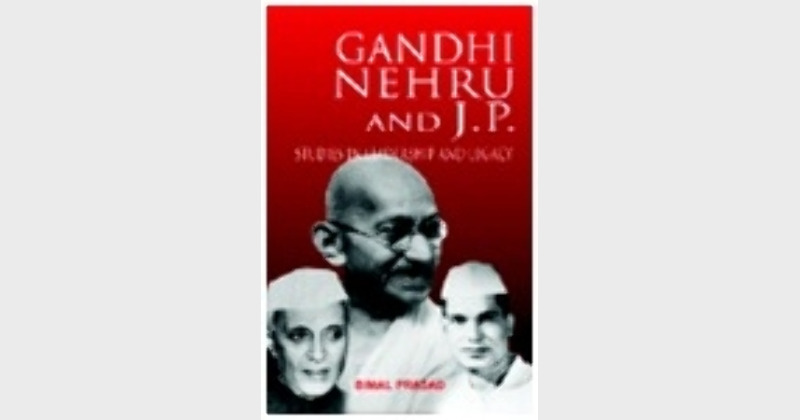
Gandhi, Nehru and JP: Studies in Leadership and Legacy, Bimal Prasad, Promilla & Co., Publishers, Pp 389, Rs 495.00

ONE of India’s foremost historians of the Gandhian era, presents this study of the legacies of Gandhi, Nehru and JP in respect of their style of political leadership in a particular period of Indian history. It reads like a balanced and critical view of all the three leaders under one cover in the context of their objective of establishing a just economic, social and political order in India.

 Some recent studies have tried to depict Gandhi and Nehru as representing two contrasting systems of thought and action and to project either one or the other, depending on one’s predilection, as providing a panacea for India’s problems which is a prejudiced view. But the author-historian rejects this simplistic view and takes a fresh look at their political ideologies and presents a comparative perspective. As a result, neither do the three leaders appear as rivals nor as ideologically opposed, but as complementary to each other.

The book is divided into four chapters with the first three chapters devoted individually to each statesman while the fourth presents the conclusion.

The first chapter traces the emergence of Mahatma Gandhi as a political leader of the masses and discusses the distinctive characteristics of his style of leadership. Gandhi emphasised the virtue of conciliation rather than conflict. One of the keys to the continuance as well as emergence of Gandhi’s leadership was his supreme sense of tactics. He knew, as no one else among his contemporaries in India did, both when to start a movement and when to suspend it. When he referred to his ‘inner voice’ regarding his crucial decisions, it did not result due to any occult or mystical source, but were “determined according to the exigencies of the situation”, as he himself admitted when writing in 1939. Actually it was “his capacity to crystallise the prevailing mood of the people” which was the secret of his hold over other leaders as well as the masses. In the 1942 ‘Quit India’ movement, he received an unprecedented popular response while on the other hand, in 1946-47, in site of his unhappiness over the events leading towards Partition of India, he did not even think of launching a campaign of civil disobedience. This he pointed out to one of his associates that as a result of one year of communal riots, the situation was surcharged with communalism and was not at all favourable for a struggle.

But what is more touching to read is that when Nehru and Sardar Patel were busy settling the terms of the Partition and getting the first draft of the Mountbatten Plan, as amended by the British cabinet, Gandhi was not consulted and he mentioned in the Congress Working Committee meeting on May 31, 1947 that as he was against the thought of Partition of India under British supervision and in the midst of widespread Hindu-Muslim riots, “My life’s work seems to be over. I hope God will spare me further humiliation.” He continued with his musings in a low voice, “Today I find myself all alone. Even the Sardar and Jawaharlal think that my reading of the situation is wrong and peace is sure to return if Partition is agreed upon…They did not like my telling the Viceroy that even if there was to be a Partition, it should not be through British intervention or under the British rule…They wonder if I have not deteriorated with age…” 

The author says, “JP was no stickler for consistency and changed paths several times in his life, but only when be became convinced that a change was desirable. Persuasion, pressure or expediency never played any role in this.” He launched a mass movement in Bihar in 1974 in order to save democracy when Indira Gandhi declared Emergency but while leading the movement, “JP had failed to build up a second level of leadership. His record in this respect was no better than Nehru’s.” This the author says when referring to JP’s illness and weakness to pursue the movement. The author adds that JP “shows an utter lack of a sense of tactics, which was a major weakness of JP as a political leader.”

The final chapter seeks to highlight the common points in the political legacies left by the three leaders and points out that they can serve as the ideological foundations of a new India based on the principles of egalitarianism and social justice.
(Promilla & Co., Publishers, C-127 Sarvodaya Enclave, New Delhi-110017; www.biblioasia.com)

ShareTweetSendShareSend
✮ Subscribe Organiser YouTube Channel. ✮
✮ Join Organiser's WhatsApp channel for Nationalist views beyond the news. ✮
Previous News

A road map for enlightened public life

Next News

A comparative study of three legendary men

Related News

The Preah Vihear Temple on a cliff in the Dangrek mountains along the border of Cambodia-Thailand

Thailand-Cambodia conflict: UNESCO urges urgent protection of the Hindu temple & cultural heritage

Representative Image

Baloch woman critically injured in Kech as Pakistani forces accused of indiscriminate firing

Ambassador Harish Parvathaneni, India's Permanent Representative to the UN

India calls for “pragmatic engagement” with Taliban at UNSC meeting on Afghanistan

Hindu–Sikh Unity: The foundation of Punjab’s strength and stability

Muhammad Yunus, Chief Advisor of the Interim administration of Bangladesh

Unmasking Muhammad Yunus: Series of lies etched with corruption, plagiarism, shadow deals & ultimate thirst for power

Bhattacharya, IAS (Retd.),

Telangana: Retired IAS officer turns economics lecture into anti-Hindu tirade; FIR filed at IPE Hyderabad

Load More

Comments

The comments posted here/below/in the given space are not on behalf of Organiser. The person posting the comment will be in sole ownership of its responsibility. According to the central government's IT rules, obscene or offensive statement made against a person, religion, community or nation is a punishable offense, and legal action would be taken against people who indulge in such activities.

Latest News

The Preah Vihear Temple on a cliff in the Dangrek mountains along the border of Cambodia-Thailand

Thailand-Cambodia conflict: UNESCO urges urgent protection of the Hindu temple & cultural heritage

Representative Image

Baloch woman critically injured in Kech as Pakistani forces accused of indiscriminate firing

Ambassador Harish Parvathaneni, India's Permanent Representative to the UN

India calls for “pragmatic engagement” with Taliban at UNSC meeting on Afghanistan

Hindu–Sikh Unity: The foundation of Punjab’s strength and stability

Muhammad Yunus, Chief Advisor of the Interim administration of Bangladesh

Unmasking Muhammad Yunus: Series of lies etched with corruption, plagiarism, shadow deals & ultimate thirst for power

Bhattacharya, IAS (Retd.),

Telangana: Retired IAS officer turns economics lecture into anti-Hindu tirade; FIR filed at IPE Hyderabad

The Tamil Community in Moreh

Tamil footprints on the Indo-Myanmar frontier: A civilisational saga from Rangoon to Moreh

Duff performance in front of Chennakeshava temple, Mangaluru cancelled after opposition from Hindu organisations

Karnataka: Performance of Duff in front of Chennakeshava temple cancelled due to opposition from Hindu organisations

Modi–Putin diplomacy triumphs as Congress drowns in its own confusion

Bangladesh national elections scheduled for February 12

Bangladesh elections on Feb 12; First since the topple of Hasina regime, Set to decide political course of the country

Load More
  • Privacy
  • Terms
  • Cookie Policy
  • Refund and Cancellation
  • Delivery and Shipping

© Bharat Prakashan (Delhi) Limited.
Tech-enabled by Ananthapuri Technologies

  • Home
  • Search Organiser
  • Bharat
    • Assam
    • Bihar
    • Chhattisgarh
    • Jharkhand
    • Maharashtra
    • View All States
  • World
    • Asia
    • Africa
    • North America
    • South America
    • Europe
    • Australia
  • Editorial
  • Operation Sindoor
  • Opinion
  • Analysis
  • Defence
  • Culture
  • Sports
  • Business
  • RSS @ 100
  • Entertainment
  • More ..
    • Sci & Tech
    • Vocal4Local
    • Special Report
    • Education
    • Employment
    • Books
    • Interviews
    • Travel
    • Health
    • Politics
    • Law
    • Economy
    • Obituary
  • Subscribe Magazine
  • Read Ecopy
  • Advertise
  • Circulation
  • Careers
  • About Us
  • Contact Us
  • Policies & Terms
    • Privacy Policy
    • Cookie Policy
    • Refund and Cancellation
    • Terms of Use

© Bharat Prakashan (Delhi) Limited.
Tech-enabled by Ananthapuri Technologies