Industrial revolution in its 3rd century is about convergence
Manju Gupta
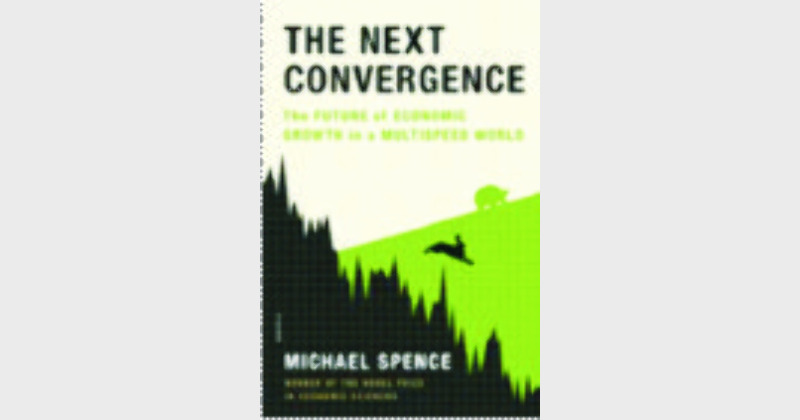
The Next Convergence: The Future of Economic Growth in a Multispeed World, Michael Spence, Farrar, Straus and Giroux, Pp 296, $ 17.00
This book is about the third century of the Industrial Revolution, the one we are now living in. The author says that economic growth was negligible till about 1750. Then around 1750, England started on a new course of Industrial Revolution, when per capita incomes started to rise. This pattern continued rapidly till the 19th century, probably due to the growth of applications of science and technology to production, logistics and communication, management and institutional innovations and change in governance and the way politics and government interacted with the economy.
In the last four years, the author noticed that the pattern of growth and poverty reduction in the developing world has been spreading and accelerating and along with it, a growing sense of optimism. It also dawned on him during the process that the high dependence on advanced economies has started to decline, especially in the last 10 years, and the developing world is becoming a large and increasingly important part of the global economy, with all the opportunities and challenges that go along with this growth. “The largely separate worlds of the advanced and developing countries are converging. As a consequence, the growth of the developing world will increasingly be part of the lives of every one, regardless of where they live and work.”
This book is divided into four parts. Part I deals with the rapidly shifting characteristics of the post-war global economy. It is, in effect, a picture of what the global economy looks like and how it got three in the last 50 years.
Part II is devoted to sustained high growth and poverty reduction in the developing world; where it is occurring, how it happens and where it is not occurring with some attempt to analyse the reasons for the much slower growth in lagging regions.
Part III turns to the short-and longer-term impacts of the global economic and financial crisis that gripped the world starting in 2008. What effect did it have on the developing countries? Here the author shows what is the importance of interdependence; how well the developing countries responded to the crisis and what is the medium and longer-term outlook for them in a world in which developed countries struggle with de-leveraging, fiscal stability, a shortfall in demand, high unemployment and low growth. What lessons have the emerging economies absorbed and how these lessons will impact financial and economic globalisation, growth strategies and dynamics and the lessons that developing countries have learnt that are relevant in the more advanced economies.
Part IV turns to the future and a set of abuses, forces and trends that have to do whether this pattern of spreading high growth in incomes and wealth can be sustained. There are economic governance, natural resource and environmental braking mechanisms that may slow the process down or cause it to stop altogether. In looking at these, we encounter a variety of different versions of what are sometimes called “adding-up” problems.
The prime goal of the author is to make the dynamics of developing-countries growth more understandable and growth’s relationships to and interdependencies with the global economy more visible and easier to understand. He advocates a greater knowledge of the evolution of this increasingly large and important part of the world – the developing countries and the reaction of developing countries to international issues are conditioned by their growth experience and prospects. He advises the developed world to see the developing countries through the latters’ eyes just as they will need to see through the formers’ eyes. This two-way understanding is likely to be an essential underpinning of the world’s future capacity to manage global interdependence. With it, progress on a host of issues – climate change, the WTO, regulating the global financial system, global governance, rebalancing of the global economy and maintaining stability – will be difficult to achieve.
(Farrar, Straus and Giroux, 18, West 18th Street, New York 100 110; www.fsgbooks.com)
Manju Gupta
The first Pop Age: Painting and Subjectivity in the Art of Hamilton, Lichtenstein, Warhol, Richter and Ruscha, Hal Foster, Princeton University Press, Pp 338, £ 19.95 The prime concern of this book is how Pop art often folds painting and photography into each other; how in doing so, it combines the effect of immediacy with the facts of mediation; how, in this combination, Pop art might evoke artistic tradition even as it foregrounds contemporary subjects; how in the treatment of image culture, it strikes an ambiguous attitude, neither critical nor complicit strictly; and finally, how Pop art indicates through such ambiguity, not only a heightened confusion between publicity and privacy, but also a deepened implication of image and subjectivity.
The author chooses five Pop artists – Richard Hamilton, Roy Lichtenstein, Andy Warhol, Gerhard Richter and Ed Ruscha to reflect and expound upon because “they evoke, more graphically than any other, the changed conditions of painting and views in the first age of Pop art, which here I take to have begun in the mid to late 1950s.” The theme for this thesis of his is that a shift occurred during this time in the status of image and subjectivity alike, and the signal work of these five artists registers it most suggestively.
All of them advanced the use of collage that Pop art then adapted to painting – in this, the key moment came when Hamilton moved from the collage format to “just what is it that makes today’s homes so different, so appealing?” to “tabular pictures”.
Pop art puts painting under pressure chiefly in order to register the effects of consumer culture at large (glossy magazine ads, iconic movie images, blurry television screens and so on), but even as it does so, it sometimes looks back to the tradition of the tableau. And in this interplay of low and high, Pop art remains in touch with “the painting of modern life”, defined by a century before by Charles Baudelaire as an art that strives “to distil the eternal from the transitory.”
On the one hand, at the time of Pop art, mass media seemed to trump artistic mediums and Pop art suggests that almost anything can be reformatted as an image and shuttled across various modes of presentation. On the other hand, Pop art resists any teleology of media (as promoted by Marshall McLuhan, for whom the fate of a medium like radio was to become the content of television) and uses painting to reflect on the transformations wrought on both popular culture and fine art by photography, film, television and so on. Thus at a time when painting seemed to be overturned not only in mass culture but also in avant-garde art, painting returned, in the most impressive examples of Pop art, almost as a meta-art, able to assimilate some media effects and to reflect on others precisely because of its relative distance from them.
The author says that the portrayed subject in this art tends to be superficial, even flat, psychologically as well as physically. The comics in book figures of Lichtenstein are a chief case in point, but hardly the only one, as the blank pose is often adopted in Pop personae too. The author says, “Interest in the superficial, the banal and the neutral, which is also strong in Richter and Ruscha, is not really an aesthetic reaction to the deep subjectivity which is still encoded in residual forms of surrealism and abstract expressionism.”
Pop art often suggests paradoxical structures of feeling, looking and meaning: an effect that is flat one moment and intense the next, a gaze that is deadpan at times and desirous at others; a significance that seems all but absent at first glance and super abundant a second later, with the viewer positioned as a black scanner one moment and a frenetic iconographic the next. This book is a gripping narrative and is of special interest to art historians artists and art lovers.
(Princeton University Press, 41, William Street, Princeton, New Jersey – 08540)