Dr R Balashankar
Russian Politics – The Paradox of a Weak State, Marie Mendras, Hurst & Company, HB, Pp 349, £25.00
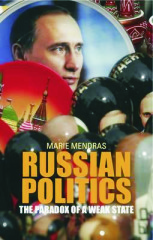 Vladimir Putin is widely seen as the man who pulled Russia from the verge of an abyss. Who brought stability to the nation that was reeling under series of political uncertainties. But according to author, Marie Mendras, Putin is the biggest problem for Russia, a single stumbling block in the country’s path of progress. In Russian Politics – The Paradox of a Weak State, Mendras heaps charges on Putin, of being an authoritarian, of being corrupt and on a mission to demolish all the public institutions. She harps on the theme that Russia is a “strong power based on a weak state.”
“After the 1990s, which were marked by the dismantling and very imperfect rebuilding of government organizations, Vladimir Putin sought to undermine all the institutions that did not come within the compass of the central state from his point of view. Whereas Boris Yeltsin had let the institutions decline, his successor pursued a systematic strategy of hollowing out public institutions.” In this model, she says the ordinary Russians enjoy lot of personal freedom, which they had not under the Communist rule, but they are pushed out of the political system. “Private individual is now free while the public citizen is very weak.”
Marie Mendras discusses the economic, political and social conditions that prevailed in the Communist era and how after the fall of the Soviet Union, the Russian nation reworked itself, only to land in a political system that can hardly be called better, at least from the West’s point of view. While people may have rejoiced over the fall of Communist regime, engineered by Gorbachev, the liberation also came with huge prize — the ‘free‘ nation now was only three quarters of its previous size, with a large part of the land lying in Siberia and the Far East. The population had shrunk by half. Fourteen republics had broken away, taking with them the mineral resources, and industries. It created a crisis of identity for the Russians. “When Vladimir Putin came to power in 1999-2000, conditions were conducive for a new attempt at ideologizing the nation and power.”
Gorbachev was the darling of the West. For, he single handedly did what as a block the West had been attempting for decades—to bring down the communist rule. With it came the withering away of the Eastern Europe. The Western, capitalist conquest of the world was near-complete. Putin, with his brusque and not-so-friendly demeanor put paid to all the labour, by steering Russia away from the total take over by the West and its values.
Post Gorbachev and Yeltsin, Russia was rudderless, a scene in which the communists gained strength. In the 1995 elections, they put up a good show. “There are several reasons for the strength of the Communist vote nearly five years after the demise of the USSR, the chief one being the feeling of depression and helplessness which had overcome the whole of Russia since 1992.” Putin, when he took over, Marie Mendras says, put up a pretense of building democracy, to win applause from the West. He later abandoned this quest. “The most striking feature of this systematic hollowing out of the institutions of state and society is that it now took place openly, in broad daylight, with no pretense of keeping up appearances. Until 2003, Putin’s regime attempted to maintain a semblance of democracy and still courted the approval of Western democracies. The fundamental difference between Vladimir Putin’s first and second term is the abandonment of civil liberties, competition, and self-government specific to liberal-democratic societies.”
That is the biggest charge against Putin. He no longer enjoys the appreciation of the West or craves for their approval. He has fallen out of their favour and worse, does not seem to mind it. He has refused to play by their rules only. The rest of the points in the chargesheet are only add-ons to this basic quarrel.
Marie Mendras projects three paradigms that appear decisive for the present and future of the strength of the Russian system. They are: the relationship with the outside world would be a determining factor for the development of Russia; the relationship between the individual citizen and the state; and the weakening of the state in the post-Communist era. In all her arguments, the author ignores the fact that Russia is an old country, older than most countries in the West, a nation that has seen some of the worst political trysts and suffered the most reprehensible dictatorship. But from each, it has arisen. The Russians have the resilience. And the West has mostly been only onlookers to these events. Judging Russia and its politics through the standards of the soft democracies of the West is not a fair study. If this book suffers from a flaw it is the overbearing tone of being judgmental. Unlike the floundering economies of Europe, being supported on their feet by global borrowings and donations, Russia is holding on its own. It is the strength of the state. The charges against Putin are not extraordinary. Nothing that has not been hurled at political leaders of a functional vibrant democracy like India.
The book was originally written in French and is supported by the French Ministry of Foreign Affairs. It was first published in 2008. Marie Mendras is Professor at Sciences Po University and Research Fellow with the National Centre for Scientific Research in Paris.
(Hurst & Company, 41 Great Russell Street, London, WC1B 3PL)