BOOKMARK-I
July 25, 2026
  • Read Ecopy
  • Circulation
  • Advertise
  • Careers
  • About Us
  • Contact Us
Android AppiPhone AppArattai
Organiser
  • ‌
  • Bharat
    • Assam
    • Bihar
    • Chhattisgarh
    • Jharkhand
    • Maharashtra
    • View All States
  • World
    • Asia
    • Europe
    • North America
    • South America
    • Africa
    • Australia
  • Editorial
  • International
  • Opinion
  • RSS @ 100
  • More
    • Op Sindoor
    • Analysis
    • Sports
    • Defence
    • Politics
    • Business
    • Economy
    • Culture
    • Special Report
    • Sci & Tech
    • Entertainment
    • G20
    • Azadi Ka Amrit Mahotsav
    • Vocal4Local
    • Web Stories
    • Education
    • Employment
    • Books
    • Interviews
    • Travel
    • Law
    • Health
    • Obituary
  • Subscribe
    • Subscribe Print Edition
    • Subscribe Ecopy
    • Read Ecopy
  • ‌
  • Bharat
    • Assam
    • Bihar
    • Chhattisgarh
    • Jharkhand
    • Maharashtra
    • View All States
  • World
    • Asia
    • Europe
    • North America
    • South America
    • Africa
    • Australia
  • Editorial
  • International
  • Opinion
  • RSS @ 100
  • More
    • Op Sindoor
    • Analysis
    • Sports
    • Defence
    • Politics
    • Business
    • Economy
    • Culture
    • Special Report
    • Sci & Tech
    • Entertainment
    • G20
    • Azadi Ka Amrit Mahotsav
    • Vocal4Local
    • Web Stories
    • Education
    • Employment
    • Books
    • Interviews
    • Travel
    • Law
    • Health
    • Obituary
  • Subscribe
    • Subscribe Print Edition
    • Subscribe Ecopy
    • Read Ecopy
Organiser
  • Home
  • Bharat
  • World
  • Operation Sindoor
  • Editorial
  • Analysis
  • Opinion
  • Culture
  • Defence
  • International Edition
  • RSS @ 100
  • Magazine
  • Read Ecopy
Home Bharat

BOOKMARK-I

Economics today is much more than money and taxes. It has evolved into a science overlapping on other social sciences. Now, the governments decide how much, how and on what to spend money on.

Archive ManagerArchive Manager
Feb 4, 2012, 11:52 pm IST
in Bharat
Follow on Google News
FacebookTwitterWhatsAppTelegramEmail

The prosperity formula?

By Dr R Balashankar?
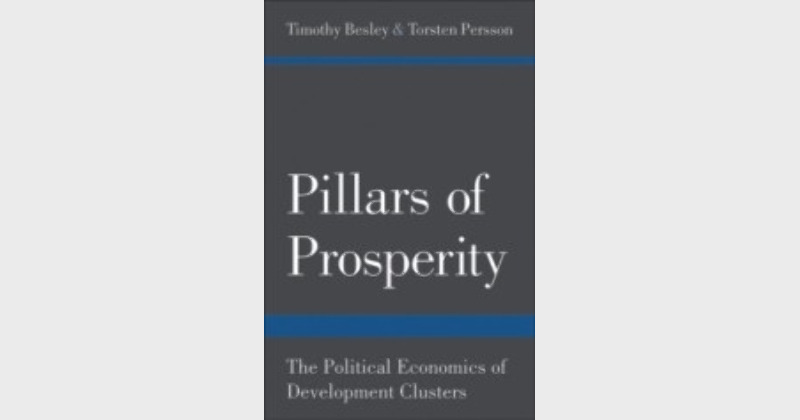
undefined?Pillars of Prosperity: The Political Economics of Development Clusters, Timothy Besley and Torsten Persson, Princeton, Pp 375 (HB), $ 45.00?

Economics today is much more than money and taxes. It has evolved into a science overlapping on other social sciences. Now, the governments decide how much, how and on what to spend money on. For instance, the tax system in India is so all-pervading that it determines the amount of petrol we use, the number of calls we make, the cigarrets we puff away and the levels of saving a citizen can and cannot do. That after all this, the income disparities are growing and the rich are getting richer and the poor poorer is an undeniable fact.

Timothy Besley and Torsten Persson in their book, Pillars of Prosperity: The Political Economics of Development Clusters, discuss the factors that lead to prosperity and poverty at a very theoretical level. With well-defined formulas, complete with symbols and equations, the two scholars break down economics and governance. The discourse is based on the three parametres for prosperity — effective state institutions, the absence of political violence and high per-capita incomes. Two of these three had been prescribed by Adam Smith nearly 200 years ago. He said, “Little else is required to carry a state to the highest degree of opulence from the lowest barbarism, but peace, easy taxes, and a tolerable administration of justice, all the rest being brought about  by the natural course of things.”

Besley and Persson have set out to understand and unravel “why some countries are rich and others poor?” Today, the income disparity between some of the poorest and some of the richest is as high as 200 times. “It has long been understood that economic development is about much more than rising income. Indeed, state effectiveness is now given center stage in practical policymaking, with a greater focus on how to deal with countries hobbled by weak, fragile, or failed states,” say the authors. Their approach is macroeconomic and macropolitical.

In an exercise undertaken to predict pillars of prosperity, using eight linear specifications, India, China, Myanmar and Sri Lanka are among the Asian countries that were way off in the predicted and actual ranking (negative). The analysis for India goes like this: “India is the country with the largest difference in both rank and index value. As already noted, India suffers from a low value of state capacity as well as a great deal of political violence. In terms of predictors, however, India has quite cohesive political institutions, being one of the oldest democracies in the developing world. It is ethnically fragmented, which works against common interests of the state, but it has a history with threats of external conflict, which works in favour of common interest…”

This is a highly theoretical book, starting on a certain premise and dealing in a limited area. It is an academic exercise meant to provoke debate and discussion. Timothy Besley is the Kuwait Professor of Economic and Political Science at the London School of Economics and Political Science and Torsten Persson is the Torsten and Ragnar Soderberg Chair in Economic Sciences and professor of economics at the Institute for International Economic Studies, Stockholm University.    

(Princeton University Press, 41 William Street, Princeton, New Jersey 08540)?

ShareTweetSendShareSend
✮ Subscribe Organiser YouTube Channel. ✮
✮ Join Organiser's WhatsApp channel for Nationalist views beyond the news. ✮
Previous News

NEWS ROUND-UP?1

Next News

NEWS ROUND-UP-II

Related News

Central chairman of the Baloch Students Organisation (BSO), Jihand Baloch

BSO Chief Jihand Baloch detained again; Rights Groups claim fresh wave of enforced disappearances by Pakistsan

RSS Pracharak V Bhagayya Ji Addressing the ‘Yuva Samvad’ programme in Ranchi

Jharkhand: RSS aims to foster social unity, social harmony and national spirit: V Bhagayya Ji

From Most Backward States to Hilly States the Image of Investment is Changing

Beyond the Coastal Giants: Odisha, Uttar Pradesh and Himalayan states redefine India’s investment map

- AIIMS NORCET 11 applications open for nursing officer posts across AIIMS Institutes

AIIMS NORCET 11 Notification Released: Online Registration Open, CBT Exams from September 12

Security forces secure the site after a suicide attack in in Tank district

Pakistan: 12 soldiers, 2 policemen killed by TTP rebels in Tank district of restive Khyber Pakhtunkhwa province

July 25, 1986, Muktsar Bus Massacre: When Khalistani radicals killed passengers simply for being Hindu

Load More

Latest News

Central chairman of the Baloch Students Organisation (BSO), Jihand Baloch

BSO Chief Jihand Baloch detained again; Rights Groups claim fresh wave of enforced disappearances by Pakistsan

RSS Pracharak V Bhagayya Ji Addressing the ‘Yuva Samvad’ programme in Ranchi

Jharkhand: RSS aims to foster social unity, social harmony and national spirit: V Bhagayya Ji

From Most Backward States to Hilly States the Image of Investment is Changing

Beyond the Coastal Giants: Odisha, Uttar Pradesh and Himalayan states redefine India’s investment map

- AIIMS NORCET 11 applications open for nursing officer posts across AIIMS Institutes

AIIMS NORCET 11 Notification Released: Online Registration Open, CBT Exams from September 12

Security forces secure the site after a suicide attack in in Tank district

Pakistan: 12 soldiers, 2 policemen killed by TTP rebels in Tank district of restive Khyber Pakhtunkhwa province

July 25, 1986, Muktsar Bus Massacre: When Khalistani radicals killed passengers simply for being Hindu

FCRA Tightens Grip on Proselytisation: Curbs foreign funds for forced conversion & other anti-sovereign endeavours

PM Modi's Late-Night Instagram Reel Sets World Record with 303 Million Views,

Mass Connect Continues: PM Modi’s Instagram reel sets a new 24-hour world record with 303 million views

NTA Recruitment Drive 2026: 4 General Manager, 16 Young Professional Posts Open Amid Institutional Reforms

NTA Overhaul Begins After NEET Row: Applications open for 4 General Managers, 16 young professionals

China targets Tibet's largest Buddhist Centre in new demolition drive

Larung Gar: How China is secretly razing down World’s Largest Tibetan Buddhism Monastery

Load More
  • Privacy
  • Terms
  • Cookie Policy
  • Refund and Cancellation
  • Delivery and Shipping

© Bharat Prakashan (Delhi) Limited.
Tech-enabled by Ananthapuri Technologies

  • Home
  • Search Organiser
  • Bharat
    • Assam
    • Bihar
    • Chhattisgarh
    • Jharkhand
    • Maharashtra
    • View All States
  • World
    • Asia
    • Africa
    • North America
    • South America
    • Europe
    • Australia
  • Editorial
  • Operation Sindoor
  • Opinion
  • Analysis
  • Defence
  • Culture
  • Sports
  • Business
  • RSS @ 100
  • Entertainment
  • More ..
    • Sci & Tech
    • Vocal4Local
    • Special Report
    • Education
    • Employment
    • Books
    • Interviews
    • Travel
    • Health
    • Politics
    • Law
    • Economy
    • Obituary
  • Subscribe Magazine
  • Read Ecopy
  • Advertise
  • Circulation
  • Careers
  • About Us
  • Contact Us
  • Policies & Terms
    • Privacy Policy
    • Cookie Policy
    • Refund and Cancellation
    • Terms of Use

© Bharat Prakashan (Delhi) Limited.
Tech-enabled by Ananthapuri Technologies