
A provoking study?
Migrants enrich culture and economy ?
By Dr R. Balashankar?
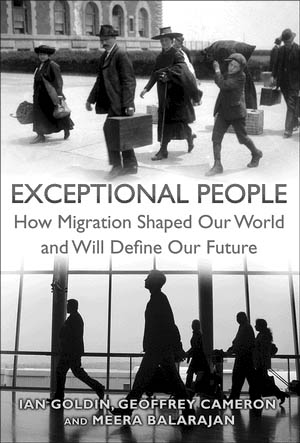 Exceptional People – How Migration shaped Our World and Will Define Our Future, Ian Goldin, Geoffrey and Meera Balarajan, Princeton University, Pp 371(HB), $35
With economic recession hitting nations globally, accompanied by high levels of unemployment, the politicians have announced a slew of measures – be it in the US, the UK or any of the European countries – to bring stricter immigration laws to curb foreigners from ‘ grabbing’ the jobs at home. Does migration add to the economic wellbeing of the receiving nation or heap woes? The debate on the issue has opened yet again.
According to authors Ian Goldin, Geoffrey Cameron and Meera Balarajan, immigration actually contributes to the economic growth of the receiving nation, as well as benefits the sending nation. In their book Exceptional People – How Migration shaped Our World and Will Define Our Future they say, “Embracing more migration is in our collective interest. The coming century will witness unprecedented demographic changes in societies around the world, especially in the developed countries facing shrinking populations… We need leadership that can effectively advance a global migration agenda.”
In a well-argued account, the authors have sought to “shift discussion on international mobility away from narrow national-level immigration debates, toward a more global view of migration.” There is also the distinction between migration and immigration. While migration tends to be most often temporary, immigration is permanent shifting. “Migrants are uncommon people, and they often move several times in search of opportunity and safety.”
The book touches upon the historical role of migration in human progress and development, the contemporary scene where migration is guided and managed by laws, and finally looks at the future scenario in relation to migration, its social, economic and political implications. There was a time when people moved across continents without restrictions and made new homes. Then came forced migrations in the form of contract and indentured labour. Today, the issue of shifting, especially across national boundaries is a complicated issue, involving several laws and long waits, spawning illegal movement and ‘human trafficking.’
“International migration pays dividends to sending countries, receiving countries, and migrants themselves. In receiving countries, it promotes innovation, boosts economic growth, and enriches social diversity, and it is a boon for public finance.” However, high rates of migration do carry costs that are unevenly carried by particular localities and countries. A case in point here could be the pouring in of Bangladeshis into the eastern border states of India, putting a huge pressure on the health and civic amenities and also upsetting the balance of economy and politics (voting).
The earliest biological exchanges from immigrations were disastrous mostly to the receiving population. “Diseases introduced (by) Europeans spread from tribe to tribe far in advance of the Europeans themselves, killing an estimated 95 per cent of the pre-Columbian Native American population.” Several communities were dissipated without trace by such diseases as smallpox, measles, influenza, and typhus. “The fact that Europeans appeared to be immune to these diseases had a demoralising effect on indigenous populations, who became more compliant and dependent on the new arrivals” says the book.
During the period of indentured labour, people from colonies were force-recruited to work in new territories’ for cultivation. For the World Wars also, all the nations recruited soldiers from poorer and weaker nations most of the time by force. The wars added the problem of refugees, to the existing issue of migration, resulting in millions of people out of their homes in alien countries. The book gives extensive statistical support to these facts.
Economy being the major reason for migration, the changing industrial scenario attract different kinds of labour. The oil boom in Gulf, the growth of automobile, the construction work in various industrialising countries – all these required different levels of labour. According to a study done by the US Department of Labour, in the early 1990s, around 85 per cent of the 670,000 farm workers in the US were migrants, many of whom were undocumented. “The characteristics of migration can be summed up with three principles: the individual agency of a migrant, the social dynamics of migration processes, and political and economic structures” say the authors.
Today, under controlled migration, there are more than 200 migrants globally, accounting for three per cent of the population. Migration between developing countries is almost equal to migration from these countries to developed countries.
Asserting that migration, perhaps the most widely researched topic but also the most commonly misunderstood, bears fruit in the medium and long run, the authors say “Reaping the full benefits of migration requires governments to relieve its short-run costs and mitigate negative impacts on localities and groups that are shouldering a heavier share of costs.”
A government-sponsored study in the UK found that migrants contributed about £6 billion to the national economy in 2006. Another informed estimates puts the “modest” net gain to the US to the tune of $10 billion a year. “The United States has long benefitted from the creative and intellectual contributions of its migrants. According to some sources, immigrants have made up more than three times as many Nobel Laureates, National Academy of Science members, and Academy award film directors as have native-born Americans” says the book.
Making a strong case for allowing and promoting greater inter-country, inter-continental movement of people, Ian Goldin, Geoffrey and Meera Balarajan present strong arguments, even while weighing the concerns of nations that are recipients of migrants. “Reforming migration policy at the national level needs to be complemented by coordinated approaches to global migration governance. Migration is the orphan of the global institutional architecture. The international institutional framework is silent on systemic migration issues, other than refugees” they say.
The book needs to be read by policy makers and political leaders, who more often than not act on the basis of narrow considerations and ill-informed debating points. This is a thoroughly researched and statistically supported and well-argued book. Ian Goldin is director of the Oxford Martin School, University of Oxford, Geoffrey Cameron is a research associate at the Oxford Martin School and Meera Balarajan works for a research organisation in the UK.
(Princeton University,41 William Street, Princeton, New Jersey 08540) ?