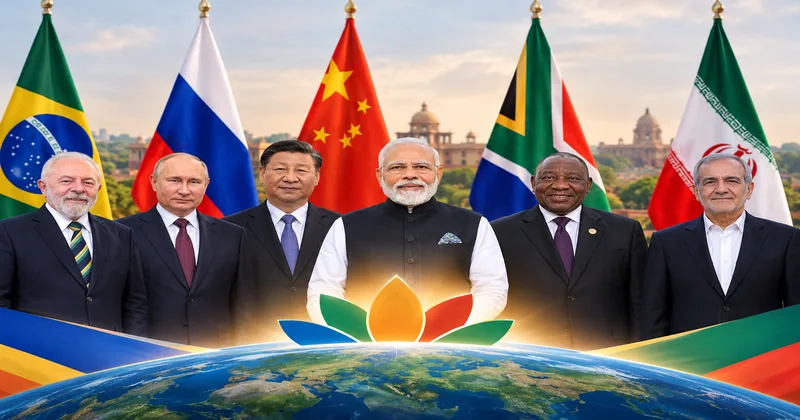
New Delhi: India is set to become the diplomatic epicentre of the Global South, as it is set to host the 18th BRICS Leaders’ Summit at Bharat Mandapam on September 12 and 13. The expanded 11-member multilateral forum, is entering a new phase, with New Delhi seeking to turn its growing economic and geopolitical weight into practical cooperation on trade, technology, energy, health and sustainable development.
From BRIC to an expanded BRICS: Tracing the timeline
What began as BRIC—Brazil, Russia, India and China—has evolved into a much broader coalition of emerging economies. The grouping held its first Foreign Ministers’ meeting on the sidelines of the UN General Assembly in New York in 2006, followed by its inaugural leaders’ summit in Yekaterinburg, Russia, in 2009.
South Africa joined in 2011, transforming BRIC into BRICS. The bloc then underwent its biggest expansion in 2024, when Egypt, Ethiopia, Iran, Saudi Arabia and the UAE became full members. Indonesia followed in January 2025, taking the core grouping to 11 countries.
The wider BRICS framework also includes 10 partner nations—Belarus, Bolivia, Cuba, Kazakhstan, Malaysia, Nigeria, Thailand, Uganda, Uzbekistan and Vietnam, giving the platform an increasingly broader footprint and a strong voice across the Global South.
India’s four-pillar BRICS vision
India’s 2026 chairship is built around the theme “Building for Resilience, Innovation, Cooperation and Sustainability”, under the broader vision of “Humanity First”. The four pillars seek to move BRICS beyond political declarations and more towards practical & measurable cooperation.
Resilience focuses on protecting economies and societies from supply-chain disruptions, health emergencies, geopolitical shocks and climate risks. Innovation places Artificial Intelligence, fintech, digital public infrastructure and data-driven systems at the centre of future growth.
The Cooperation pillar seeks deeper trade, institutional connectivity, development finance and economic-policy coordination, while Sustainability emphasises climate action, green finance, clean-energy transitions and sustainable development.
India has already conducted more than 350 BRICS-related meetings and high-level engagements across over 25 cities during its current chairship, thus reflecting the importance asserted by New Delhi to the forum to accelerate cooperation among the member-states across wide range of subjects and formulating BRICS as a strong voice of the emerging economies & Global South, which represents more than 50 per cent of the global population & 40 per cent of Global GDP.
Trade, MSMEs and the push for financial connectivity
Economic cooperation will remain central to the New Delhi summit. BRICS members are advancing the Strategy for BRICS Economic Partnership 2030 while supporting a multilateral trading system with the World Trade Organization at its core.
The multilateral forum has also adopted following measures for realising the economic integration of the Global South:
Global Value Chains Action Plan 2026-2030: to strengthen trade corridors and manufacturing integration. India is placing MSMEs at the heart of this agenda.
BRICS MSME Cooperation Portal: New Delhi has proposed a BRICS invoice discounting mechanism to address trade-finance challenges, along with connecting technology centres, financial institutions, training organisations and policymakers.
BRICS Incubator Network & BRICS Startup Innovation Fund: The innovation push aims to connect startup ecosystems and a proposed fund aimed at expanding early-stage and growth financing for the MSMEs & startups of the Global South.
Agriculture, health and energy to take centre stage
India is also using its chairship to promote cooperation with direct social and developmental benefits.
BRICS Network on Digital Agriculture: Through this, India is coordinating efforts to deploy AI, geospatial technologies and digital public infrastructure in agriculture. Initiatives on farmers’ rights, seed systems, genetic resources and agricultural inputs are designed to deepen cooperation among the Global South to seal food security.
16th BRICS Health Ministerial Declaration: Healthcare is another major priority. The unanimous adoption of the health declaration in Chandigarh reinforced commitments to universal health coverage, pandemic preparedness, digital health and affordable medicines. India has additionally spearheaded mental-wellness cooperation through NIMHANS.
BRICS Energy Ministers’ Meeting & Digital Centre of Excellence for Smart Grids and Energy Storage: Energy security is particularly significant for a forum comprising major energy producers, consumers and industrial economies. Following the Energy Meet in Gurugram, members adopted principles on smart grids and launched a Digital Centre of Excellence for Smart Grids and Energy Storage, with cooperation extending to hydrogen, biofuels, critical minerals and carbon capture.
Digital infrastructure, climate resilience & human resource development
BRICS Digital Public Infrastructure Repository: India is seeking to make digital cooperation another defining feature of BRICS 2026. The proposed BRICS Digital Public Infrastructure Repository would facilitate knowledge-sharing and testing of scalable digital solutions, while a proposed logistics and supply-chain framework aims to strengthen connectivity and reduce vulnerabilities in international trade.
Urban sustainability is also gaining prominence through proposed mechanisms for urban research, knowledge-sharing and sustainable mobility. Climate-resilient urban infrastructure principles is another key priority seek to help member-states prepare cities for growing environmental risks.
BRICS CONNECT: Human-capital development forms another layer of the agenda, with BRICS CONNECT focusing on labour-market intelligence, skill forecasting and digital employment services, alongside youth cooperation, women’s digital capacity-building and academic exchanges.
BRICS Business Forum and Women’s Business Alliance
The September 12-13 summit will be preceded by the BRICS Business Forum and Women’s Business Alliance session on September 11.
A summit with major geopolitical stakes
Prime Minister Narendra Modi will host leaders from the expanded grouping, with Russian President Vladimir Putin confirmed to attend and Chinese President Xi Jinping expected to participate. A Xi visit would be his first trip to India since his 2019 informal meeting with PM Modi in Mamallapuram. Thus, the BRICS Summit will gain greater strategic importance from the Sino-India relations prism as well, post the Glawan clash of 2020 and gradual & cautious restoration of bilateral ties.
The summit also comes at a significant moment for India’s diplomacy. With BRICS marking 20 years since its foundation, New Delhi is seeking to consolidate the expanded grouping around Global South priorities while pushing reforms in global financial and political institutions.
From building the New Development Bank to shaping the Global South
India’s four BRICS chairships—in 2012, 2016, 2021 and 2026—reflect the groupings evolving priorities in line with geopolitical realities. Its first chairship helped transform BRICS from an informal dialogue platform into a more institutionalised grouping and contributed to the creation of the New Development Bank in 2014.
At the 2016 Goa Summit, India placed greater emphasis on counter-terrorism, connectivity and collective security. In 2021, amid the COVID-19 pandemic and tensions along the Line of Actual Control, India prioritised public health, economic recovery and preserving consensus within the bloc.
In 2026, the challenge is considerably larger: managing an expanded BRICS while ensuring that its growing membership translates into concrete outcomes.
For New Delhi, the summit is therefore more than a diplomatic gathering. It is an opportunity to shape the future architecture of the Global South—through greater financial autonomy, technological cooperation, resilient supply chains, energy security and institutional reforms.