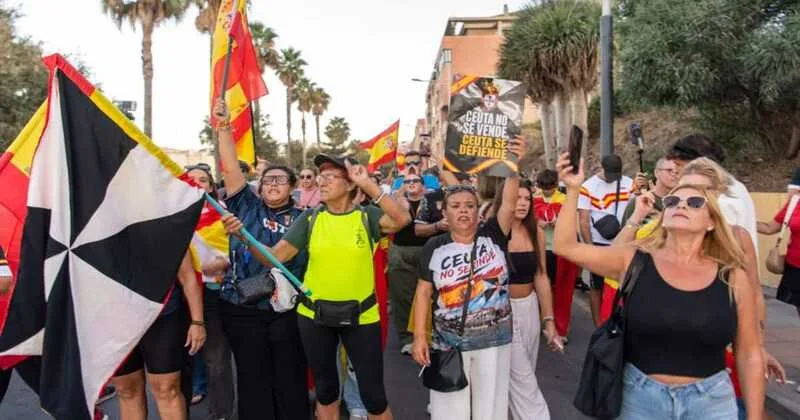
New Delhi: Residents of Spain’s North African enclave of Ceuta staged fresh protests over security and hygiene concerns following a massive influx of migrants from Morocco, with demonstrations escalating into clashes with police.
The unrest in Ceuta has intensified amid growing tensions between Spain’s residents, Moroccan migrants and authorities as thousands remain in the small territory after crossing Europe’s African border in July 2026.
Ceuta residents clash with police as migrant protests intensifies in Spain
On August 27, protests in Spain’s Ceuta escalated when police charged demonstrators at a beach where hundreds of migrants from Morocco have been sleeping. A group of protesters moved into the area occupied by the migrants, and some belongings were set on fire during the disturbances, according to images broadcast on Spanish public television. The clashes reflected the continuing anger among Ceuta residents over the presence of large numbers of migrants in the Spanish enclave.
Earlier on Thursday, dozens of Spain’s Ceuta residents staged a sit-in that temporarily prevented Red Cross vehicles from reaching the beach to distribute food to hundreds of migrants from Morocco staying in the area. Demonstrators, many waving Spanish flags, chanted “They should leave” and “Out with the Red Cross” before police dispersed the protesters.
🇪🇸 CEUTA ESTALLA: TERCER DÍA CONSECUTIVO DE PROTESTAS
LOS CEUTÍES VUELVEN A TOMAR LAS CALLES Y AVANZAN HACIA BENÍTEZ
La protesta no se detiene. Por tercer día consecutivo, los ceutíes vuelven a salir masivamente a las calles.
El hartazgo crece y las protestas se intensifican… pic.twitter.com/OoWZhrfUHr
— Media Oriente (@MediaOriente) August 28, 2026
Tensions in Spain’s Ceuta had already risen late on August 26, when police fired tear gas to prevent confrontations between protesters and migrants from Morocco camping on the beach. Residents of Ceuta have held regular demonstrations, citing what they describe as security and hygiene problems linked to the influx of migrants into the small Spanish territory.
Morocco migrant influx triggers security crisis in Spain’s Ceuta
The latest protests in Spain’s Ceuta follow a massive influx of migrants from Morocco that triggered a wider European migrant alert. Ceuta, home to around 80,000 people and covering only about 18.5 square kilometres, has faced intense pressure since at least 60,000 people crossed into the Spanish enclave over several days in July 2026.
Spain’s leftist government says that most of the migrants who entered Ceuta from Morocco have since left the enclave. However, thousands remain in the territory, wandering through streets and sleeping on beaches. The continued presence of migrants has contributed to growing tensions between Ceuta residents, police and the migrants who remain in the Spanish territory on Europe’s African border.
Security concerns in Spain’s Ceuta intensified further in the early hours of Thursday when a military vehicle carrying four soldiers was reportedly “ambushed” by around 70 migrants from Morocco. According to a police spokesperson in Ceuta, the migrants attacked the military vehicle with stones and other objects.
The four soldiers fled the scene and called for police assistance. Spanish police subsequently detained 12 migrants, all of them Moroccan, the police spokesperson said. One soldier suffered minor injuries after being struck by a stone. The motive for the attack was not immediately clear.
Two additional arrests were later made after migrants attacked a police officer, according to sources. The separate incidents involving Spanish police, soldiers and migrants have further heightened security concerns in Ceuta, where residents have repeatedly protested against the consequences of the Morocco migrant influx.
Kissy Chandiramani, Ceuta’s autonomous city finance councillor, said “the tension in the city of Ceuta is very high” because there was “no response” from Spain’s government and residents felt “abandoned”. However, she also appealed for calm, saying that while people had the right to protest, growing hostility would not resolve the crisis facing Spain’s North African enclave.
Spain’s leftist government calls for calm as Ceuta crisis deepens
Spain’s Interior Minister Fernando Grande-Marlaska called for calm on August 28 after Ceuta residents clashed with police during protests against migrants who have remained in the Spanish enclave following the mass influx from Morocco. The Spanish government has faced growing pressure as tensions between residents and migrants continue across Ceuta, one of Europe’s only land borders with Africa.
“Violence is not the answer,” Grande-Marlaska told Spain’s parliament on Friday. The Interior Minister called for calm and an end to all forms of violence, saying that violence was not the way to resolve the complex problems facing Ceuta following the Morocco migrant influx.
🚨🇪🇸 CEUTA ERUPTS! Locals have HAD ENOUGH!
Huge crowds are gathering outside the Ulises Hotel, where Minister Ángel Víctor Torres may be staying.
Tensions are RISING as police flood the area. Protests are spreading across the city!pic.twitter.com/UUn82JwVwE
— Global Dissident (@GlobalDiss) August 25, 2026
The protests in Spain’s Ceuta have intensified in recent days, particularly around the beaches where migrants from Morocco have been sleeping. Demonstrators have demanded the restoration of security and normality, while clashes with Spanish police have added another dimension to the crisis.
Juan Vivas, the head of Ceuta’s local government, said peaceful protests aimed at demanding a “return to normality” were justified. However, the Ceuta leader warned that Spanish authorities would take action against anyone committing vandalism or violence during the demonstrations.
“We totally reject the use of any kind of violence,” Vivas said in an institutional address. “No one can or should take the law into their own hands. The defence of Ceuta and the interests of its people can only be pursued through legality.”
The political dispute over the Morocco migrant crisis in Spain’s Ceuta has also intensified. Many parties have demanded that all migrants be rounded up and sent back to their home countries. Grande-Marlaska, however, accused these parties of “inciting hatred and confrontation” in Ceuta.
Spain’s leftist government has said that every individual migrant must be identified to determine whether they are entitled to asylum or whether they are subject to deportation. The Spanish government has also stressed that unaccompanied migrant children require special protection under the applicable framework.
Ceuta and Melilla, another small Spanish territory in North Africa, form Europe’s only land border with Africa. The latest protests in Spain’s Ceuta underline the growing tensions surrounding the migrants who crossed from Morocco in July 2026 and remain in the territory.
With Ceuta residents continuing to protest over security, hygiene and the presence of migrants, and Spanish police responding to clashes and disturbances, the Morocco migrant crisis remains a major challenge for Spain’s leftist government. The situation in Ceuta has brought residents, migrants, police and political leaders into an increasingly tense confrontation at one of Europe’s most sensitive borders with Africa.