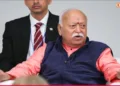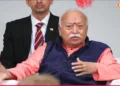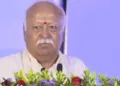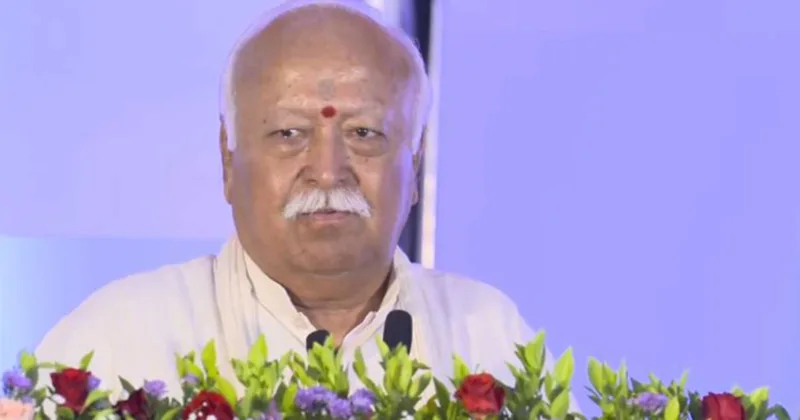
New York: RSS Sarsanghchalak Dr Mohan Bhgawat’s America visit carries a message Washington should not overlook; he sees a long-term U.S.-India partnership as important to India’s future.
Last night in New York, I was seated at the same table as Mohan Bhagwat at an exclusive dinner hosted in his honour by the U.S.-India Strategic Partnership Forum (USISPF).
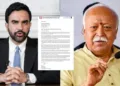
Only a day earlier, I had written about Mohan Bhagwat in Times Now and other media, describing him as “The Keeper of India’s Civilisation.”
I had written that without ever having met him. My assessment was based entirely on research.
Now I had the opportunity to meet the man himself.
During our conversation, I shared with him some of the central observations from my article:
1. Mohan Bhagwat is “The Keeper of India’s Civilisation.”
2. Bhagwat holds no government office.
He commands no military. He signs no legislation. His name does not appear on an Indian ballot.
Yet he leads a century-old organisation whose influence reaches deeply into India’s political, social and cultural life.
3. Prime Minister Modi is, in many ways, an RSS gift to India–and to the world.
4. Bhagwat speaks in the language of Vishwaguru–India as a guide to the world–and Vasudhaiva Kutumbakam: “The world is one family.”
And finally:
5. If America wants to understand where nearly 1.5 billion Indians may be heading, Mohan Bhagwat is one of the voices it cannot afford to ignore.
My Dinner Takeaway
I came away with one conclusion that Washington should pay attention to:
Mohan Bhagwat believes in the long-term importance of the U.S.-India relationship.
That matters.
Bhagwat is not part of the Indian government. He does not negotiate treaties or sit across from American officials at the State Department.
He leads the Rashtriya Swayamsevak Sangh, the century-old organisation that has profoundly influenced India’s political and cultural landscape and helped shape generations of leaders–including Prime Minister Narendra Modi.
I did not encounter a man talking about turning India away from America.
I encountered an Indian leader looking at the relationship in much longer historical terms.
That distinction is important.
Governments change. Presidents change. Prime ministers change. Tariffs come and go. Diplomatic disagreements erupt and eventually subside.
But the strategic logic connecting the United States and India is bigger than any single administration.
Both countries face a changing China.
Both are navigating an artificial-intelligence revolution that will reshape economic and national power.
Both have enormous interests in technology, energy, defence, education and investment.
And both are democracies noisy enough to disagree with each other regularly.
A mature partnership must be strong enough to survive those disagreements.
That is why Bhagwat’s thinking deserves American attention.
Washington should resist viewing India exclusively through its government.
If Americans want to understand where India is going, they must engage not only with Modi and his ministers, but also with the institutions, thinkers, business leaders, cultural movements and civil-society organisations influencing the country beneath the surface of electoral politics.
That includes the RSS.
Engagement Does Not Require Agreement
And Washington should listen.
The U.S.-India partnership has often been described through presidents and prime ministers: Bush and Singh. Obama and Modi. Trump and Modi.
Perhaps that is too narrow.
The most durable relationship between two great democracies cannot belong only to their governments.
It has to become a relationship between their societies.
That was the larger message I took away from my dinner meeting with Mohan Bhagwat in New York. (ANI)
(Disclaimer: Al Mason is a New York-based entrepreneur and author. His work focuses on artificial intelligence, business, technology, geopolitics and global affairs. Views expressed in this article are his own and not those of ANI)