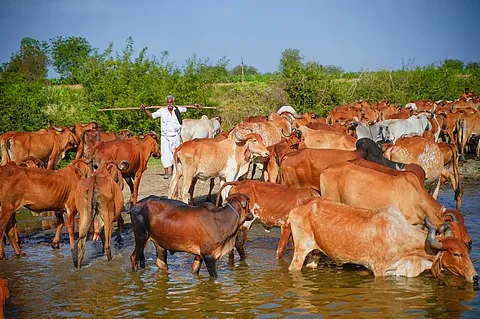
Livestock health is closely linked to the livelihoods of millions of farmers in India. Cattle, buffaloes, sheep, goats and other animals contribute to milk production, meat, farm activities and household incomes. Diseases affecting livestock can therefore have a direct impact on agricultural productivity and rural livelihoods.
Against this backdrop, the National Animal Disease Control Programme (NADCP) was launched in 2019 with a specific focus on controlling and eventually eradicating two major livestock diseases — Foot and Mouth Disease (FMD) and Brucellosis.
Over the past several years, the programme has combined mass vaccination with disease surveillance, digital monitoring, laboratory support, veterinary infrastructure and measures to track animal movement.
The impact is reflected in the reported decline in disease outbreaks. FMD outbreaks fell from 132 in 2019 to 40 in 2025, while Brucellosis outbreaks declined from 22 to 15 over the same period.
The government has also reported improved immunity levels among livestock as a result of sustained vaccination and evidence-based disease surveillance.
FMD Vaccination at heart of the programme
Foot and Mouth Disease is a highly contagious viral disease that affects cloven-hoofed animals, including cattle, buffaloes, sheep, goats and pigs.
Although FMD may not always result in high mortality among adult animals, it can have serious economic consequences. The disease can reduce milk production, slow animal growth, affect reproductive performance and reduce the working capacity of draft animals.
Disease outbreaks can also affect livestock trade by triggering restrictions in domestic and international markets.
The NADCP addresses these risks through a nationwide vaccination strategy. Eligible livestock are vaccinated against FMD every six months, helping build and maintain immunity across animal populations.
So far, the programme has administered 147.16 crore FMD vaccine doses, benefiting around 8.04 crore farmers.
The vaccination campaign is supported by other measures, including disease surveillance, cold-chain infrastructure, outbreak investigation, virus isolation and typing, as well as regulation of animal movement through quarantine facilities and check-posts.
Improved Immunity Against FMD
The government’s disease-control strategy is not based only on the number of animals vaccinated. It also assesses whether vaccination is generating adequate levels of immunity.
According to programme data, average protective immunity against the three major FMD virus serotypes, O, A and Asia1, stands at 78.1 per cent, 71.7 per cent and 77.6 per cent, respectively.
One notable development has been the absence of an FMD outbreak caused by Serotype Asia-1 in India for the last three years.
Such surveillance helps authorities identify gaps in immunity and determine where additional vaccination or disease-control interventions may be required.
The combination of vaccination coverage and immunity monitoring therefore provides a more comprehensive picture of the country’s progress in controlling FMD.
Brucellosis: Protecting Animal Health and Productivity
Brucellosis is another important livestock disease targeted under NADCP.
The disease primarily affects the reproductive system of cattle and buffaloes. It can lead to fertility problems and affect lactation, ultimately impacting milk and meat production.
Unlike some diseases that can be treated with medication, there is no curative treatment for bovine Brucellosis. This makes vaccination an important tool for controlling its spread.
Under the programme, female bovine calves between four and eight months of age receive a one-time Brucellosis vaccination during their lifetime.
Post-vaccination monitoring conducted in 2025 recorded seroconversion rates of 75.63 per cent among cattle calves and 67.17 per cent among buffalo calves.
The decline in reported Brucellosis outbreaks from 22 in 2019 to 15 in 2025 indicates progress, although continued vaccination and surveillance remain necessary to control the disease.
Extending Disease Control to Migratory Livestock
The programme has also expanded its focus to livestock populations that move across regions.
Since 2024, FMD vaccination has been extended to pastoral sheep and goats in Haryana, Himachal Pradesh, Uttarakhand and the Union Territories of Jammu and Kashmir and Ladakh.
Migratory livestock can travel across large geographical areas, creating potential pathways for the spread of infectious diseases.
Extending vaccination coverage to these populations therefore helps reduce the risk of disease transmission along migratory routes and strengthens the overall disease-control network.
Surveillance goes beyond vaccination
One of the key features of NADCP is its emphasis on surveillance alongside vaccination.
The programme uses sero-surveillance and sero-monitoring to understand disease exposure, immunity levels and the effectiveness of vaccination.
Sero-surveillance helps authorities estimate exposure to disease and assess immunity among animal populations. Sero-monitoring, meanwhile, tracks antibody levels over time to determine whether animals have developed an adequate response following vaccination.
This information can help policymakers identify areas where vaccination coverage or immunity may need to be strengthened.
The programme also involves outbreak investigations, laboratory testing, virus isolation and typing, creating a system that allows authorities to respond to disease threats based on evidence.
Digital Tracking of Livestock
Technology has become another important part of India’s livestock disease-control system.
Under NADCP, livestock are being ear-tagged and registered, with their information uploaded to the Bharat Pashudhan Portal.
By July 2026, more than 39 crore livestock had been registered on the platform. Each registered animal receives a unique 12-digit Tag ID.
The system links animal registration with vaccination information for FMD and Brucellosis.
This digital connection improves traceability and allows authorities to monitor vaccination coverage more effectively. It can also help in identifying animals and tracking their health records during disease-control operations.
The government is further looking at AI-enabled analytics, vaccination traceability, real-time dashboards and evidence-based planning to strengthen disease surveillance and improve the allocation of resources.
Veterinary Services Reach Farmers’ Doorsteps
Disease prevention is being complemented by efforts to improve access to veterinary care.
The government has strengthened last-mile veterinary services through Mobile Veterinary Units (MVUs), which provide treatment and other veterinary services closer to farmers and livestock.
Currently, 4,019 MVUs are operational across 29 States and Union Territories.
Operating through the toll-free number 1962, these units have provided doorstep veterinary services to 136 lakh farmers and treated 276 lakh animals.
Such services are particularly important in rural and remote areas, where farmers may face difficulties in transporting livestock to veterinary hospitals or clinics.
The programme has also supported the training of 39,810 Multi-Purpose Artificial Insemination Technicians in Rural India (MAITRIs), strengthening the network of frontline livestock service providers.
Strengthening Veterinary Infrastructure
Disease control also requires laboratories, vaccines, cold-chain systems and scientific research.
NADCP is supported by veterinary infrastructure and systems for vaccine development and quality testing. Financial support is also being provided to key Indian Council of Agricultural Research (ICAR) institutions for vaccine research, disease surveillance, sero-surveillance, disease modelling and state-level sampling.
These facilities are important for identifying disease outbreaks quickly, understanding circulating virus strains and ensuring that vaccination programmes remain effective.
The availability of reliable laboratory and surveillance systems also strengthens India’s ability to respond to emerging disease threats rather than relying only on action after an outbreak occurs.
Integrating Livestock Health Under a Wider Framework
The government has built on the NADCP framework by bringing different livestock health interventions together under the Livestock Health and Disease Control Programme (LHDCP).
Under the revised framework, NADCP, the Livestock Health and Disease Control component and the Pashu Aushadhi initiative have been brought under a common umbrella.
The objective is to enable more integrated implementation of livestock health interventions, bringing disease prevention, veterinary services and healthcare closer together.
The total budget outlay for LHDCP for 2026-27 is Rs 2,010 crore.
The integrated approach is intended to ensure that livestock health is addressed through prevention, treatment, surveillance and improved access to veterinary services.
Linking disease control with livestock productivity
Healthy animals are essential for improving productivity, particularly in the dairy sector.
According to the data provided, the productivity of indigenous and non-descript cattle increased from 927 kg per animal per year in 2014-15 to 1,343.2 kg in 2024-25, representing a rise of 44.89 per cent.
Buffalo productivity increased from 1,880 kg to 2,365.2 kg per animal per year over the same period, a rise of 25.80 per cent.
Overall average bovine productivity increased from 1,640 kg per animal per year in 2014-15 to 2,250 kg in 2024-25, marking an increase of 36.63 per cent.
Milk production has also expanded substantially. India’s milk production rose from 146.31 million tonnes in 2014-15 to 247.87 million tonnes in 2024-25, representing a 69.4 per cent increase over the decade.
The government aims to raise average milk production further to 3,000 kg per animal per year by 2030.
Disease control is an important part of this productivity push because healthier animals are better positioned to maintain milk production, reproduction and overall performance.
One health approach and pandemic preparedness
Livestock disease control also has implications beyond agriculture.
The government’s approach is increasingly linked to the One Health framework, which recognises the close relationship between human, animal and environmental health.
Early detection and control of animal diseases can help reduce the risk of zoonotic disease transmission. It can also support responsible use of antimicrobials and strengthen preparedness for emerging health threats.
The National One Health Mission, approved by the Prime Minister’s Science, Technology and Innovation Advisory Council in 2022, seeks to coordinate and integrate One Health-related activities across the country.
India has also received international support for strengthening animal health preparedness.
The Pandemic Fund Project on “Animal Health Security Strengthening in India for Pandemic Preparedness and Response” was launched in 2024 with US$25 million from the G20 Pandemic Fund.
The project is being implemented in partnership with the Asian Development Bank, Food and Agriculture Organization and World Bank.
Its focus includes strengthening disease surveillance, including genomic and environmental surveillance, upgrading laboratory infrastructure and improving cross-border cooperation.
Standardised Response to Disease Outbreaks
The government has also introduced Standard Veterinary Treatment Guidelines and a Crisis Management Plan for Animal Diseases.
The treatment guidelines are intended to promote scientific veterinary practices, rational use of medicines and antimicrobial stewardship.
The crisis management plan provides a framework for preparedness and rapid response when animal disease outbreaks occur.
Together, these measures seek to ensure that India’s livestock sector is better prepared not only to manage existing diseases but also to respond quickly to emerging and transboundary threats.
A Disease-Secure Livestock Sector
India has more than 535 million livestock, including 302.79 million bovines, according to the 20th Livestock Census 2019.
With such a large livestock population, animal health is directly connected with rural livelihoods, food security, dairy production and agricultural productivity.
The progress recorded under NADCP demonstrates the importance of combining vaccination with surveillance, digital monitoring, veterinary services and scientific research.
The decline in FMD outbreaks from 132 to 40 and Brucellosis outbreaks from 22 to 15 between 2019 and 2025, along with improved immunity levels, indicates the impact of sustained disease-control efforts.
The next phase is expected to focus on further strengthening disease surveillance, genomic monitoring, laboratory capacity, AI-enabled disease intelligence and climate-resilient systems.
The government is also seeking greater alignment with international standards for FMD freedom and stronger coordination under the One Health framework.
For farmers, the objective ultimately goes beyond disease numbers. Healthier livestock can mean better milk production, improved productivity, lower disease-related losses and more secure rural livelihoods.
As India seeks to build a more productive and resilient livestock sector, NADCP and the wider LHDCP framework are providing an increasingly integrated system for prevention, surveillance, treatment and preparedness.
The decade ahead will require maintaining high vaccination coverage, closing immunity gaps and ensuring that veterinary services and disease surveillance reach the last mile. Sustained investment in these areas will remain critical to protecting India’s livestock wealth and strengthening the livelihoods that depend upon it.