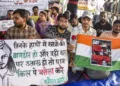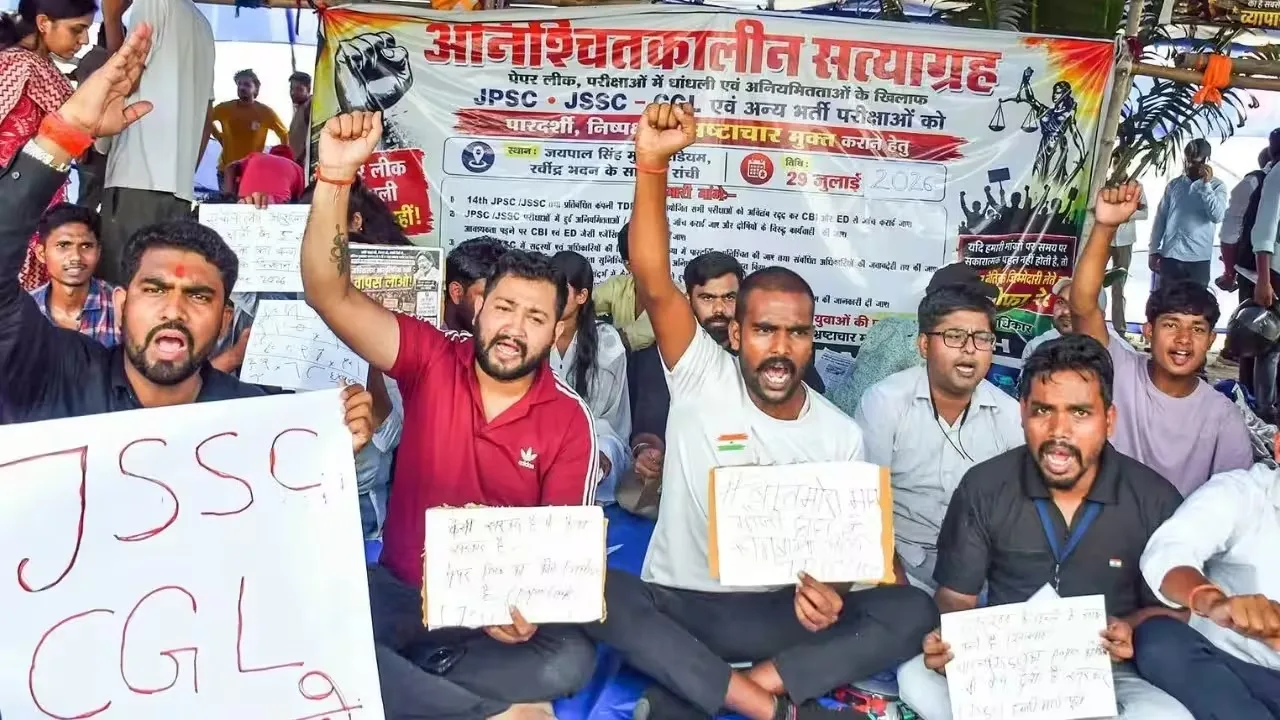
The ongoing protest by government job aspirants in Jharkhand entered its 22nd day on Saturday, August 15, with student leaders hardening their stand against the Hemant Soren-led government and setting an August 18 deadline for action over irregularities in recruitment examinations.
Protesters associated with the JPSC-JSSC agitation have demanded the cancellation of recruitment examinations and results facing allegations of irregularities, along with an independent investigation into the recruitment process.
Student leader Ravindra Paswan warned that the agitation could enter a more aggressive phase if the government failed to address the protesters’ demands by the deadline.
Paswan said the protesters had “had enough of Gandhian methods and peaceful protests” and invoked revolutionary freedom fighter Bhagat Singh while signalling an escalation of the agitation.
He warned that if the demands remained unresolved after August 18, “lakhs of students and youths” would march towards Chief Minister Hemant Soren’s residence on August 20.
The warning marks a significant escalation in an agitation that has continued for more than three weeks and has increasingly put the state government under pressure over its recruitment system.
‘Lakhs of students and youths will march’
Paswan said the government had been given time until August 18 to take a decision on the students’ demands.
Among the issues raised by protesters are the cancellation of JSSC results facing allegations of irregularities, scrapping examinations conducted through the TDPL agency and ordering a CBI investigation into alleged wrongdoing.
The protesters are also seeking cancellation of the JSSC-CGL and JPSC 11th-13th examinations.
They have demanded that the allegations surrounding the recruitment process be investigated either by the Central Bureau of Investigation or by an independent committee comprising retired judges from outside Jharkhand.
According to the protesters, an investigation conducted independently of the state administration is necessary to restore confidence among candidates.
The students have maintained that their agitation is not merely about the results of individual examinations but about the credibility of Jharkhand’s entire government recruitment system.
Protesters signal end to ‘Gandhian Methods’
Paswan’s remarks also reflected growing frustration among the protesters after more than three weeks of agitation.
His statement that students had had enough of “Gandhian methods and peaceful protests” was accompanied by an invocation of Bhagat Singh, as he warned of a tougher phase if the state government did not act.
The remarks came amid preparations for a larger mobilisation on August 20.
The protesters have indicated that students and job aspirants from different districts will be mobilised for the planned demonstration.
The administration, meanwhile, faces the challenge of preventing any confrontation while dealing with an increasingly assertive protest movement.
Effigy-burning campaign across Jharkhand
Another student leader, Piyush Kumar, announced that protesters would begin burning effigies at district headquarters across Jharkhand.
He said the protest would target effigies of Chief Minister Hemant Soren, Congress leader Rahul Gandhi and political parties supporting the state government.
The move indicates that the recruitment agitation is also acquiring a wider political dimension, with protesters seeking to hold not only the JMM leadership but also its political allies accountable.
The Congress is a constituent of the ruling coalition in Jharkhand.
Kumar also referred to an earlier demonstration at the Vidhan Sabha and described it as only a “preview” of what could happen during the next phase of the agitation.
The protesters have sought to build pressure on the ruling coalition ahead of their August 20 programme.
What are the students demanding?
At the centre of the agitation are allegations of irregularities in examinations conducted for government recruitment in Jharkhand.
The protesters have demanded the cancellation of the JSSC-CGL results and JPSC 11th-13th examinations, besides seeking action over examinations conducted through the TDPL agency.
A key demand is an independent investigation into the allegations.
The protesters want either a CBI inquiry or an investigation by a committee of retired judges from outside Jharkhand. They argue that such an inquiry is necessary to establish accountability and ensure that candidates receive a fair recruitment process.
The students maintain that alleged irregularities have affected the confidence of thousands of aspirants who spend years preparing for government recruitment examinations.
For many candidates, the issue is also linked to repeated delays and uncertainty surrounding recruitment.
The protesters say they want a transparent, accountable and time-bound system in which examination results cannot be manipulated and allegations of wrongdoing are investigated promptly.
Devendra Mahto’s hunger strike draws attention
The agitation has also drawn attention to JLKM leader Devendra Mahto, who was reportedly on the 14th day of a hunger strike.
Mahto alleged that police prevented him from leaving Sadar Hospital to participate in the protest march.
Videos circulated on social media purportedly showed Mahto involved in a scuffle with security personnel while attempting to leave the hospital.
The precise circumstances surrounding the confrontation could not be independently verified.
His hunger strike, however, has become another focal point of the ongoing agitation as protesters seek to increase pressure on the state government.
Students say fight goes beyond one examination
The protesting aspirants have repeatedly maintained that the movement should not be viewed merely as a dispute over one recruitment examination.
They argue that allegations surrounding multiple recruitment exercises have created wider questions over the functioning and credibility of institutions responsible for selecting candidates for government jobs.
The protesters say the movement is aimed at securing equal opportunities for candidates and restoring faith in the recruitment process.
With government employment remaining highly competitive, allegations of paper leaks, manipulation or other irregularities can affect thousands of aspirants who spend years preparing for examinations.
This has made transparency in recruitment a major concern among students participating in the Ranchi agitation.
Hemant Soren acknowledges concerns over recruitment exams
Chief Minister Hemant Soren, meanwhile, addressed concerns surrounding recruitment examinations during his Independence Day speech.
Soren acknowledged that questions over the examination system had affected the trust of a generation of job aspirants.
He assured candidates that allegations of wrongdoing would be investigated impartially and that those found guilty would face legal action regardless of their influence or position.
At the same time, Soren cautioned against declaring individuals guilty without evidence and said action should be based on facts established through investigation.
“Merely apprehending the guilty is not the solution,” Soren said while emphasising the importance of broader reforms aimed at preventing irregularities in future examinations.
Soren promises technology-secured exams, annual calendar
The Chief Minister also outlined several measures aimed at strengthening Jharkhand’s recruitment system.
Among the proposed changes is a time-bound annual examination calendar intended to provide greater certainty to candidates regarding recruitment schedules.
The government has also proposed greater use of technology to secure examinations and prevent manipulation.
Other measures outlined by Soren include timely publication of answer keys and OMR sheets and the creation of multiple levels of accountability in the recruitment process.
The government has presented these reforms as part of an effort to rebuild trust among students and job aspirants.
‘Students’ voice with students’ campaign launched
The Jharkhand government has also launched the “Students’ Voice with Students” campaign to seek suggestions on reforms to the recruitment examination system.
Under the initiative, suggestions are being sought from students, teachers, educationists and parents.
The government says the exercise is intended to identify shortcomings in the existing system and develop measures to make examinations more transparent and reliable.
The protesters, however, are demanding immediate action on examinations already facing allegations of irregularities, along with an independent investigation.
August 20 emerges as key date
With the August 18 deadline approaching, August 20 has emerged as the next major flashpoint in the JPSC-JSSC agitation.
The protesters have made it clear that they intend to mobilise students and youths for a march towards the Chief Minister’s residence if their demands remain unresolved.
The ultimatum comes after more than three weeks of demonstrations and reflects growing frustration among job aspirants.
For the Hemant Soren government, the immediate challenge will be whether its promises of systemic reforms and investigations are enough to convince the protesters to withdraw their proposed mobilisation.
For the students, the focus remains on three central demands — action against examinations facing allegations of irregularities, an independent investigation and accountability for those found responsible.
With protesters warning of a mass mobilisation after August 18, the recruitment examination controversy is set to remain a major challenge for the Jharkhand government in the coming days.