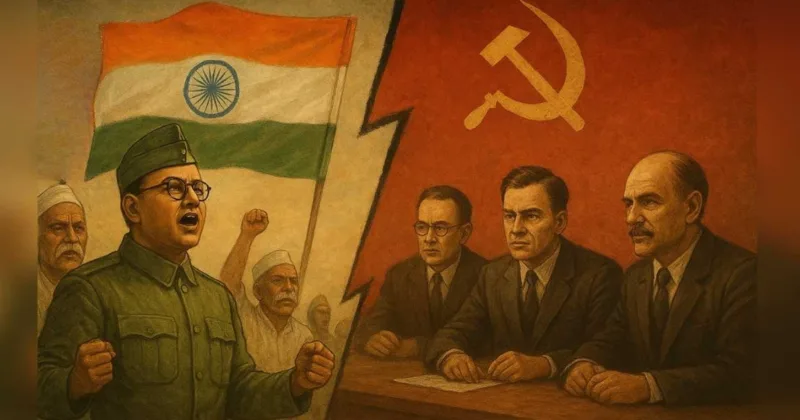
History does not always progress in a straight line, especially when a political party’s ideological compass is steered not by its own soil but by directives from abroad. The inception of the Communist Party of India (CPI) on Tashkent soil in 1920 by Manabendra Nath Roy (M.N. Roy) and Abani Mukherji, and its subsequent official organization in Kanpur in 1925, carried a strange historical self-contradiction from its very birth. While the Indian National Congress was an organic movement emerging from India’s own soil, society, and culture, the Communist Party’s ideological control and directives came directly from the headquarters of the Communist International (Comintern) in Moscow.
The geopolitical interests of the international Red camp were more vital to them than their own country’s independence movement. Consequently, whenever the interests of Moscow clashed with Indian nationalism, the Indian communists chose a path of historic and ruthless betrayal. The history of the Indian communists’ imperialist appeasement and backstabbing of their own motherland between 1939 and 1947 remains a highly volatile chapter in India’s political history. This continuity of political opportunism and foreign allegiance did not end with the Partition of India in 1947; rather, its ugly face was repeatedly exposed in relation to the security and sovereignty of independent India.
Early Conflict and the Blind Alley of Non-Cooperation (1929–1934)
It is not as if the Indian communists were allies of the colonial power from the very beginning. In the 1920s and 1930s, the colonial British government took extremely harsh measures to suppress the communists. In March 1929, in the historic Meerut Conspiracy Case, 32 prominent labor leaders and communist figures—including two British communists, Philip Spratt and Benjamin Bradley—were arrested on charges of conspiring against the colonial Raj. The British government’s accusation was that these accused had entered India from the Soviet Union to hatch a secret countrywide conspiracy to spark a workers’ revolution and proletarian uprising against the British Empire. Top Congress lawyers advocated on behalf of these leaders accused under Section 121-A of the Indian Penal Code, and the long trial dragged on until August 1933.
However, in contrast to this persecution, the communists’ behavior was extremely opportunistic. In 1930, when the “Class Against Class” and “Social Fascism” theories were imported under the directives of the Comintern’s Tenth Plenum, the Indian communists completely severed themselves from their own country’s spontaneous nationalist movement. According to the “Draft Platform of Action” published in 1930 in the Comintern’s mouthpiece, Imprecorr (International Press Correspondence), the Indian communists were instructed to expose the “bourgeois reformism” of the National Congress and aggressively oppose Mahatma Gandhi’s non-violent Satyagraha (passive resistance).
Consequently, during the Civil Disobedience Movement from 1930 to 1934, when thousands of Indians were braving British lathis and bullets, the communists termed the movement a “tactic of the wealthy classes” and stayed far away from it. They even characterized the salt satyagraha or the movement to abolish the salt tax as a small, opportunistic strategy of wealthy Indians and the bourgeois class. They branded the Gandhi-Irwin Pact a total betrayal of the interests of the Indian people. Netaji Subhas Chandra Bose, in his famous autobiographical work The Indian Struggle, sharply criticized this political isolation, writing that while these ultra-leftist hyper-intellectuals claimed to be revolutionaries, they termed the country’s primary mass movement “bourgeois,” sat in the corners of their rooms during the ultimate crisis, and in turn, provided indirect advantages to the colonial administration.
The Stage of World War: Overnight Volte-Face and the “People’s War”
During the initial phase of the Second World War (September 1939 to June 1941), the communists, following Comintern directives, characterized this war as an “Imperialist War.” At that time, they raised their voice against this war through several anti-British movements, including the historic strike of 90,000 textile mill workers in Bombay on October 2, 1939. However, this so-called ideological continuity was shattered on June 22, 1941. With Nazi Germany’s invasion of the Soviet Union (Operation Barbarossa), the imperialist oppressor British overnight became a “noble ally” to the Indian communists.
The defense of the Soviet Union’s interests became far more important to them than breaking the shackles of dependent India. They raised the slogan that this war was no longer an imperialist clash, but a sacred “People’s War” to defend the socialist Soviet Union. Direct instructions from Moscow to the underground communists were brought by the notorious courier Achhar Singh Chhina, alias Larkin, who had infiltrated India as a direct messenger of the Comintern. Even India’s then British Home Secretary, Sir Reginald Maxwell, personally delivered a letter from Harry Pollitt of the British Communist Party to Sripad Amrit Dange, Muzaffar Ahmed, and B.T. Ranadive, who were detained in the Deoli Detention Camp. The letter instructed them to immediately halt the movement against the British and provide all-out assistance in war production.
The communists overnight declared that India’s freedom struggle was now irrelevant, and providing “unconditional help” to the British war effort was the primary duty of communists. Prominent political analyst and researcher D.N. Gupta, in his book Communism and Nationalism in Colonial India, documents the precise details of this historic betrayal, showing how a domestic political party declared the indefinite suspension of its own country’s freedom struggle for the geopolitical interests of a foreign power.
The Joshi-Maxwell Pact: Embracing Beijing and Moscow in the Home Department
The British imperialists did not want to miss this golden opportunity either. The Communist Party, which had been banned since 1934, was legalized overnight on July 22, 1942—exactly fifteen days before the Congress adopted the “Quit India” resolution on August 8. After this legalization, the British government quickly released radical communist leaders like B.T. Ranadive, R.S. Nimbkar, S.G. Patkar, S.S. Mirajkar, and Sajjad Zaheer from jail so they could come out and actively oppose the National Congress movement. The communists and their ally, N.M. Joshi, systematically went about demonstrating their utility to the British government.
A highly controversial and secret understanding was signed between Puran Chand Joshi (P.C. Joshi), the then General Secretary of the Communist Party, and Sir Reginald Maxwell, the Home Member of British India, which is historically known as the “Joshi-Maxwell Pact.” Renowned columnist Arun Shourie, in his authoritative book The Only Fatherland, examined the National Archives documents to prove that Joshi had submitted a detailed 120-page performance report and letter to Home Secretary Maxwell. In this report, Joshi proudly claimed that the communists were working with greater zeal than the British police to suppress the Quit India Movement and to prevent nationalist strikes in war-critical industries.
According to the testimony of former Central Committee member S.S. Batliwala (which was later published in detail in the Bombay media), under this understanding, the communists supplied the British Army Intelligence Department with the secret hideouts, routes, and movements of nationalist revolutionaries, the movements of Indian National Army (INA) members, and a blacklist of revolutionary workers in the factories of Bombay and Calcutta. The communists bragged to the British Raj that they had successfully divided the nationalist forces. Prominent historian K.K. Chaudhari, in his book Quit India Revolution: The Ethos of Its Central Direction, wrote that Joshi’s 120-page performance report was nothing short of a supreme betrayal of India’s independence. In the pages of the communists’ own mouthpiece, People’s War, Joshi proudly wrote, “We have abandoned our strike policy because we consider it anti-national and helpful to the Japanese aggressors.”
Scurrilous Character Assassination of Netaji and the Indian National Army
The communists’ propaganda weekly, People’s War, was published entirely with the funding, paper allotments, and special licensing permissions of the British government. Seeing its intensity, Sir Richard Tottenham, the Additional Secretary of the British Home Department, wrote a satisfied note in his files in August 1943, “Better and better.”
The most filthy and scurrilous attacks in this mouthpiece were directed against Netaji Subhas Chandra Bose and his Indian National Army (INA). The brave soldiers who were laying down their lives to liberate India from the British yoke were seen by the communists as “dacoits” and “pawns of chess.” Renowned researcher T.J. Nossiter, in his book Marxism in a Mixed Economy, highlighted the details of this ugly media campaign. In every issue of People’s War from 1942 to 1945, Netaji was depicted through highly distasteful cartoons:
In the cartoon of July 19, 1942, Netaji was shown as a loyal “donkey” ridden by Japanese Prime Minister General Tojo, who was whipping him.
In the cartoon of September 13, 1942, Netaji Subhas was shown as a “cur” (mongrel dog) sitting on the lap of Nazi propaganda minister Goebbels.
In the cartoon of September 26, 1943, Netaji was depicted as a mere puppet or midget in the hands of a Japanese imperialist giant.
Other cartoons depicted Netaji as a mere “fair-colored face mask” covering the face of the Japanese war demon, whose real purpose was to spread riots and slaughter in India.
B.T. Ranadive, one of the top leaders of the party, wrote directly in People’s War on December 6, 1942, that Bose was a “bandit of Japanese imperialism” and the INA was a “mercenary army of looters and dacoits.” P. Krishna Pillai, the secretary of the Kerala Communist Party, slandered Netaji in Deshabhimani on October 4, 1942, calling him a “drain worm” and a “despicable traitor sold out to the Japanese.” Echoing Beijing Radio, the communists even claimed that Subhas Bose was living in a luxurious palace in Rangoon, indulging in revelry with filthy money given by the Japanese. However, the most amusing and opportunistic volte-face occurred in 1946: when a wave of emotion swept the country over the trials of the INA soldiers at the Red Fort, these same communists began chanting slogans in praise of Netaji to hide their own sins!
During the man-made Bengal Famine of 1943, while nationalist leaders like Shyama Prasad Mukherjee set up more than 250 relief camps, the communists did not criticize the British policy of grain confiscation. Instead, they blamed only “Hindu hoarders,” completely shielding the British and the Muslim League’s Ispahani Ministry, which faced sharp criticism in prominent economist Ashok Mitra’s essay “Three Essays on the Enquiry.” The food committees formed by the communists in Bengal actually mirrored Stalin’s grain confiscation policies.
The Conspiracy of Partition: The “Adhikari Thesis” (1942)
The greatest crime of the communists in Indian history is providing theoretical justification to Muhammad Ali Jinnah’s “Two-Nation Theory” and the geographical balkanization of India. On September 19, 1942, a resolution was passed in the Central Committee of the Communist Party by the prominent communist theorist Dr. Gangadhar Adhikari, which is notorious in history as the “Adhikari Thesis.” This thesis, preserved in the P.C. Joshi Archives at Jawaharlal Nehru University (File CPI-31/1942), asserted that India was not a single state or nation, but actually a synthetic hotchpotch of eighteen sovereign nationalities (such as Bengalis, Punjabis, Sindhis, Pashtuns, etc.).
Distorting and misinterpreting Stalin’s 1913 essay “Marxism and the National Question,” Adhikari, in his 1943 booklet Pakistan and Indian National Unity, claimed that Jinnah’s demand for Pakistan was not a communal demand, but a “progressive self-determination movement” of the Muslim people. On the basis of this thesis, the communists gave a clean chit to the Muslim League as a “progressive force” and directed cunning communist leaders like Sajjad Zaheer, Abdullah Malik, and Daniyal Latifi to formally join the Muslim League to theoretically strengthen the movement for Pakistan. In their memorandums submitted to the Cripps Mission and the Cabinet Mission in 1946, the communists demanded that instead of making India a single independent state, it should be broken up into eighteen interim sovereign states—which was a blueprint for a Confederation of Independent States. Renowned nationalist writer and social worker Khwaja Ahmad Abbas later lamented, “The communists handed a theoretical weapon to the Muslim separatists and killed India.”
The Post-Independence War Against India and the Supreme Betrayal of 1962
Although India became independent on August 15, 1947, the communists’ anti-national conspiracies did not cease. On February 28, 1948, at the party’s Second Congress held in Calcutta, P.C. Joshi was replaced by B.T. Ranadive as General Secretary, who, under instructions from the Kremlin’s Cominform mouthpiece For a Lasting Peace, For a People’s Democracy, raised the slogan: “Ye Azadi Jhutha Hai” (This freedom is fake). They declared armed rebellion against the independent Indian state. From 1948 to 1951, a guerrilla war was waged against the Indian Army in the name of the Telangana Armed Rebellion, where a parallel “Gram Rajyam” was established in nearly 4,000 villages, challenging the geographical integrity of India.
However, the ultimate betrayal occurred during the Sino-Indian War of 1962. The radical, pro-Chinese wing of the left party (which went on to form the CPI-M in 1964), led by Harkishan Singh Surjeet and M. Basavapunniah, had been supporting Chinese claims on India’s borders since 1959, according to declassified WikiLeaks documents and CIA “Pollo” and “Caesar” series reports. When the war broke out and there was a desperate need for blood for wounded Indian soldiers on the battlefield, some well-intentioned party workers under the leadership of veteran Kerala communist leader V.S. Achuthanandan wanted to organize blood donation camps. However, the Politburo and the party branded this blood donation as “anti-socialist and state-appeasing” and demoted Achuthanandan from the Central Committee as punishment, banishing him to the branch level for a year. Later, during the Naxalbari armed violent movement in 1967, the Chinese Communist Party’s mouthpiece People’s Daily welcomed it as “Spring Thunder Over India.”
Soviet Funding and Ugly Interference in Controlling Sovereignty
These policies and programs of the communists were not the result of any domestic democratic deliberations, but were fueled and funded by the direct influence of a foreign power. In December 1985, a declassified report by the US intelligence agency, the CIA, titled “The Soviets in India,” exposed clear evidence showing how the activities of the Communist Party of India were directly funded through secret financial grants and kickback schemes from the Soviet Union. This financial assistance from Moscow permanently suppressed the party’s national loyalty. Similarly, a CIA memorandum dated May 24, 1976, titled “India: Present Scene, Future Prospects,” revealed that even during Indira Gandhi’s Emergency, the communists worked under Soviet directions to weaken the sovereign domestic political forces of India and disrupt independent Indian decision-making.
The Red Manifesto in the Court of History
Standing at the seventh Congress of the Communist Party in 1964, Dr. Gangadhar Adhikari himself was forced to admit, “Our failure to participate in the 1942 movement and our support for the demand for Pakistan was a grave Rightist mistake, which permanently tarnished the party’s image.” In 2002, on the 105th birth anniversary of Netaji, West Bengal’s then communist Chief Minister Buddhadeb Bhattacharjee publicly apologized at a rally, saying, “Slandering Netaji as a traitor in our evaluation of him was our historic blunder.”
The judgment of history is ruthless. The party that once chanted slogans of protecting the rights of the proletariat, but repeatedly sacrificed India’s national identity, sovereignty, and culture at the behest of foreign masters, has been permanently branded in the pages of history as a “Fifth Column” and a “trusted agent of imperialism.”