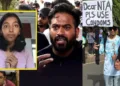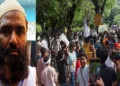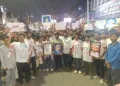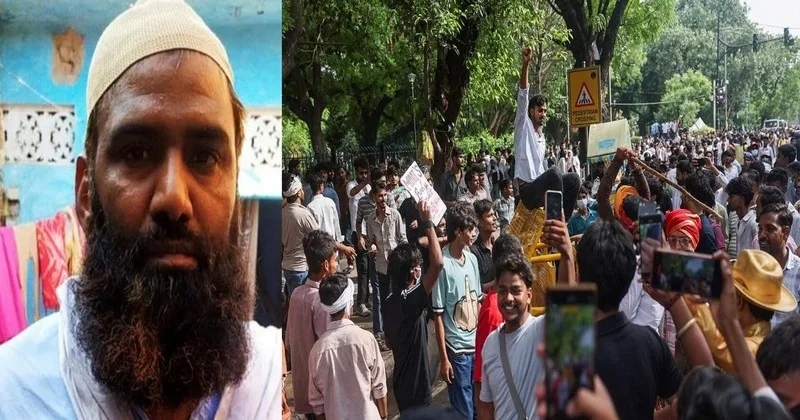
New Delhi: What was projected as a protest in the name of students and their rights is now facing scrutiny over the participation of individuals with serious criminal backgrounds. The alleged presence of Mohammad Furqan at the CJP protest at Jantar Mantar adds another dimension to an agitation that claimed to represent student grievances, particularly if police and intelligence agencies indeed tracked him among the demonstrators.
Thank you, Abhijeet Dipke.
Here is a true incident in which a notorious criminal was encountered by CM Yogi, all because of you.
Dipke, Tuu toh dev manush nikla re…..
Mohammad Furkan operated a western UP based network tied to extortion, dacoity, and contract killings,… pic.twitter.com/0EkSquQcwG
— Dr Poornima 🇮🇳 (@PoornimaNimo) August 12, 2026
Furkan was no ordinary protester. He had a long criminal history in Western Uttar Pradesh and was identified in earlier police and media reports as a shooter associated with the notorious Mukim Kala gang. His activities had been linked to extortion, attacks on traders and the atmosphere of fear that surrounded Kairana during the period when allegations of a Hindu exodus from the town became a major political issue.
Mohammad Furqan: A Name Associated With Kairana’s Criminal Underworld
Furqan’s name had become associated with the criminal network operating in the Kairana-Shamli belt. In April 2017, sources reported that Furqan, described as a member of the Mukim Kala gang, was injured and apprehended during an encounter with police. Police had been looking for him in connection with several cases involving extortion and murder. The report also stated that Furqan had killed Kairana trader Vinod Gupta in broad daylight in 2014 after an extortion demand was refused.
The criminal activities of the Mukim Kala gang became closely intertwined with the Kairana controversy. Contemporary reporting described how extortion and attacks on traders contributed to an atmosphere of fear in the town. The gang was subsequently identified as a major factor behind the insecurity experienced by sections of the local population. In other words, Furqan’s criminal background predates the CJP agitation by several years.
From Kairana’s Gang Network to Jantar Mantar
Against that backdrop, Furqan’s alleged appearance at a protest in New Delhi becomes significant. The CJP agitation was presented as a movement concerning students and their grievances. Students, like every other citizen, have the democratic right to raise concerns peacefully and demand accountability. But the participation of a person with a serious criminal background, if established by police evidence, creates a sharp contrast between the stated purpose of the protest and the profile of at least one alleged participant. The issue is not that the presence of one criminal automatically makes every protester or every student grievance illegitimate. It does not. The issue is whether criminal or disruptive elements were using a student-focused gathering as a platform for purposes unrelated to student welfare. That distinction is crucial.
A Student Protest or a Platform for Disorder?
A legitimate student movement depends on peaceful mobilisation, public debate and the presentation of grievances. Once violence, vandalism, intimidation or deliberate confrontation enters the picture, the nature of the agitation changes. The presence of Furqan therefore deserves attention because it raises concerns about the kind of people who may have been drawn into the protest. The larger concern is straightforward: a movement presented as being about students should not become a gathering point for people with criminal agendas.
Furqan’s Final Encounter With UP Police
The latest development came on August 5, when Mohammad Furqan was killed in an encounter with UP Police, according to the police account. The encounter reportedly took place in the Shamli area. Police said their team tracked Furqan and confronted him, following which he opened fire. An exchange of fire subsequently resulted in his death.
His history with the police was not new. In 2017, police had already tracked and apprehended him after an encounter in which he sustained multiple gunshot injuries. Contemporary reporting said he had more than 30 cases against him at that time.
Furkan’s criminal record is particularly significant because of the Kairana connection. Kairana became the centre of a major political controversy after it emerged that Hindu families were leaving the town because of deteriorating law and order. While the political claims surrounding the scale and causes of the alleged exodus were contested, reporting at the time documented serious concerns over criminal activity, extortion and attacks on traders. The Mukim Kala gang featured prominently in that criminal landscape.
A 2019 report noted that police investigations had attributed much of the fear surrounding the alleged exodus to the Mukim Kala gang. It identified Furqan as a sharpshooter associated with the gang and reported that he was subsequently arrested following a police encounter in 2017. Thus, Furqan’s name was already connected with one of Western UP’s most notorious crime networks long before his alleged appearance at the CJP protest.
The Bigger CJP Question
The Furqan episode consequently shifts attention from the stated slogans of the CJP agitation to the people who participated in it. A protest can begin with a legitimate grievance and still be exploited by individuals with completely different objectives. That possibility becomes particularly concerning when individuals with criminal backgrounds are found participating in the same mobilisation.
The August 5 encounter also feeds into the larger law-and-order narrative surrounding the Yogi Adityanath government. The crackdown on organised crime has been one of the defining themes of the Uttar Pradesh government’s governance narrative. Furqan’s earlier arrest after an encounter in 2017 came shortly after the Yogi government assumed office and was widely reported in the context of the state’s campaign against organised criminal networks. His latest encounter, therefore, has symbolic significance for the administration’s supporters, particularly in Kairana and other parts of Western UP where criminal gangs had once exercised considerable influence.
A protest claiming to represent students must ensure that its platform is not hijacked by individuals whose backgrounds and objectives have nothing to do with student welfare. The story is therefore no longer only about Mohammad Furqan, his criminal past or his encounter with UP Police. It is also about the character of the protest in which he was allegedly seen participating and whether a movement presented as a fight for student rights was allowed to become a platform for disruption and lawlessness.