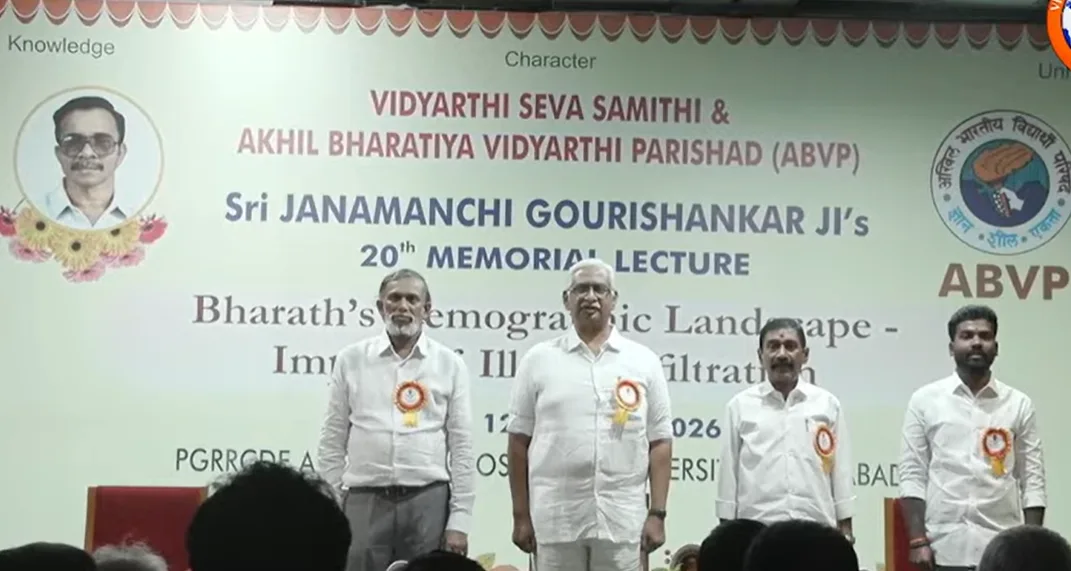
Hyderabad, August 12: Illegal infiltration should not be viewed merely as an electoral or political issue, but as a matter involving national security, demographic balance and the protection of India’s cultural and social fabric, said Bharath Kumar Ji, Dakshina Madhya Kshetra Pracharak of the Rashtriya Swayamsevak Sangh (RSS).
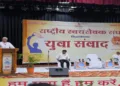
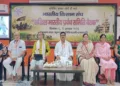
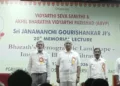
Addressing the 20th Janamanchi Gouri Shankar Memorial Lecture at the PGRRCDE Auditorium, Osmania University, Hyderabad, on Wednesday (August 12), Bharath Kumar ji said political considerations should not override the national interest while dealing with illegal migration and infiltration.
The lecture, organised by the Vidyarthi Seva Samithi and Akhil Bharatiya Vidyarthi Parishad (ABVP), Hyderabad, was held on the theme “Bharat’s Demographic Landscape: The Impact of Illegal Infiltration.”
While speaking about secularism, Bharat Kumar ji said India would remain secular as long as Hindus remain in the majority, as infiltrators entering India with an agenda to change the demography could seek to change the very identity of Bharat from its original cultural roots. He said people must understand this sinister design and its perpetrators and, with the collective responsibility of Hindus, work to counter and nullify their acts and conspiracies. He said the fate of Jogendranath Mandal under Islamic rule in West Pakistan, as well as the innumerable atrocities committed against Hindus, should be remembered.
Refugees and infiltrators are different
Bharath Kumar Ji stressed the need to distinguish between refugees and illegal infiltrators. A person fleeing a crisis in another country could be considered a refugee until normalcy was restored, whereas, he argued, infiltration involved people entering a country without authorisation and, in some cases, with a deliberate objective.
“Refugees and infiltrators are two different words. We must understand the difference between the two,” he said.
He cautioned that failure to recognise the nature and scale of illegal immigration could itself become a serious problem. Awareness, identification, verification of documentation and enforcement of immigration laws were essential, he said.
Partition and demographic changes
Referring to the Partition of 1947 on religious lines, Bharath Kumar said the creation of India and Pakistan had resulted in one of the largest episodes of displacement and communal violence. He explained the plight of Hindus during the Partition.
He referred to Sir Cyril Radcliffe, who chaired the boundary commissions tasked with demarcating the borders between India and Pakistan in 30 days, and said the hurried nature of the boundary-making process had left many Hindus clueless about the new borders.
He also referred to the creation of East Pakistan and West Pakistan, arguing that although they shared a common Islamic religious identity, significant differences in language and culture eventually contributed to the political crisis that culminated in the creation of Bangladesh in 1971.
Bharath Kumar said the plight of Hindus and other minorities in Pakistan and Bangladesh over subsequent decades should also be examined while discussing demographic changes in the region.
Conversion and cultural roots
Bharath Kumar also referred to the Meenakshipuram conversions of 1981, saying that religious conversion could have consequences extending beyond a change of faith and could affect social practices, customs and people’s connection with their traditional cultural roots.
He said concerns over demographic change had to be examined through historical experience as well as contemporary developments.
Allegations of organised settlement
Bharath Kumar alleged that illegal infiltrators from neighbouring countries, particularly Bangladesh, had entered West Bengal and then spread into different parts of India, and that political interests in some areas had contributed to their settlement.
He claimed that some infiltrators obtained Indian identity and welfare documents through fraudulent means and subsequently became eligible for government schemes. He also alleged that networks involving informal labour and documentation facilitated their movement and settlement.
He cited reports of Bangladeshi nationals being detected in Hyderabad and other parts of the country and said authorities should undertake systematic verification and deportation of those found to be residing illegally.
He further alleged that illegal infiltrators were increasingly entering different sectors of the informal economy, including construction, domestic work and other semi-skilled occupations, thereby creating competition for employment among local workers.
Border management
Bharath Kumar said stronger border management was essential and welcomed measures such as fencing, surveillance cameras, night-vision equipment and other technology being deployed along vulnerable stretches of the India-Bangladesh border.
He recalled an ABVP campaign in 2008 concerning the Siliguri Corridor, popularly known as the “Chicken’s Neck”, describing the strategically important corridor as a vital link connecting India’s northeastern states with the rest of the country.
He said border security was not merely the responsibility of security agencies but required greater public awareness as well.
‘Awareness, not fear’
Clarifying his position, Bharath Kumar said his objective was not to create fear among people but to encourage society to remain alert to the issue.
“I am not saying this to create fear. I am saying this to create awareness,” he said, stressing that not knowing about a problem could make it more difficult to address.
He called for greater vigilance regarding illegal settlements and urged people to report suspicious activities to the appropriate authorities.
Demography and national interest
Bharath Kumar also spoke about demographic trends, family structures and the need for Hindus to remain conscious of their cultural and civilisational traditions. He argued that demographic balance had implications for the long-term character of the country.
Referring to the principle of secularism, he said India’s pluralistic character will remain intact as long as Hindus remain in the majority; otherwise, he argued, even the world may struggle to recognise what Bharat represents.
He invoked Chanakya’s emphasis on protecting the country’s borders, saying national security required both strong institutions and an alert society.
Concluding his remarks, Bharath Kumar Ji called upon ABVP workers and citizens in Hyderabad to create greater awareness about illegal immigration, border security and demographic changes.
He also invoked the story of Prahlada and Narasimha, saying that when society becomes awakened and organised, it can overcome challenges confronting it.
Gouri Shankar’s contribution recalled
Former ABVP State President Ranjith Mohan also addressed the gathering and shared his association with Gowrishankar Ji and explained how he guided the youth during turbulent times, particularly when the Naxalite movement in educational institutions in the Telugu region was at its peak (1970-90s). He said Gowrishankar Ji’s guidance helped students channel their energies in positive directions.
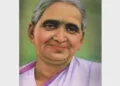
Ranjith Mohan recalled the contribution of late Janamanchi Gouri Shankar Ji, a Sangh Pracharak whose organisational vision and commitment had left a lasting impact on the student movement.
Ranjith Mohan said Gouri Shankar demonstrated remarkable foresight at a time when the Naxalite movement was at its peak and guided students and ABVP workers through a challenging period.
“Though we lost several students from ABVP during those difficult times, Gouri Shankar Ji remained committed to guiding and protecting the student community,” he said, recalling that he himself had been among those cautioned about the threat of attacks by Naxal groups.
He described Gouri Shankar’s organisational abilities as precise and disciplined, saying he trained ABVP workers through both organisational methods and personal example.
“He taught through his actions the very things he wanted to explain through words,” Ranjith Mohan said.
Gouri Shankar’s positive outlook and ability to inspire students played a key role in mobilising large numbers of students against the Naxalite movement, he recalled.
He recalled that rallies involving 30,000 and 50,000 students were organised during that period under Gouri Shankar’s guidance.
Although Gouri Shankar is no longer alive, his organisational approach and guidance continue to inspire ABVP workers, he said.
Ranjith Mohan also recalled that even when Gouri Shankar’s health was deteriorating, his primary concern remained the welfare and activities of students. “Even during his illness, he would enquire about the students and their activities,” he said.
Speaking on the occasion, Prof. Y. V. Gopala Krishna Murthy, Chairman and Managing Director of ACE Engineering Academy and ACE Engineering College, Hyderabad, recalled how the ABVP had steered students through one of the most turbulent phases in the history of the student movement in the Telugu region, when the Naxalite movement was at its peak and posed a major challenge to educational institutions and student life.
He described Janamanchi Gouri Shankar Ji as an inspiring leader and an exceptional crisis manager, whose foresight, organisational skills and calm leadership helped guide students through those difficult times.
Gouri Shankar Ji, he said, gave students direction when they faced ideological pressure and uncertainty, and helped channel their energies towards constructive and nation-building activities.
Prof. Gopala Krishna Murthy said Gouri Shankar’s strength lay not merely in his words but in his ability to lead by example. His disciplined approach, close engagement with students and ability to take decisive organisational initiatives made him a source of confidence for young activists.
He said Gouri Shankar Ji’s contribution remained significant because he successfully navigated a period when the Naxalite movement had considerable influence and student organisations faced an exceptionally challenging environment. His legacy, he said, continued through the generations of students and ABVP workers he had inspired and trained.
The event was attended by former ABVP leaders, students, academicians and professors from educational institutions.