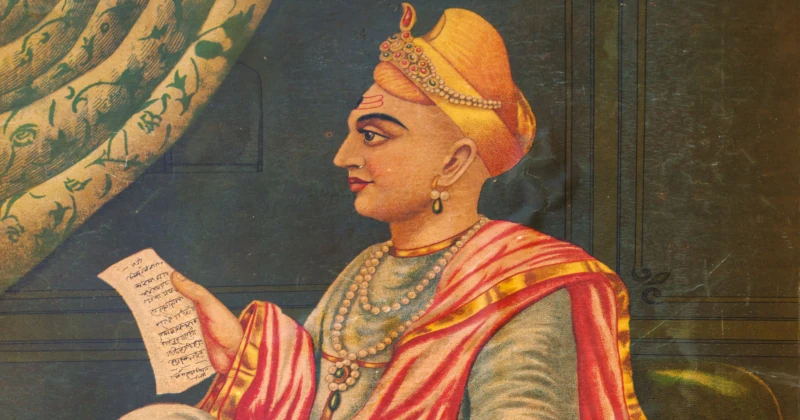
On the birth anniversary of Shrimant Peshwa Narayanrao Bhat, the Maratha Empire’s tenth Peshwa, history remembers a young ruler whose brief tenure was overshadowed by political intrigue, family tensions and a violent end.
Born on 10 August 1755, Narayanrao Bhat became the 10th Peshwa of the Maratha Empire in November 1772, succeeding his elder brother Madhavrao I. His tenure, however, lasted less than a year. In August 1773, at the age of just 18, Narayanrao was murdered in an incident that became one of the most tragic episodes in the later history of the Maratha Empire.
Narayanrao was born into the influential Bhat family, which had produced several Peshwas who played a decisive role in expanding and administering the Maratha Empire.
His early years were shaped by the political and personal upheavals within the Peshwa family. His eldest brother, Vishwasrao, who was heir to the Peshwa position, was killed alongside Sadashivrao Bhau during the Third Battle of Panipat in 1761.
श्रीमन्त पेशवा नारायणराव भट (10 अगस्त 1755 – 30 अगस्त 1773) नवंबर 1772 से अगस्त 1773 तक मराठा साम्राज्य के 10 वें पेशवा थे। उनका विवाह गंगाबाई साठे से हुआ था जिनसे बाद में सवाई माधवराव पेशवा का जन्म हुआ। अगस्त 1773 में नारायण राव की हत्या कर दी गयी थी।
उन्होंने पढ़ने, लिखने और… pic.twitter.com/psIRsHS6pn
— Rashtra Sevika Samiti Delhi Prant (@sevikasamiti) August 9, 2026
Narayanrao was particularly close to Parvatibai, the widow of Sadashivrao Bhau. She took him under her care following the death of her husband, finding in the young Narayanrao a source of affection and emotional support during a difficult period. He received a traditional education that included reading, writing and arithmetic, while also developing a practical understanding of Sanskrit scriptures.
Narayanrao was married to Gangabai Sathe on April 18, 1763, when he was not yet eight years old. Gangabai was the daughter of Krishnaji Hari Sathe. As Narayanrao grew older, he was gradually introduced to the responsibilities expected of a member of the Peshwa household.
He accompanied his elder brother Madhavrao I on military expeditions to Karnataka in 1765 and 1769, gaining exposure to the military and political affairs of the expanding Maratha state.
In April 1770, Narayanrao was injured in the wrist during an assault on Nijagal Fort. The episode came during a period when the young prince was increasingly being prepared for a larger role in administration. During the final years of Madhavrao’s rule, Narayanrao was placed under the supervision of the experienced Maratha minister Sakharam Bapu, who was tasked with training him in administrative affairs.
However, Narayanrao’s relationship with his elder brother was not always smooth. Madhavrao reportedly had serious concerns about his younger brother’s conduct and his ability to shoulder the responsibilities that would eventually come with the Peshwa’s office.
Narayanrao eventually succeeded Madhavrao and assumed the position of Peshwa in November 1772.
His accession came at a particularly sensitive moment for the Maratha Empire. The Peshwa administration was navigating competing political interests within the powerful Maratha nobility, while tensions within the Peshwa family itself were becoming increasingly consequential.
Narayanrao was still very young when he assumed the highest political office in the Maratha administration. His short reign was consequently marked by the influence of senior ministers and competing factions within the court.
Less than a year after becoming Peshwa, Narayanrao’s life came to a violent end. In August 1773, Narayanrao was murdered at Shaniwar Wada in Pune. The killing sent shockwaves through the Maratha political establishment and became one of the most controversial episodes in the history of the Peshwa dynasty.
The circumstances surrounding his death involved a bitter struggle for power within the Peshwa household and among influential court factions. The murder subsequently triggered a succession crisis and intensified political rivalries within the Maratha Empire.
Narayanrao’s death also had consequences extending far beyond his own brief reign.
His wife Gangabai was pregnant at the time of his death. She later gave birth to a son, Madhavrao II, popularly known as Sawai Madhavrao, who was subsequently recognised as Peshwa. Thus, although Narayanrao’s own tenure lasted only a few months, his death directly shaped the succession of the Peshwa institution and the political trajectory of the Maratha Empire.
Narayanrao’s life represents one of the most poignant chapters in Maratha history. Born into one of the most powerful political families of 18th-century India, he witnessed the consequences of Panipat, trained under experienced administrators and accompanied his brother on military campaigns before ascending to the Peshwa’s office at a very young age.